
Transcript
RICHARD ALBERT (DIRECTOR OF CONSTITUTIONAL STUDIES, UNIVERSITY OF TEXAS): It’s something we’re grappling with here at the University of Texas every day, in how we teach classes, how we evaluate our students, and how we as scholars do our research. It’s possible to ask any AI large language model to write us a paper.
ARCHIVAL (PBS, 8-21-24):
NEWS REPORT: LLMs start by consuming massive amounts of text: books, articles and websites.
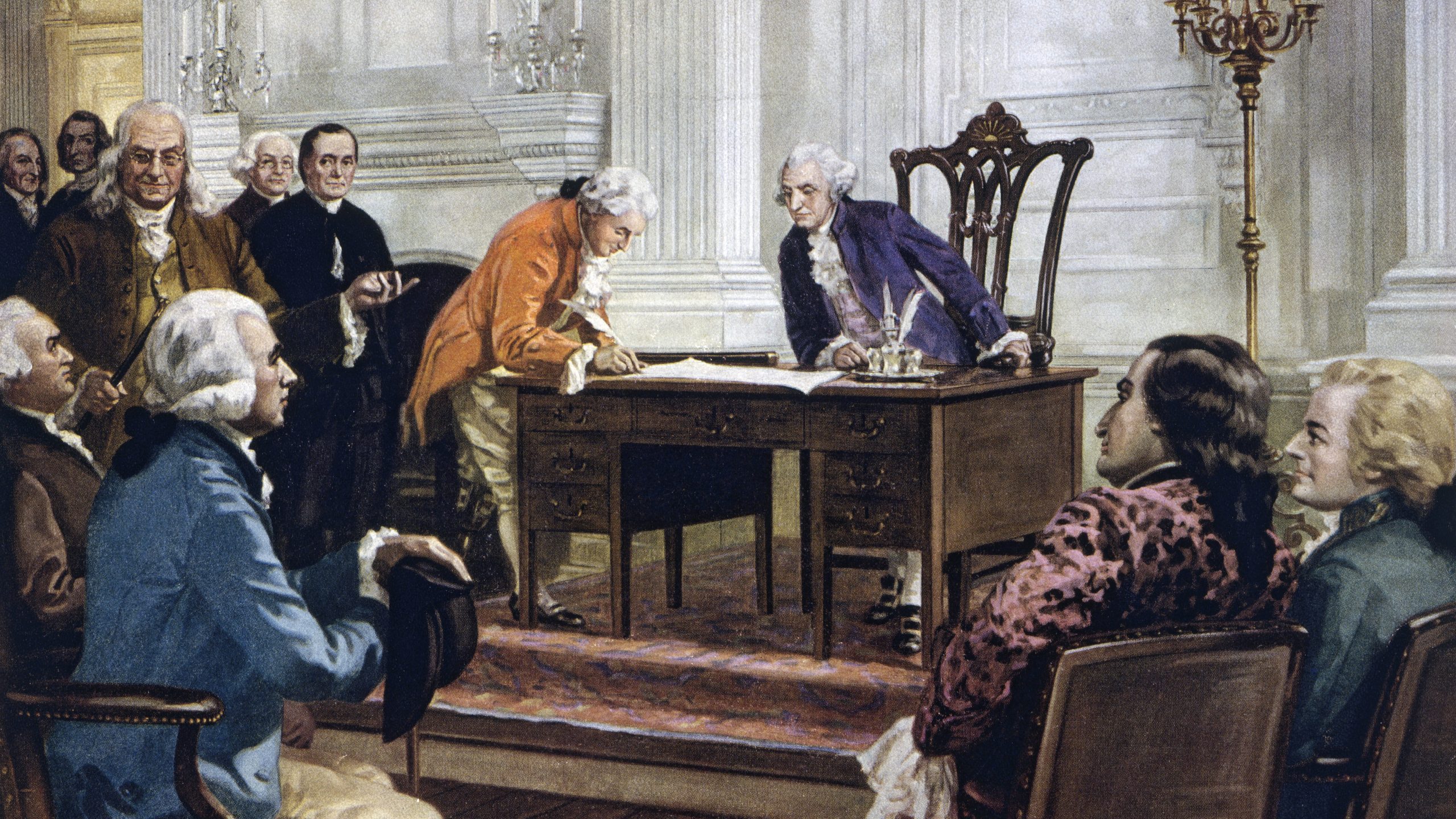
RICHARD ALBERT: But even back when the framers gathered in Philadelphia, they weren’t working on a blank slate. They could draw from different sources to write the world’s first national constitution, the longest enduring one in the history of the world. Even then, nothing was new.
TITLE: CONSTITUTION GPT
RICHARD ALBERT: After the United States declared its independence, it needed some rules, and so they created the Articles of Confederation, the first Constitution of the United States.
CLAIRE RYDELL ARCENAS (ASSOCIATE PROFESSOR OF HISTORY, UNIVERSITY OF MONTANA): The Articles of Confederation emerge in 1777 in the midst of the Revolutionary War. They need additional coordination among the states to fight the British Empire. But at the same time, they’re deeply suspicious of centralized power. They’ve just declared independence from one of the biggest empires on the planet. They don’t want to recreate that. So we see in the Articles of Confederation a very weak centralized government, a lot of power being left to the states, and pretty quickly people realize they just simply aren’t working.
RICHARD ALBERT: So in 1787, the framers said, we’re not going to amend the Articles. We’re going to propose an altogether new constitution. The stakes could not have been higher at that point. Had the country failed to perfect the project of self-governance, think of the message that would have sent to the rest of the world that yearned for independence, for freedom from imperial powers.
CLAIRE RYDELL ARCENAS: The American Revolution and constitutional creation emerges at the tail end of this century-long period known as the Enlightenment. It spans the globe. It’s a time of incredible innovation, and one of the most important things is an understanding of the individual being able to think and act for themselves, rather than just receiving information from the church or a monarch.
RICHARD ALBERT: The fingerprints of scholars of the Enlightenment are all over the Constitution.
CLAIRE RYDELL ARCENAS: We think of John Locke, David Hume, Rousseau, a range of thinkers concerned about how you create good citizens.
RICHARD ALBERT: We the people, the battlecry – that idea of popular sovereignty is drawn directly from ideas of the Enlightenment. No longer do we look to deities. We look to the people for the authority to say these are the rules that will bind us. Another big influence on the framers was Montesquieu, the scholar from France. He gives the idea of separation of powers. Article I sets up the legislature; Article II, the executive; Article III, the judiciary. That is putting into practice the theory of Montesquieu. And the framers also brought with them their knowledge about what worked and what didn’t in their own state constitutions.
ARCHIVAL:
1787, here in Independence Hall…
CLAIRE RYDELL ARCENAS: When we imagine what it was like to be a founding father, there’s a tendency to picture men with their books of political theory open next to them, copying passages from previous thinkers, and they certainly were doing some of that.
ARCHIVAL:
Members of the convention drew from four principal sources.
CLAIRE RYDELL ARCENAS: But what we also know is they are out in the world experiencing politics in their own towns and states. A good example is James Madison, who has a reputation for being this really nerdy founding father. He always has his nose in a book. But before the Constitutional Convention, Madison gathers on-the-ground information talking with people about how their state government is working. The framers are not just copying what’s been done before. We’re turning our knowledge into what will work for our particular moment.
RICHARD ALBERT: The U.S. Constitution has influenced probably every single constitution since then. But after the devastation: the right to a job, to healthcare, housing, food. When the framers wrote the Constitution, they expected it would be amended, and in the first 15 years or so, there were many amendments. Why has the Constitution gone from amendable to, today, unamendable?
Other countries have asked for my advice, to write a new constitution or amend an existing one, and there is a role for AI in constitution-making. In a second, it can read all of the world’s constitutions in any language and then report back to you how other countries have addressed similar challenges. AI can also collate data about what the people wish for themselves and how they feel about draft constitutions before they ultimately vote on it. The values and views of a people should remain sacred to a constitution, but these are important precedents for those tasked with drafting it.
CLAIRE RYDELL ARCENAS: The ideas contained in the Declaration of Independence, in the U.S. Constitution, many of them are not ideas that no one had ever thought about, but the American founding documents are profoundly human. These texts were not written by a single individual separate from the world around him. They’re created by a team with competing ideals, and the process of debating and finding common ground is one of the hallmarks of the documents we know today.
(END)
An Enlightened Idea: The Constitution Drew on Centuries-Old Principles
The framers drew on Enlightenment thought and experience to design a new government.
The U.S. Constitution emerged from a long tradition of political thought and hard experience. “Even back when the framers gathered in Philadelphia, they weren’t working on a blank slate,” Richard Albert, a constitutional law expert at the University of Texas, told us.
In 1787, delegates in Philadelphia set out to replace the Articles of Confederation, whose weak central government had exposed the limits of the young nation. They drew on Enlightenment ideas about popular sovereignty and separation of powers, along with lessons from earlier governments and their own state constitutions.
The result was the first complete written national constitution, designed to balance authority and liberty through checks, balances and compromise. The framers expected the document to evolve, building in a process for amendment. Over time, it has influenced constitutional systems across the globe, even as other nations adopted different approaches, including broader social rights.
The Constitution reflects both inherited ideas and an ongoing experiment in self-government. “The framers are not just copying what’s been done before,” said Claire Arcenas, a historian at the University of Montana. “We’re turning our knowledge into what will work for our particular moment.”
- Producer / Editor: Matthew Spolar
 Grades
9-12
Grades
9-12

 Grades
9-12
Grades
9-12

 2 Lesson Plans