Transcript
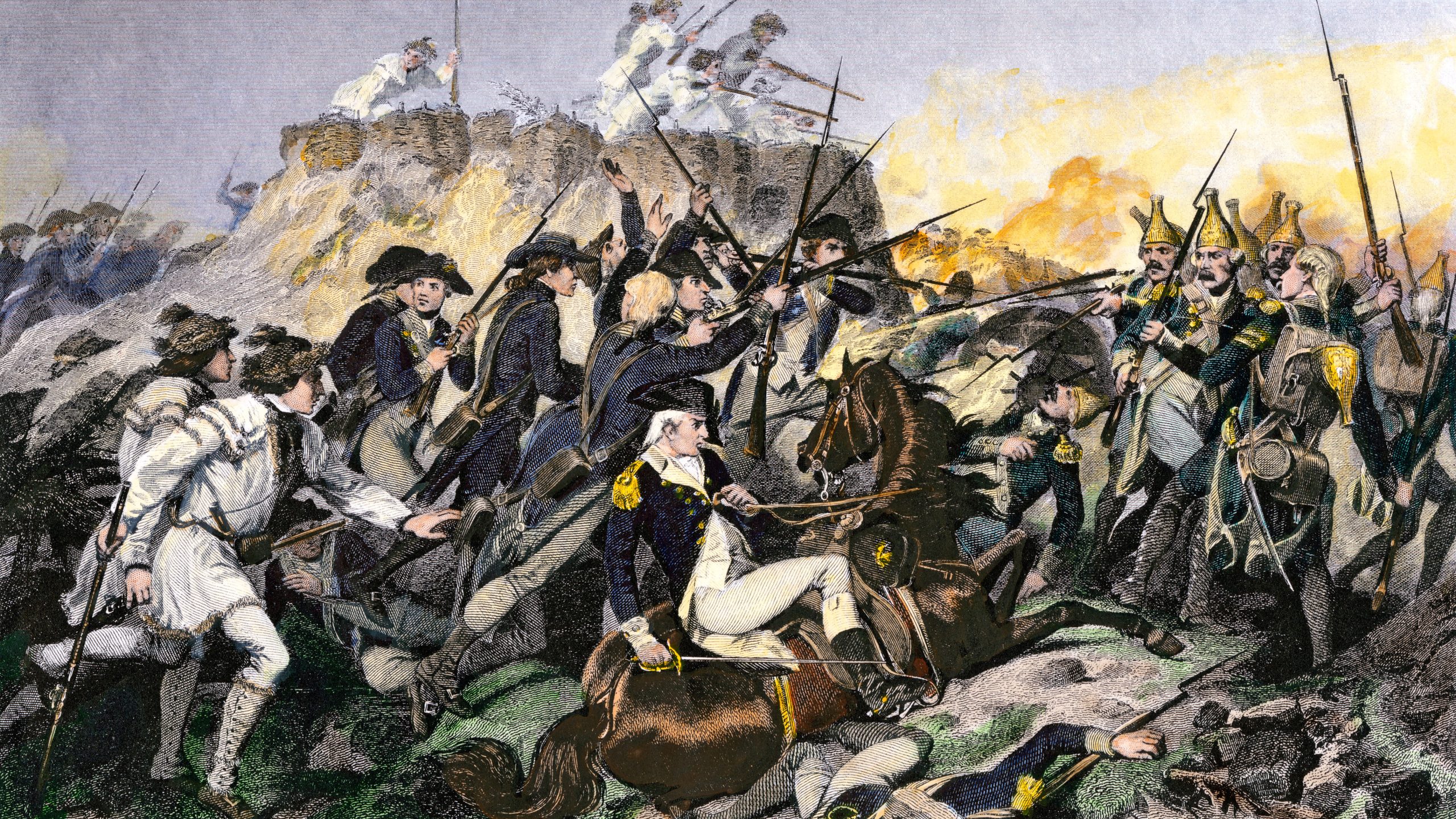
BRADY CRYTZER (ASSOCIATE EDITOR, JOURNAL OF THE AMERICAN REVOLUTION): In the fall of 1781, we will see the battle many view as the great culmination of the American Revolution: Yorktown. Immortal images of the Americans and British squaring off on this battlefield, a David versus Goliath matchup. But as you zoom in closer you see artillery being manned by the French, German auxiliaries fighting alongside the British. There were actually a lot of players on the field, and if you view the war as part of a larger global struggle, you’re going to find all the great powers of Europe had already been fighting, and this is simply a new chapter in that book.
TITLE: A WIDER WAR
BRADY CRYTZER: 1776, as important as it is for us today in the 250th anniversary, is really one of the darkest times of the American Revolution for General George Washington. He’s running out of men. He’s running low on supplies. He’s been chased out of New York and New Jersey. Things are looking pretty bleak, and this is when Benjamin Franklin makes the journey to France.
FRANÇOIS FURSTENBERG (PROFESSOR OF HISTORY, JOHNS HOPKINS UNIVERSITY): Thanks to his scientific discoveries and writings, Franklin was maybe the only well-known American in European circles, so he was sent to solicit support for the American cause. He famously paraded around Paris in a fur hat because many in France saw Americans as a kind of noble savage who lived in a state more pure than the civilized decadence of European cities.
BRADY CRYTZER: When you look at the scale of North America compared to the homeland of these European powers, Britain and France are roughly the size of Texas and Mississippi today. North America as a whole, the more these empires explored, the more they found, and they wanted to make sure they controlled the future of that continent.
FRANÇOIS FURSTENBERG: But French authorities wanted to be sure that this was a war that was winnable before they would enter it. So in the initial years, France covertly supplied munitions and financing.
BRADY CRYTZER: As bleak as 1776 is, 1777 is an absolute turning point in the war. There’s an enormous victory in upstate New York, in a place called Saratoga, and this will convince the French the Americans could win. The French give General Washington a blank check: You get howitzers and mortars and cannons, all the things you need to win a war. They also commit full access to their navy, which is essential. They’ll give us good commanders on the ground.
FRANÇOIS FURSTENBERG: It’s possible to think of the 18th century as a period of extended warfare between the French and the British empires. Surely the greatest conflict, at least before the American Revolution, was the Seven Years’ War, which broke out in North America.
BRADY CRYTZER: Winston Churchill called the Seven Years’ War the first true world war in human history. It brought together the two biggest superpowers in Europe to fight each other on five separate continents.
FRANÇOIS FURSTENBERG: It was a tremendous British victory. France was forced to cede all of Canada and Louisiana, and by Louisiana, I mean all the territory between the Mississippi River and the Rocky Mountains.
BRADY CRYTZER: But the British Empire learns very quickly that victory comes at a cost. Their imperial debt almost doubles, and to save money, they whittle down their military. So when the American Revolution kicks up, they realize they need support to help them. First, they went to Russia, who had just fought off a number of revolutions on their own front, and they were rejected. They next went to Amsterdam, and the Dutch said, we are a republic; we’re not going to lend our soldiers to fight another republic. So Britain went to the Germans.
In the 1770s, Germany is a hodgepodge of over 100 different principalities. These small German monarchs might not have access to land or natural exports. What they do have to sell are their people. History records these soldiers as Hessians because of the 30,000 German auxiliaries that came to the New World, the majority came from the principalities of Hesse-Cassel and Hesse-Hanau. We often view the German auxiliaries as mercenaries, but these poor men had no choice but to fight.
FRANÇOIS FURSTENBERG: This turned into a public relations boon for the American side, because they talked about the cruelty of these mercenaries hired by the British crown.
BRADY CRYTZER: The Germans take a backseat to the British high command, but they’re very critical of some early British decisions, because Germans understand rebellions need to be ended quickly. Every minute, every hour the American Revolution goes on, it gets stronger.
FRANÇOIS FURSTENBERG: Ultimately, the French pulled Spain into the war to support the Americans. The Spanish had lost Florida to the British in the Seven Years’ War, and they saw the United States largely as a buffer zone to protect their main interests in Mexico.
BRADY CRYTZER: Nearly all of their combat comes on the American Gulf Coast, at battles like Mobile and Pensacola, but the Spanish aren’t just absentee participants. They are fighting in the revolution.
FRANÇOIS FURSTENBERG: One of the interesting developments in thinking about the American Revolution in recent years has been thinking about it more as an international event. It was French support that enabled the United States to secure its independence in 1783. Then it was American independence that influenced the French Revolution. These were truly sister republics, but that alliance began to fall apart. In World War II, France was conquered almost immediately by German forces. There was a sense the United States had really rescued France.
ARCHIVAL (NBC NEWS, 3-14-03):
NEWS REPORT: France has become a real pain in the axis.
FRANÇOIS FURSTENBERG: Then, in the early 2000s, France refused to join the military effort in Iraq.
ARCHIVAL (CNN, 2003):
NEWS REPORT: Instead of offering French fries, some restaurants across the country now calling them freedom fries.
BRADY CRYTZER: Americans today have a sense that the French are somehow weak or ineffective on the battlefield. In the 1770s, that was absolutely not the case. I don’t think there’s any question America does not exist today if not for French involvement.
(END)
How the World Came to Fight in America’s Revolution
Foreign powers shaped the Revolution, turning a colonial revolt into a global conflict.
The American Revolution is often framed as a David vs. Goliath story, the Colonies against powerful Britain. But some historians say the full picture is more complicated.
Winning independence took diplomacy and alliance-building, not just battlefield victories. France, Spain and the German states all played significant roles. Benjamin Franklin spent years in France securing support, and French naval and military assistance proved critical to the war’s outcome.
“I don’t think there’s any question America does not exist today if not for French involvement,” Brady Crytzer, associate editor of the Journal of the American Revolution, told us in an interview for this film.
Britain, short on troops, hired German soldiers, known as Hessians, to bolster its forces. Spain entered the war with its own objectives.
The Revolution was tied to rivalries that stretched across Europe. “If you view the war as part of a larger global struggle, you’re going to find all the great powers of Europe had already been fighting, and this is simply a new chapter in that book,” Crytzer told us.
- Producer / Editor: Matthew Spolar
 Grades
6-8
Grades
6-8

 Grades
8-12
Grades
8-12

 2 Lesson Plans