
Lesson Plan: How Enlightenment Thought Influenced American Government
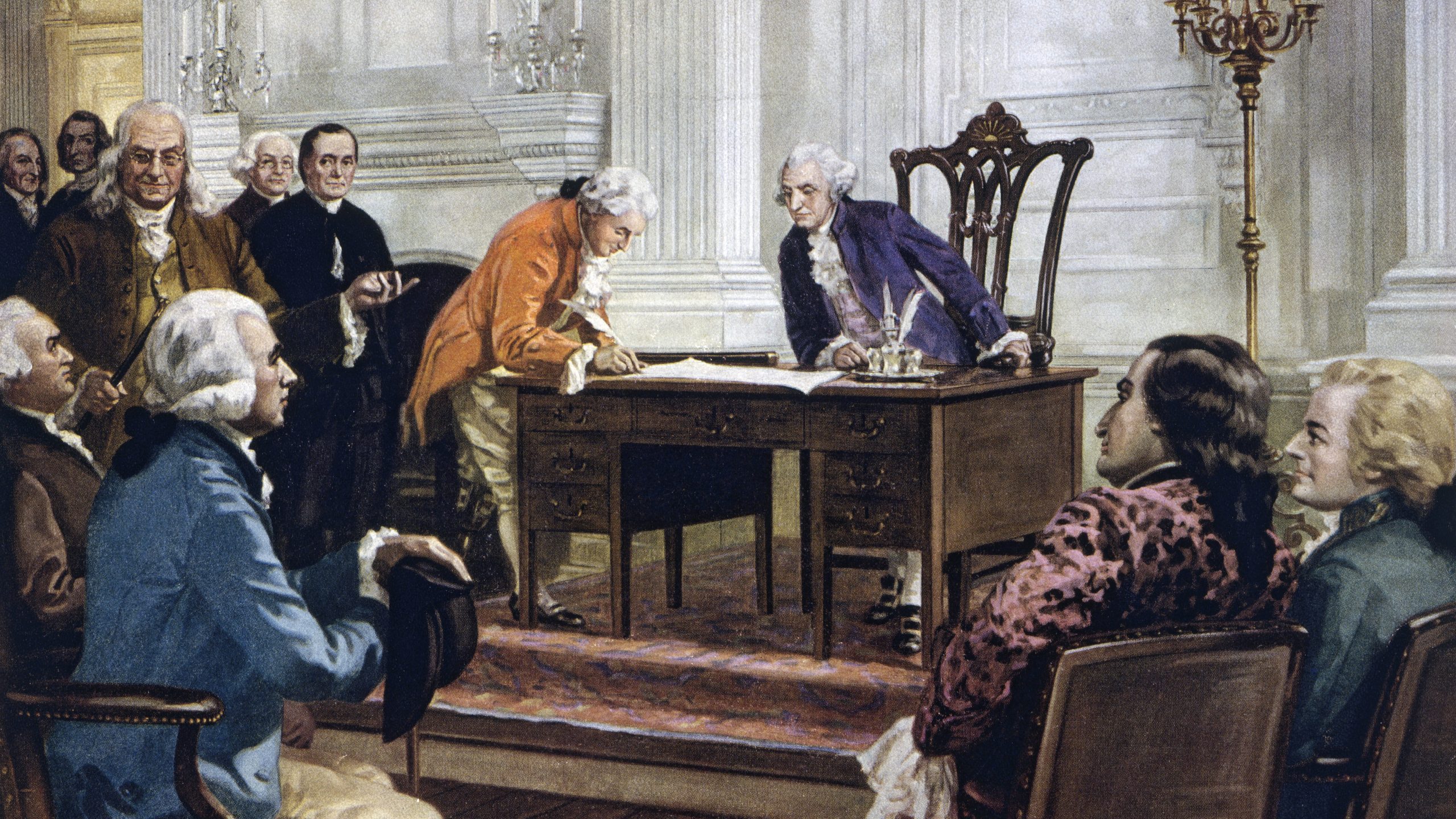
If you had to write a new constitution or constitutional amendment, how would you begin and what sources would you consult? The American founding generation did not conjure our founding documents out of thin air; they were influenced by the writings of Enlightenment-era thinkers. This lesson helps students examine the Enlightenment thinkers’ influence on the American founding generation and explores how artificial intelligence could be used in the drafting of future constitutions and amendments.
Subjects:
Civics/Government, AP U.S. Government and Politics
-
This lesson would be beneficial in a Civics/Government class to examine the creation of the United States Constitution and the amendment process.
-
This lesson would be beneficial in AP U.S. Government and Politics for Topic 1.1 – Ideals of Democracy and Topic 1.6 – Principles of American Government
Grade Level:
9-12
Lesson Duration:
2 classes/periods (of a traditional 45-60 minute class period).
Essential Questions:
-
How did Enlightenment-era texts and thinkers influence the members of the American founding generation and the documents they created?
-
What rights do other constitutions around the world guarantee their citizens?
Lesson Objectives:
Students will:
-
Assess the positives and negatives of crowd-sourcing constitutional proposals.
-
Analyze enlightenment texts, summarize the text message, and assess how the text influenced the members of the American founding generation.
-
Compose a new constitutional amendment to protect a right not already in the United States Constitution after researching how that same right is protected in other countries’ constitutions.
Materials:
-
Retro Report video “An Enlightened Idea: The Constitution Drew on Centuries-Old Principles” (Transcript)
-
Student Activity handout
-
Iceland Proposed Constitution | Eco Jurisprudence Monitor
-
Iceland’s experiment with crowd-sourcing its constitution just died | Quartz
-
Montesquieu – The Spirit of the Laws | National Constitution Center
-
John Locke – Second Treatise of Government – Sect. 89, 95, 96. | Project Gutenberg
-
Amendment Process | National Constitution Center
-
Constitute Project | Comparative Constitutions Project at the University of Texas at Austin and the University of Chicago
Procedure:
-
Distribute the Student Activity handout . Have students begin the Introduction/Brainstorm (individually or in small groups), where the students put themselves in the role of delegates to a constitutional convention. Have students consult one or more of the resources related to Iceland’s proposed “crowd-sourced” constitution. Students will consider the pros and cons of crowdsourcing a constitution.
-
Note: Iceland’s crowdsourced constitution was supported by the public, but failed to achieve ratification by the Parliament. It remains in limbo today with little likelihood of adoption.
-
-
Show the Retro Report video “An Enlightened Idea: The Constitution Drew on Centuries-Old Principles” and have students answer the focus questions provided.
-
What influenced the creation of the government under the Articles of Confederation?
-
What were some of the influences on the framers of the United States Constitution?
-
Why are the values and views of the people so important in drafting constitutional language?
-
-
After watching the video, review students’ answers as needed. Follow-up questions may include:
-
Why do you think the Constitution has become harder to amend?
-
Should AI be used in writing constitutional language, or should the process be more human-driven?
-
-
Group Activity: Students will research excerpts of John Locke’s “Second Treatise of Government” and Montesquieu’s “The Spirit of the Laws” and identify ways in which those texts influenced members of the American founding generation. Form four groups and assign each group one of the readings. Groups will share the paraphrase of their assigned text and where they see the influence of the text in the documents created by the American founding generation.
-
Extension Activity – You may assign students to run the text excerpt through an AI model to see the AI’s perspective on how the text influenced the American founding generation. Groups can write an assessment on whether they agree or disagree with the AI model’s assessment.
-
-
Assessment: Students will choose a right that is protected in the constitutions of other countries that is not protected in the U.S. Constitution.
-
Students will examine two or three constitutions that protect their chosen rights and summarize the language.
-
Students will then use the constitutional language and their summaries to draft their own amendment to the U.S. Constitution to protect their chosen right. (Note: Review the Constitutional Amendment Process with students so they understand that their amendment proposal must earn approval from three-quarters of the states.)
-
About the Author:
Ryan Werenka teaches Social Studies at Troy High School in Michigan. He was named 2021 Michigan History Teacher of the Year by the Gilder Lehrman Institute of American History and was awarded the James Madison Memorial Fellowship in 2025.
Standards
College, Career, and Civic Life (C3) Framework for Social Studies
-
D2.Civ.3.9-12. Analyze the impact of constitutions, laws, treaties, and international agreements on the maintenance of national and international order.
-
D2.Civ.5.9-12. Evaluate citizens’ and institutions’ effectiveness in addressing social and political problems at the local, state, tribal, national, and/or international level.
-
D2.Civ.8.9-12. Evaluate social and political systems in different contexts, times, and places, that promote civic virtues and enact democratic principles.
-
D2.Civ.12.9-12. Analyze how people use and challenge local, state, national, and international laws to address a variety of public issues.
-
D2.Civ.14.9-12. Analyze historical, contemporary, and emerging means of changing societies, promoting the common good, and protecting rights.
Common Core Literacy Standards
-
CCSS.ELA-Literacy.RH.9-10.1. Cite specific textual evidence to support analysis of primary and secondary sources, attending to such features as the date and origin of the information.
-
CCSS.ELA-Literacy.RH.9-10.2. Determine the central ideas or information of a primary or secondary source; provide an accurate summary of how key events or ideas develop over the course of the text.
-
CCSS.ELA-Literacy.RH.9-10.4. Determine the meaning of words and phrases as they are used in a text, including vocabulary describing political, social, or economic aspects of history/social science.
-
CCSS.ELA-Literacy.RH.9-10.5. Analyze how a text uses structure to emphasize key points or advance an explanation or analysis.
-
CCSS.ELA-Literacy.RH.11-12.1. Cite specific textual evidence to support analysis of primary and secondary sources, connecting insights gained from specific details to an understanding of the text as a whole.
-
CCSS.ELA-Literacy.RH.11-12.2. Determine the central ideas or information of a primary or secondary source; provide an accurate summary that makes clear the relationships among the key details and ideas.
-
CCSS.ELA-Literacy.RH.11-12.4. Determine the meaning of words and phrases as they are used in a text, including analyzing how an author uses and refines the meaning of a key term over the course of a text (e.g., how Madison defines faction in Federalist No. 10).
-
CCSS.ELA-Literacy.RH.11-12.5. Analyze in detail how a complex primary source is structured, including how key sentences, paragraphs, and larger portions of the text contribute to the whole.
AP US Government and Politics
-
Topic 1.1 – Ideals of Democracy
-
Learning Objective – LO 1.1.A – Explain how democratic ideals are reflected in the Declaration of Independence and the U.S. Constitution.
-
Essential Knowledge – EK 1.1.A 1 – The U.S. government is based on the following democratic ideals:
-
i. Natural rights (all people have certain rights that cannot be taken away)
ii. A social contract (an implicit agreement among the people in a society to give up some freedoms to maintain social order)
iii. Popular sovereignty (all government power comes from the consent of its people)
iv. Limited government (a government’s power cannot be absolute)
-
Topic 1.6 – Principles of American Government
-
Learning Objective – LO 1.6.A – Explain the constitutional principles of separation of powers and checks and balances.
-
Learning Objective – LO 1.6.B – Explain the effects of separation of powers and checks and balances for the U.S. political system.
-
Essential Knowledge – EK 1.6.A.1 – The specific and separate powers delegated to Congress, the president, and the courts allow each branch to check and balance the power of the other branches, ensuring no one branch becomes too powerful.
-
Essential Knowledge – EK 1.6.B.1 – Separation of powers and checks and balances creates multiple access points for stakeholders and institutions to influence public policy.
-
