Transcript
JOHN BRIDGELAND (CO-CHAIR, IN PURSUIT; FOUNDER, MORE PERFECT): Some first ladies, like Nellie Taft, broke traditions to make traditions. People have said it almost feels like a co-presidency, and that was unheard of. William Howard Taft, when he’s elected president, wrote – I feel like a fish out of water. Becoming president was my wife’s ambition.
TITLE ON SCREEN:
In Her Own Right
The First Lady as Strategist
JOHN BRIDGELAND: Nellie Taft came from a very political family, it sort of inspired her into public service. At the age of 16 – and by the way, she’s smoking, drinking, gambling, breaking all sorts of traditions for that age, for women in particular – she goes to the White House for the silver wedding anniversary of President Rutherford B. Hayes and his wife. And she says, I look forward to returning to this White House as its mistress. She’s only 16 years old, and she’s envisioning that some day she’ll marry a future president of the United States, and of course, that eventually becomes true.
ARCHIVAL:
NEWSREEL ANNOUNCER: William Howard Taft, a portly, jovial personality with an infectious chuckle.
JOHN ROBERTS (CHIEF JUSTICE OF THE UNITED STATES): From the very beginning, Taft wanted to be a judge. At a very young age, he argued the government’s cases before the Supreme Court. He loved everything about the Supreme Court.
ARCHIVAL:
NEWSREEL ANNOUNCER: Theodore Roosevelt. . .
JOHN ROBERTS: And then, at the end of Teddy Roosevelt’s second term, Taft was Roosevelt’s favorite to succeed him.
JOHN BRIDGELAND: Nellie Taft had an ambition for her husband that he didn’t have for himself. She wanted him to be president.
ARCHIVAL (1908):
NEWSREEL ANNOUNCER: A staunch supporter of the Roosevelt policies, which he promises to continue.
JOHN ROBERTS: I really think he sort of set aside his real ambition of becoming chief justice to please her, but also because, believe it or not, it seemed to be a sure thing.
ARCHIVAL (1908):
NEWSREEL ANNOUNCER: Times are right for a William Howard Taft in the White House.
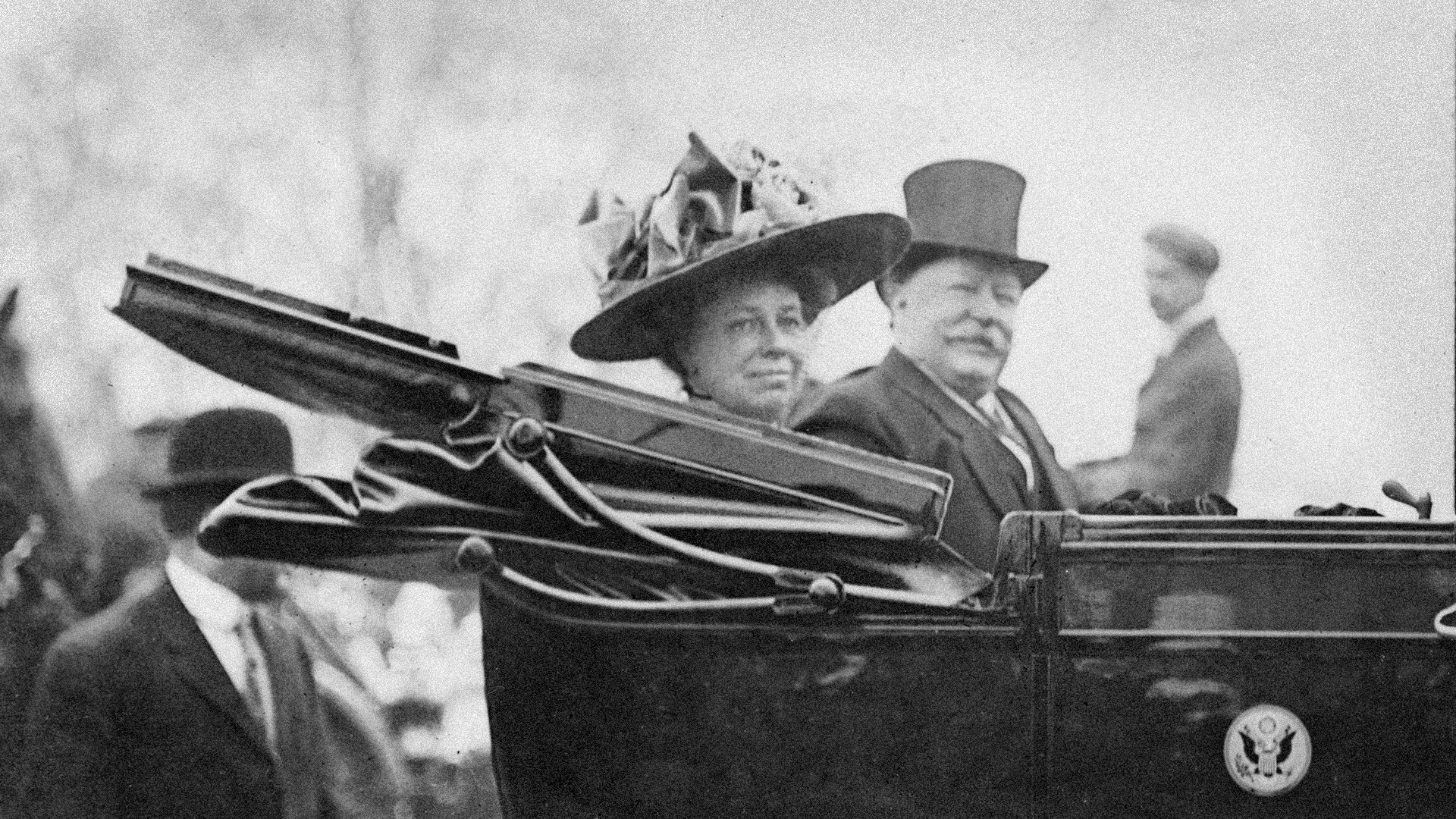
JOHN BRIDGELAND: She’s the first first lady in the inaugural parade. By tradition, the new president and the former president would ride together. She displaced Teddy Roosevelt. You look in the carriage; it’s William Howard Taft and Nellie Taft, side by side.
She’s in cabinet meetings. She’s actively advising him on his speeches, on his comments. She presses him on an executive order to safeguard working conditions for the federal workers. She promotes people in the White House who are Black Americans. Nellie had been so busy, the New York Times had written a piece saying it’s rare a first lady has had such a big impact within just a few months.
And then she goes on to have a stroke. It causes her an inability to speak. It paralyzes part of her body. She takes a year to recover. It’s also been written that because she wasn’t as active in advising him, in part because of the disability, William Howard Taft didn’t have the political success he maybe could have, particularly in navigating the relationship with Teddy Roosevelt.
JOHN ROBERTS: Teddy Roosevelt had said he wasn’t going to run for president again, and yet Taft, getting close to the end of his first term, all of a sudden faces Roosevelt as his competition. He was betrayed by his best friend, and the effect of that was that Taft, during that election, carried exactly two states, the worst showing that had ever been made by an incumbent president.
JOHN BRIDGELAND: Nellie Taft felt like her husband didn’t get the credit and adulation of Teddy Roosevelt, who was extremely inspiring and charismatic. She became very resentful when Roosevelt goes off on his third-party run.
ARCHIVAL (LIBRARY OF CONGRESS, 1912):
NEWSREEL ANNOUNCER: Teddy’s forming of the Bull Moose Party in 1912 accounted for the loss of the presidency for Taft in his bid for a second term.
JOHN BRIDGELAND: In an odd way, Nellie Taft probably felt more committed to the presidency than President Taft, in terms of what his ambition was. Nellie believed the White House and the nation’s capital should be open to all Americans, not some elite, confined institution for the wealthy or the politically connected. Given the president is working on a whole host of issues, often things that are coming his way that he didn’t anticipate, the first lady has more flexibility to think more holistically about culture.
When they go through Japan, Nellie’s inspired by the cherry blossoms in Tokyo. She envisioned this source of national identity, and so she arranges for 3,000 cherry trees to arrive in Washington and get planted.
Each spring, when millions of Americans come to Washington, D.C., to see our nation’s cherry blossoms – and also, by the way, looking at the statue of Thomas Jefferson, who wrote our Declaration of Independence – they should think of Nellie Taft, who made that possible. Democracy is more than laws and reforms. It’s also about creating a shared civic culture and having the courage to be inclusive and to build it, and that’s ultimately what Nellie Taft represented.
(END)
This First Lady Wanted Her Husband To Be President More Than He Did
Nellie Taft challenged traditions and helped shape her husband’s presidency.
Nellie Taft envisioned a life in the White House long before her husband, William Howard Taft, became president. He preferred a judicial career, but she encouraged him to pursue the presidency, and she became a trusted political adviser.
In this short video, Chief Justice John Roberts and John Bridgeland, the co-chair of In Pursuit and founder of More Perfect, examine the first couple’s differing ambitions and the influence Nellie brought to an unelected role.
As first lady, she challenged conventions and pursued projects intended to broaden Washington’s cultural life. Her support for planting Japanese cherry trees along the Tidal Basin left a lasting public legacy.
- Producer / Editor: Matthew Spolar
 Grades
6-12
Grades
6-12


 1 Lesson Plan