
Transcript
ARCHIVAL(1934):
ANNOUNCER: Mrs. Roosevelt hooked onto the cableway in place of a concrete bucket.
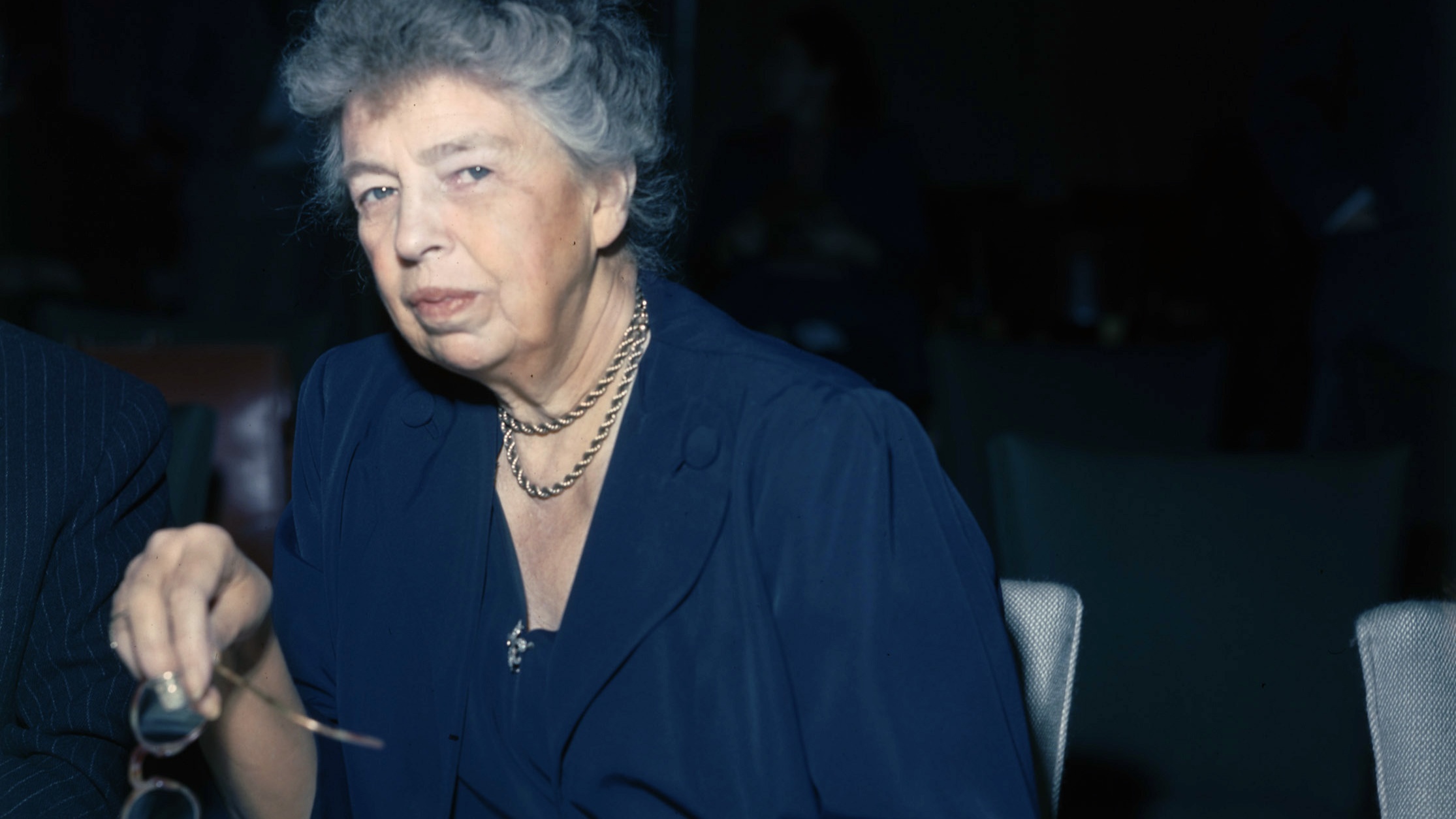
ANITA MCBRIDE (CO-AUTHOR, “REMEMBER THE FIRST LADIES”): Eleanor Roosevelt was an incredibly impactful first lady, a trailblazer by every explanation of the word. And not only during her first lady years, but also after she left the White House.
ARCHIVAL(U.C.L.A. FILM AND TELEVISION ARCHIVE, 4-27-45):
PRESIDENT HARRY TRUMAN: If we do not want to die together in war, we must learn to live together in peace.
ANITA MCBRIDE: When she was called on by Harry Truman to help lead this new deliberative body. . .
ARCHIVAL (U.C.L.A. FILM AND TELEVISION ARCHIVE, 4-27-45):
NEWSREEL ANNOUNCER: The opening session of the United Nations security conference.
ANITA MCBRIDE: . . . Where all nations can come together, air their grievances, prevent wars from happening – he knew how formidable she could be.
TITLE ON SCREEN:
Our Better Half
The First Lady as Humanitarian
ARCHIVAL(UNIVERSAL NEWSREEL, 3-5-33):
PRESIDENT FRANKLIN DELANO ROOSEVELT: Let me assert my firm belief that the only thing we have to fear is fear itself.
KEN BURNS (DOCUMENTARY FILMMAKER): Franklin Delano Roosevelt is among the most consequential presidents in American history. F.D.R. helps lift the country out of the Depression and then gets us through the Second World War.
ARCHIVAL(UNIVERSAL NEWSREEL, 3-20-44):
ANNOUNCER: That brings in Eleanor Roosevelt…
ANITA MCBRIDE: Eleanor Roosevelt didn’t want to be relegated to the social role of first lady.
ARCHIVAL:
ELEANOR ROOSEVELT: I think, in some miraculous way, this problem is going to be solved.
ANITA MCBRIDE: She begged her husband to give her an official role, which he did not want to do. But ultimately, he saw her value. She was his eyes, ears and legs.
ARCHIVAL(1943):
ANNOUNCER: Mrs. Franklin D. Roosevelt in the field uniform of the American Red Cross visits United States base hospitals in the South Pacific.
ANITA MCBRIDE: Eleanor had always been interested in civil rights and human rights. That’s fundamental to who she was. She tried to guide her husband against the internment of Japanese here in the United States during World War II.
ARCHIVAL(UNIVERSAL NEWSREEL, 1943):
ANNOUNCER: Notices were posted. All persons of Japanese descent were required to register.
ANITA MCBRIDE: She used her platform as first lady to really elevate the importance of dignity for everyone.
ARCHIVAL (UNIVERSAL NEWSREEL, 7-14-44):
ANNOUNCER: The president announces in a letter to the chairman of the Democratic National Committee that he will accept the nomination for a fourth term.
ANITA MCBRIDE: There were doubts about F.D.R. running for another term, and about his health. Eleanor felt she had assurance from the president’s doctors that he was able to withstand the pressures of the presidency.
ARCHIVAL (UNIVERSAL NEWSREEL, 7-14-44):
ANNOUNCER: His letter concludes – Reluctantly but as a good soldier, I repeat that I will accept and serve in this office if I am so ordered by the commander-in-chief of us all, the sovereign people of the United States.
ARCHIVAL (UNIVERSAL NEWSREEL, 1945):
PRESIDENT FRANKLIN DELANO ROOSEVELT: I do solemnly swear . . .
ANITA MCBRIDE: F.D.R. gets reelected.
ARCHIVAL (UNIVERSAL NEWSREEL, 1945):
PRESIDENT FRANKLIN DELANO ROOSEVELT: . . . that I will faithfully execute. . .
ANITA MCBRIDE: Within months, he’s in Georgia, in Warm Springs, with his mistress, and he dies of a cerebral hemorrhage.
KEN BURNS: Eleanor discovers he has been seeing her own social secretary for a long time; as she got activist, she moved out in the world. Just incredible pain and loss and suffering. She always considered herself an ugly duckling, and no one ever disabused her of that.
ANITA MCBRIDE: When she brings Harry Truman in to tell him F.D.R. has died, Eleanor famously says to him – Now all the problems are his. So this was going to be a big transition for her too, and the Trumans gave her the time she needed to pack up and get out of the White House.
ARCHIVAL (1946):
ANNOUNCER: The first meeting of the General Assembly of the United Nations organization. At the entrance to the hall, crowds congregate to watch the arrival of the delegates.
ANITA MCBRIDE: There are many things Eleanor could have done, and that people wanted her to do. But after the devastation of World War II, there is strong belief that this world body, for countries to peaceably discuss their differences, was important and necessary. And in this new world order, President Truman comes and asks her to help with the Human Rights Commission.
ARCHIVAL:
ELEANOR ROOSEVELT: I knew I would have to do the very best I could because I was the only woman on the delegation.
ANITA MCBRIDE: The male delegates may have perceived human rights not as critical or not as important as dealing with the atomic bomb. But we know just from history this continues to be held up as one of the most important documents since the United Nations Charter, an attempt to guarantee the human rights of every human being on the planet.
ARCHIVAL (UNITED NATIONS ASSOCIATION OF THE USA, 1948):
ELEANOR ROOSEVELT: We stand today at the threshold of a great event, both in the life of the United Nations and in the life of mankind.
KEN BURNS: The Universal Declaration of Human Rights is one of the great achievements. And there’s one person responsible for that, and that’s Eleanor Roosevelt. She knew how to cajole the Soviets. She knew how to cajole this group and that group. The jokes at the time were horrifically cruel, and yet she was able, to the very last day of her life, work to make the world that we enjoy better.
ANITA MCBRIDE: Eleanor Roosevelt established a model for first lady activism, and one of the important things we see with a lot of modern first ladies now: Once they leave the position, the work that they’ve engaged in or that they care about doesn’t have to end.
(END)
Eleanor Roosevelt: From First Lady to Human Rights Leader
At the United Nations, Eleanor Roosevelt helped turn human rights principles into a global standard.
Eleanor Roosevelt expanded the role of first lady, using her position to advocate for civil and human rights and to travel on behalf of President Franklin D. Roosevelt during World War II. After F..D.R’s death in 1945, President Harry Truman appointed her to the first U.S. delegation to the United Nations.
Roosevelt went on to chair the U.N. Commission on Human Rights and helped guide the international effort to draft the Universal Declaration of Human Rights, adopted in 1948. In this short video, filmmaker Ken Burns and Anita McBride, director of the First Ladies Initiative at American University, examine how Roosevelt’s work after the White House extended her influence and helped establish a blueprint for future first ladies.
- Producer / Editor: Matthew Spolar
 Grades
6-12


 2 Lesson Plans
