
Transcript
ARCHIVAL (MS NOW, 7-9-26):
NEWS REPORT: It looks like Donald Trump, renovator-in-chief, is starting another White House construction project.
ARCHIVAL (CNN, 6-18-26):
NEWS REPORT: His golden makeover of the Oval Office.
ARCHIVAL (NBC, TODAY SHOW, 6-4-26):
NEWS REPORT: Renovating the Rose Garden.
ARCHIVAL (BBC NEWS, 10-25-25):
NEWS REPORT: Satellite images show the entire East Wing has been flattened by demolition crews.
ARCHIVAL (CNN, 12-26-25):
PRESIDENT DONALD TRUMP: It’ll be the most beautiful ballroom, and it’ll handle inaugurations.
ANITA MCBRIDE (CO-AUTHOR “REMEMBER THE FIRST LADIES”): From the beginning of its history in 1792 till today, the White House has had many tumultuous ups and downs. It is constantly going through changes, and adapting to the different families that are living there.
TITLE ON SCREEN:
Our Better Half
The First Lady as Steward
ANITA MCBRIDE: The first occupants, the Adams, came in in 1800 and found it unfinished. Abigail Adams writes to her daughter that there’s unfinished plaster on the walls; that she used what is now the East Room as a place to hang their laundry.
One of the most dramatic moments for the White House was when it was burned in 1814 by the British when the Madisons are living there.
During the Harrison administration, electricity was brought in, although the Harrisons were afraid to use it. They thought they’d be electrocuted. They had servants and staff turn on the lights.
And then Teddy Roosevelt and Edith Roosevelt come to the White House with this big family. They put in a new elevator, moved staircases around and oversee the addition of an executive wing, which we now know as the West Wing.
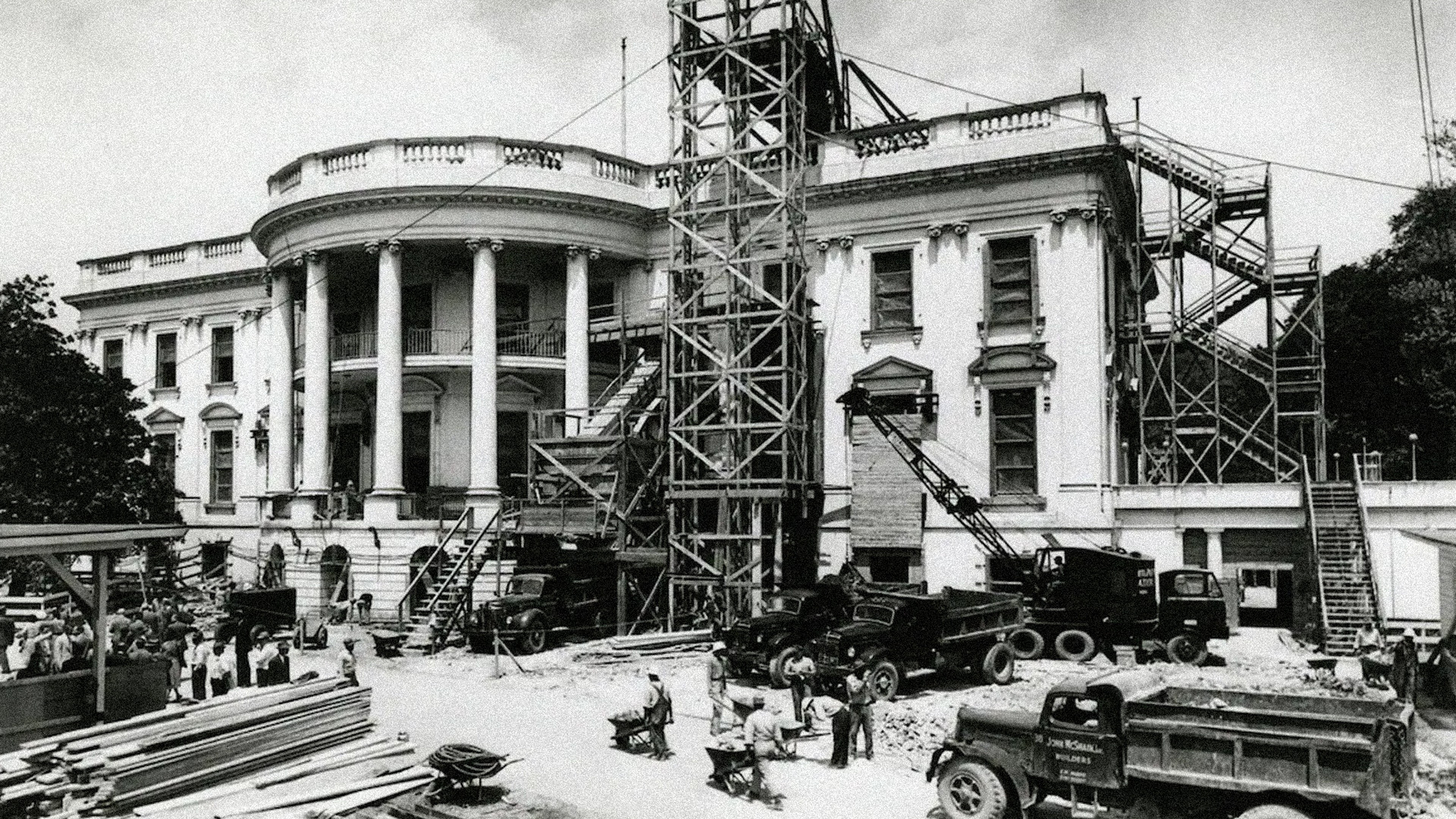
Every president, every first family, has had some impact on the White House, but the most major reconstruction in modern times, of course, happened during the Truman presidency.
ARCHIVAL (REUTERS, 4-22-52):
ANNOUNCER: The nation’s most famous home.
ANITA MCBRIDE: The White House hadn’t had much refurbishment during the Franklin Delano Roosevelt administration. That was not anything that Eleanor Roosevelt really paid attention to, and it also was wartime. So the White House was really falling apart. In fact, Eleanor told Bess Truman to be wary of the rats. The White House had rats.
When the Trumans come in, there were creaks and things, of course, that they heard, but there was one particular incident where Mrs. Truman is hosting a group of ladies from the Daughters of the American Revolution on the state floor, and she hears, you know, a tinkling of the chandelier in the Blue Room. After the event, she goes upstairs, trying to figure out what was happening. Come to find out Harry Truman is upstairs, taking a bath.
The structural review of the White House determined it was uninhabitable. It was unsafe. And Harry Truman famously said – wouldn’t that have been something if he and his bathtub had crashed right through onto the Daughters of the American Revolution.
ARCHIVAL (GETTY, 1948):
ANNOUNCER: The Trumans get a temporary White House.
ANITA MCBRIDE: So the Trumans had to move out.
ARCHIVAL (GETTY, 1948):
ANNOUNCER: It was recently discovered that the White House was in immediate danger of falling apart.
ANITA MCBRIDE: Harry, Bess, and Margaret, their daughter, lived over at Blair House while plans were being developed for the reconstruction. Of course, all that had to be funded by the Congress, and the Congress wanted to go the cheapest route, and the cheapest route was to tear the whole building down and rebuild, including the exterior, and it was the Trumans who felt that that was inappropriate, that White House history had to be preserved as much as possible, and that, of course, was the most expensive way.
Bess Truman always preferred to be in the background. She didn’t like doing press conferences; she didn’t like the media. She worried about the country’s perception of her being adequate and up to the task as first lady, particularly after following someone as visible as Eleanor Roosevelt. Bess knew she could never be that public face, and said – I’m not going down into any coal mines.
But Bess Truman was very astute politically. She had helped Harry with all of his campaigns. She knew Washington. She knew Capitol Hill. She knew what buttons to push. And so she went to the senators on both sides of the aisle, and to their spouses. Basically her message was, if you tear the whole building down, the American people will never forgive you.
This was the one time that she did use her role as first lady to speak out, and ultimately they secured the money that was needed to do this the right way.
ARCHIVAL (REUTERS, 4-22-52):
ANNOUNCER: 1600 Pennsylvania Avenue, stately and fresh after a $5,800,000 renovation.
ANITA MCBRIDE: So Bess Truman really rose to the occasion, and she did it when it was most important.
(END)
The Fight to Save the White House from Demolition
Bess Truman rarely sought the spotlight, but she fought to preserve the White House.
Recent renovations at the White House have renewed debate over how the building should change and what must be preserved. More than 75 years ago, that question confronted First Lady Bess Truman.
By the late 1940s, the White House was structurally unsafe, forcing the Truman family to move into Blair House while engineers and Congress considered what to do next. One proposal called for demolishing the mansion and rebuilding it from scratch.
Bess Truman, a first lady who generally avoided publicity, favored preserving the historic exterior while rebuilding the interior. In this short video, Anita McBride, a co-author of “Remember the First Ladies,” explains how Truman drew on her political experience and relationships on Capitol Hill to make the case.
“If you tear the whole building down, the American people will never forgive you,” was Truman’s message, McBride says.
Congress ultimately funded the more expensive reconstruction, preserving the White House’s outer walls.
- Producer / Editor: Matt Spolar
 Grades
7-12
Grades
7-12


 1 Lesson Plan

