Transcript
ARCHIVAL (CLIP FROM”MISSION TO MARS,” 2000):
MAN: OK, we’re ready to light this candle.
MAN: Let’s go to Mars.
NARRATION: What was once the stuff of sci-fi films – living on other planets – is now a focus of serious scientific research.
ARCHIVAL (AL JAZEERA, 9-19-17):
ANCHOR: A NASA-backed research team has emerged from 8 months of isolation on a remote Hawaiian volcano.
ARCHIVAL (CHANNEL 9 NEWS, 8-29-16):
NEWS REPORT: There they are, leaving after spending a year living life as if they were on Mars.
NARRATION: But the dream of living in outer space also inspired a private experiment in the Arizona desert decades a go.
ARCHIVAL (NBC NEWS, 9-26-91):
NEWS REPORT: Four men and four women are spending their first night in Biosphere 2.
ARCHIVAL (ABC NEWS, 11-9-89):
MARGARET AUGUSTINE: The first prototype for a total live system that you’d be able to take to another planet.
NARRATION: An experiment that was haunted by questions from the start.
BIOSPHERE 2: AN AMERICAN ODYSSEY:
NARRATION: News cameras captured the theatrics as eight men and women were about to be closed inside Biosphere 2 in the fall of 1991.
ARCHIVAL (NBC NEWS, 9-26-91):
JANE POYNTER: I take my last breaths of this atmosphere, knowing that I will take breaths from a different atmosphere from all of you for two years.
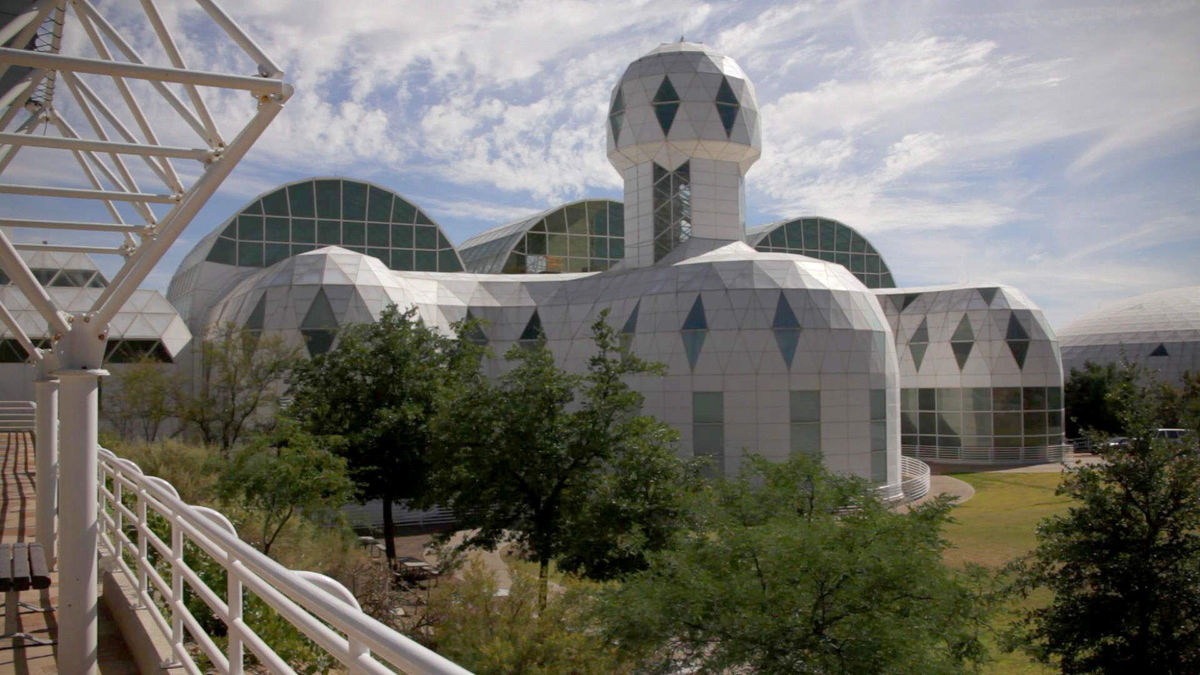
NARRATION: It had taken four years to build the three-acre, nine-story high complex in the Arizona desert. The goal was for Biosphere 2 to support its inhabitants without help from the outside world. They would grow enough food on their half-acre farm while the five wilderness areas would naturally recycle their air and water. Jane Poynter and Taber MacCallum were two of the eight so-called Biospherians, who planned to live and work inside for two years.
JANE POYNTER (FORMER BIOSPHERIAN): When we went into Biosphere 2, the big question was: is this even possible? Can we take something like Biosphere 2 – an artificial biosphere, the first ever built, that’s on completely different scales from planet Earth – and will it even work?
TABER MACCALLUM (FORMER BIOSPHERIAN): Most people on the Earth thought Biosphere 2 was going to green slime in a matter of weeks, right. You know, you can’t just bottle up theses complex ecosystems with bunch of people and expect it to live, right?
NARRATION: The unconventional $150 million project was funded by Edward Bass, heir to a Texas oil fortune, and conceived of largely by his friend, a former metallurgist named John Allen. Scientists from respected institutions, like the Smithsonian and the University of Arizona signed on as paid consultants, and helped the project gain credibility.
ARCHIVAL (NBC NEWS, 8-9-91):
REPORTER: When Secretary of Commerce Robert Mosbacher visited the site, he called it a noble experiment.
ARCHIVAL (ABC NEWS, 11-9-89):
REPORTER: The biggest payoff from Biosphere 2 could be a better understanding of our world, and of how we may someday live on other worlds.
JANE POYNTER: Before we went into the Biosphere, I mean it was insane! We were on the cover of everything. We were on all the major talk shows. I mean, it was nutty!
NARRATION: But within weeks of the experiment’s launch, and with the media spotlight still shining, problems began to surface at Biosphere 2.
ARCHIVAL (NBC NEWS, 1-31-92):
REPORTER: Jane Poynter had to leave Biosphere 2 when she accidentally sliced off the tip of one of her fingers. When she returned, she brought back a whole bunch of supplies. Biosphere 2 officials reluctantly revealed that information.
JANE POYNTER: That was incredibly frustrating. It started hitting the media across the world that the entire experiment had been negated because I had come out, for one thing, and that I had taken a duffle bag in, which was apparently full of food and heaven knows what I’d taken in. But none of it was true, all that was in there was like some drawings and a couple of things like that in it.
NARRATION: Regardless of what was in the bag, Poynter’s exit had compromised the closed experiment. And it was further compromised when the Biospherians had to supplement their diet with grains and beans from their seed stock.
ARCHIVAL (NBC NEWS, 9-25-92):
REPORTER: While their home video shows them feasting, the truth is the Biospherians have had trouble growing enough food to sustain themselves. Taber MacCallum has lost 54 pounds, though he says he’s okay.
TABER MACCALLUM: I really do like my new weight much more.
NARRATION: But the most damning news was that to protect themselves from dangerously high levels of carbon dioxide in their enclosed environment, the Biospherians relied on a machine that had been secretly installed before the experiment even started.
MARC COOPER (FORMER REPORTER, VILLAGE VOICE): They ordered and installed a CO2 scrubber, which is a machine that you use on a submarine.
NARRATION: Marc Cooper broke the story.
MARC COOPER: It made the entire experiment worthless, whatever value it had. I don’t think it had any value in the first place.
NARRATION: In the months before the Biosphere 2 launch, Cooper’s exposés revealed that most of the Biospherians had little academic training as scientists, and that their project was born of a startling past.
MARC COOPER: There was a book written about cults back in 1969, and there’s a whole chapter about these guys on their original commune.
ARCHIVAL (NBC NEWS, 9-26-91):
REPORTER: Back in the Sixties and Seventies, some of the people running Biosphere 2 had a little theater group and lived together on a commune. Their leader was a fellow who went by the nickname Johnny Dolphin. He is John Allen, and it is his philosophies that inspired Biosphere 2.
NARRATION: According to Cooper, the real story behind Biosphere 2 was Allen’s driving philosophy that the earth was doomed and that mankind could achieve “cosmic immortality” by building biospheres in outer space.
MARC COOPER: The media’s running around with its hair on fire saying “oh this a great thing because this is going to help us understand the environment, help us save the environment, help us save the world.” In fact these people had already made the decision that Earth was doomed, that they were not God’s chosen people, but they were their own chosen people to propagate humanity on another planet!
NARRATION: Biospherians Jane Poynter and Taber MacCallum say space colonization was only a distant goal, and that Cooper’s characterizations of the group and their work were overblown.
TABER MACCALLUM: You take the definition of a cult and, you know, many companies and organizations fit it. You know, yes we were a very, very tight-knit group with some very, very charismatic leaders. In some ways that’s what it takes to do something as totally off the charts as Biosphere 2.
NARRATION: By the end of the two-year mission, the Biospherians, in the words of Jane Poynter, had suffocated, starved and gone mad. The group split into factions, disagreed over scientific goals, and barely spoke to one another. Nevertheless, they put aside their differences to re-emerge triumphantly for the cameras. But the looming question remained.
ARCHIVAL (CBS NEWS, 9-26-93):
NEWS REPORT: Many are still asking, was it good science?
JANE POYNTER: It was an experiment. This was something that nobody ever tried before, so things were going to go wrong. As soon as things did go wrong, I mean it really did fall.
NARRATION: In 1994, Ed Bass brought in new management and ended manned missions at Biosphere 2. John Allen returned to his ranch in New Mexico, and Jane Poynter and Taber MacCallum got married that summer on the Biosphere lawn. As for the Biosphere 2 story, it simply faded away, popping up only occasionally, and in less than flattering company…
ARCHIVAL (BIO-DOME, 1996):
STEPHEN BALDWIN:Welcome to Bio-Dome.
PAULY SHORE: Welcome to the future.
BOTH: Viva los Bio-Dome! Viva los Bio-Dome!
NARRATION: Biosphere 2 failed as a human habitat, but in the mid 1990s, was transformed into a research facility, and led, for a time, by Steve Bannon, who would become President Trump’s chief political strategist.
ARCHIVAL (YOUTUBE, 1995):
STEVE BANNON: It’s been referred to in the past as a ‘planet in a bottle.’ This actually allows them to study and monitor the impact of enhanced CO2 and other greenhouse gases on humans, plants and animals.
JOHN ADAMS: Welcome to Biosphere 2.
NARRATION: Today, the structure is owned by the University of Arizona and is considered the world’s largest earth science laboratory, producing important research on issues like climate.
JOHN ADAMS (ASSISTANT DIRECTOR, BIOSPHERE 2): Most laboratory research and growth chambers that you have are you know something the size of a refrigerator. Or you’re working outside in a natural scenario where you have all of the variability but you have very little control capabilities. And Biosphere is this intermediate step.
JOOST VAN HAREN (ASSISTANT RESEARCH PROFESSOR, BIOSPHERE 2): So we can change the temperature. We can change the humidity. We can change the amount of rainfall to help predict what might happen to rainforests under different conditions.
JOHN ADAMS: We don’t have zip-lines running through Biosphere, we don’t have, you know, a roller-coaster going around. You know, it’s really, sort of science at a very fundamental level with the backdrop of an engineering marvel.
NARRATION: Meanwhile, the mission of the original Biosphere 2 lives on in NASA and the University of Hawaii’s HI-SEAS project, studying what it would take for a human team to reach and live on another planet.
(END)
Biosphere 2: A Faulty Mars Survival Test Gets a Second Act
NASA isn’t the first organization to experiment with living on Mars – in 1991 eight people sealed themselves inside a giant glass biosphere to practice space living. By the time they emerged two years later, they had “suffocated, starved and went mad.”
Biosphere 2 was a vast, greenhouse-like structure that replicated the ecosystems of “Biosphere 1” –- Earth. The inhabitants called themselves “Biospherians,” and dressed in Star Trek-like uniforms promised not to emerge for two years.
The $150 million experiment aimed to collect data with an eye to building structures to colonize space. But it quickly went awry, and led to many questions. Was this really science? Or just science fiction?
Decades later, the dreams that gave rise to Biosphere 2 continue…
- Producer: Joshua Fisher
- Producer: Sean Skelton
- Editor: Ben Howard
 Grades
9-12
Grades
9-12

 1 Lesson Plan