
Lesson Plan: Biosphere 2: A Faulty Mars Survival Test Gets Second Act
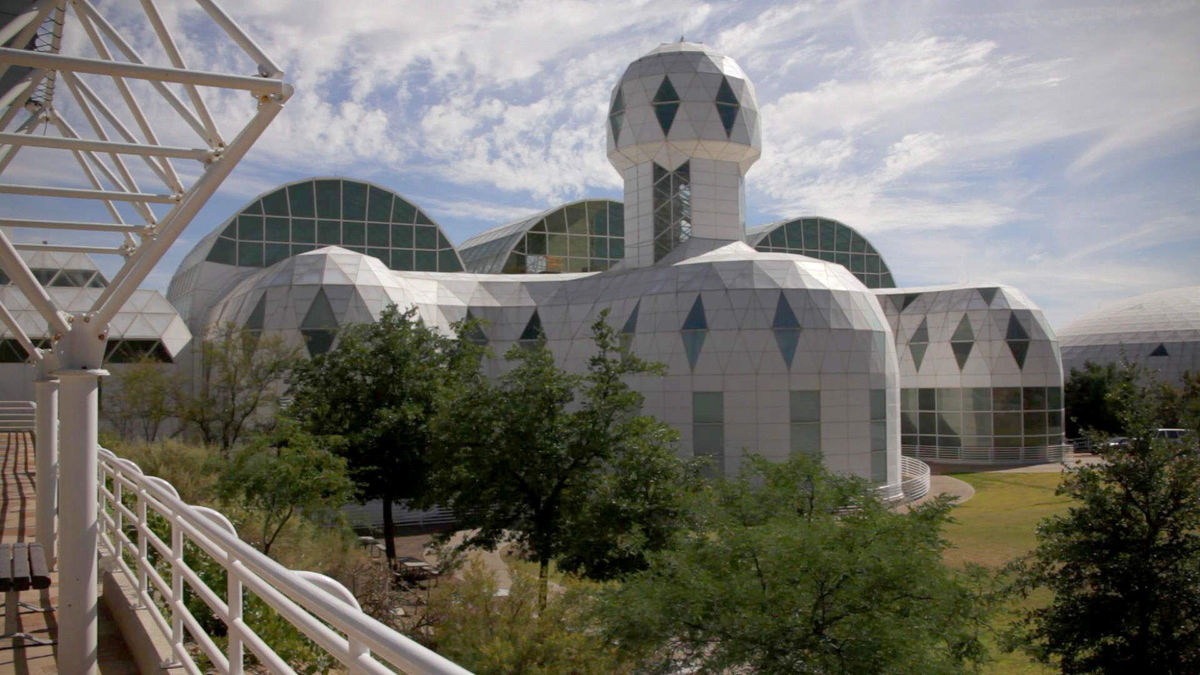
Biosphere 2, constructed in the Arizona desert during the late 1980s, was an exciting yet challenging model of planet Earth. The structure set out to teach about the pillars of sustainability by examining a thermodynamic closed system, the delicate cycling of nutrients, and man’s ecological footprint. Students will examine thermodynamic systems, learn how matter and energy move through the planetary system, and understand how Earth sustains itself.
Subjects:
Environmental Science
-
This covers content related to ecosystems and the biotic and abiotic interactions, biogeochemical cycles, how humans alter natural systems when using resources.
Grade Level:
-
9-12: General Science; 11-12: AP Environmental Science
Lesson Duration:
3 lessons (45 minute periods)
-
Day 1: Steps #1-5
-
Day 2: Steps #6-9
-
Day 3: Steps #10-11
-
For educators with less time, consider doing a 1-day lesson with a modified version of day 2 with different cycles as examples of how Earth recycles matter in a closed system.
-
Essential Questions:
-
Should we consider Biosphere 2 a failure or a success?
-
What kind of physical systems exist in the universe?
-
How does the original biosphere maintain a balance that sustains life?
Lesson Objectives:
Students will:
-
Describe different thermodynamic systems and explain how matter and energy are utilized.
-
Explain how carbon and nitrogen cycle through planet Earth.
-
Identify categories in an ecological footprint and calculate their own footprint.
Materials:
-
Retro Report video ”Biosphere 2: A Faulty Mars Survival Test Gets a Second Act” (Transcript)
-
Student Activity handout
-
Thermodynamic System visual | Wikipedia
-
The Earth is an open and closed system visual | OERu
-
Biogeochemical visual: Nitrogen Cycle | “Understanding Global Change,”University of California Museum of Paleontology
-
Biogeochemical visual: Carbon Cycle | “Understanding Global Change,”University of California Museum of Paleontology
-
Ecological Footprint Calculator | Global Footprint Network
Procedure:
-
Distribute the Student Activity handout and have students examine the Thermodynamic System visual from Wikipedia. Students are to fill in the related section on the Student Activity handout, defining the types of thermodynamic systems shown (isolated, closed, open), providing a real world example for each, and determining which type of system the original biosphere, Earth, is.
-
Have students share definitions as a class. Next, provide examples and have students respond aloud: “Which type of thermodynamic system is:
-
An ocean (open)
-
An incandescent light bulb (closed)
-
The atmosphere (open)
-
A thermos filled with coffee (depends if sealed – open or closed)
-
The universe (isolated)
-
-
Next, have students watch the Retro Report video “Biosphere 2: A Faulty Mars Survival Test Gets a Second Act” (Transcript) and answer corresponding focus questions on the Activity handout.
-
To help students get a better sense of the type of system that Earth is and how the Biosphere 2 was constructed, have them examine the excerpts and diagram from “The Earth is an open and closed system” in the next section of the handout and respond to the related prompts:
-
What colors or shapes represent energy inputs/outputs in the thermodynamic system? Is energy exchanged between the system and the surroundings (outside the system)?
-
What colors or shapes represent matter inputs/outputs in the thermodynamic system? Is matter exchanged between the system and the surroundings (outside the system)?
-
Decide which type of thermodynamic system Earth is. Provide a rationale.
-
Decide which type of thermodynamic system Biosphere 2 was. Provide a rationale.
-
-
After students respond to the prompts, review as a whole class, as necessary. Highlight examples of energy in the Earth system (solar energy and thermal energy) and examples of matter (living things and non-living things).
-
Begin by having students revisit the diagram from “The Earth is an open and closed system” and focus on the matter in the system. Identify the matter in the diagram and break it down to the base parts – the elements. For example, trees, water, soil, air, and animals are all made up of the elements in macromolecules (carbon, hydrogen, oxygen, sulfur, nitrogen, and phosphorus). This should be a review of any prerequisite biology class.
-
Next, introduce biogeochemical cycles to the students as a way to recycle finite resources on Earth. Break students into pairs and have each pair select a biogeochemical cycle. Choose from one of the following cycles: Carbon Cycle or Nitrogen Cycle.
-
Instruct the pair to examine the cycle and four examples of each of the four categories (matter, process, reservoir, and human impacts).
-
Matter – this would be the actual compounds like carbon dioxide
-
Process – this would be the way that the matter is cycled like photosynthesis
-
Reservoir – this would be the holding tank for the matter like ocean
-
Human Impact – this would be the way humans interfere like burning fossil fuels
-
-
Partner each pair with another pair that did the other cycle. Have students share responses for the four categories. As time allows, regroup as a whole class to review both biogeochemical cycles.
-
Introducing the concept of sustainability as “meeting the needs of the present without compromising the ability of future generations to meet their own needs.” (Sustainability | United Nations). Ask students how that definition relates to the previous activity. Prompt their thinking by asking the following:
-
Are you living sustainably as an individual?
-
Is the world living sustainably?
-
How many Earths would be needed to support the lifestyle of humans today?
-
What are categories of consumption?
-
-
Explain that they are going to attempt to answer the questions above by taking an ecological footprint quiz. Tell students that they will assess their own consumption patterns in the following categories (food, energy, housing, and transportation). They will be assigned two values. One is the amount of land needed to support their individual lifestyle each year. The other is the number of Earths it would take to support their lifestyle. Have students take the quiz and then fill in the graphic organizer. Place students into a pair again and have them answer the prompt: Explain why you are or why you are not living within the limit of one biosphere.
About the Author:
Derek Dubossi is an Advanced Placement Environmental Science educator at the prestigious Fiorello H. LaGuardia High School for Music and Art & the Performing Arts in New York City. He earned a M.A. degree in science education from Teachers College, Columbia University. He was a finalist for the PolarTrec program to the Arctic and was awarded a Funds for Teachers grant to study coral reef restoration in Bonaire. He has been a member of the Math for America master teacher fellowship for nine years.
Standards
Next Generation Science Standards
-
ESS3.C: Human Impacts on Earth Systems: Things that people do to live comfortably can affect the world around them. But they can make choices that reduce their impacts on the land, water, air, and other living things.
-
ESS3.A: Natural Resources: Living things need water, air, and resources from the land, and they live in places that have the things they need. Humans use natural resources for everything they do.
-
K-ESS2: Systems and System Models – Systems in the natural and designed world have parts that work together.
-
1.1 Ecosystems are the result of biotic and abiotic interactions.
-
1.4 The carbon cycle is the movement of atoms and molecules containing the element carbon between sources and sinks.
-
1.5 The nitrogen cycle is the movement of atoms and molecules containing the element nitrogen between sources and sinks.
-
5.1 The tragedy of the commons suggests that individuals will use shared resources in their own self-interest rather than in keeping with the common good, thereby depleting the resources.
