Transcript
Click here for the full video page and educator materials.
JOE JULIANO (IN INTERVIEW): January is a crazy race to the finish line. All across the country, you’ve got teams just like mine that are scrambling, pushing it to the limits because they all want a chance at the national title. The state competition is just this huge moment.
TEXT ON SCREEN:
GRAHAM MCBRIDE
FOOTHILL HIGH SCHOOL, CA
GRAHAM MCBRIDE (TEACHER): A lot of my stress goes into the preparation for the state competition because then it’s it’s, it’s, it’s over if we don’t advance.
TEXT ON SCREEN:
ANGELA DIPASQUALE
GRANT HIGH SCHOOL, OR
ANGELA DIPASQUALE (TEACHER): I feel some of that pressure. Gosh, what if this is the year that we don’t advance to nationals?
TEXT ON SCREEN:
STACEY SKLAR
AMADOR VALLEY HIGH SCHOOL, CA
STACEY SKLAR (TEACHER): You can’t fake it, you really have to be good.
TEXT ON SCREEN:
SCHUYLER VANVALKENBURG
GLEN ALLEN HIGH SCHOOL, VA
SCHUYLER VANVALKENBURG (TEACHER): We’re talking about losing by the smallest of margins or winning by the smallest of margins.
TEXT ON SCREEN:
ERIN LINDT
SOUTH HIGH SCHOOL, WY
ERIN LINDT (TEACHER): We didn’t even make it to state my first year here, but then I was like we’re coming back with a vengeance.
TEXT ON SCREEN:
MARC MONDRY
EAST BRUNSWICK HIGH SCHOOL, NJ
MARC MONDRY: It gets tougher every year. You know, teachers get better, schools get more competitive.
TEXT ON SCREEN:
SAM ULMSCHNEIDER
MAGGIE L. WALKER GOVERNOR’S SCHOOL, VA
SAM ULMSCHNEIDER: You may have a stellar, amazing group of students, but someone else may have an even more stellar and amazing group of students.
TEXT ON SCREEN:
MIKE THOMAS
SHERIDAN HIGH SCHOOL, WY
MIKE THOMAS: Everybody wants to win and that’s just the way it is.
TEXT ON SCREEN:
RICHMOND, VIRGINIA
12 HOURS BEFORE STATE COMPETITION
ROHINI: I think we’re all just facing a general exhaustion from repeated like information. So I think we should calm down.
SKYLAR: This is unit bonding time.
ALICE: Yeah.
ALICE: Maggie Walker has a history.
ROHINI (IN INTERVIEW): Twenty-five years is a long legacy.
ALICE (IN INTERVIEW): And now we have to kind of prove ourselves.
AVERY (IN INTERVIEW): We’ve pretty much been having practice rounds every day and prepping for states by, like, really beefing up our study guide. It’s intense, but I have never felt smarter in my life.
SKYLAR: Can I tell you guys some of the random things that I pulled up that I feel like I should share with everyone?
AVERY: You should.
SKYLAR: One thing is the cube rule. Do we know what this is? Because I did not know what this is.
ALICE: The what?
SKYLAR: Cube. Rule. Like a square, but in 3D. [LAUGHS] Sorry.
SKYLAR: We’re passionate for learning in a very nerdy way and all we talk about is the Constitution.
AVERY: But do you have the scholar that came up with this rule, because that would make it even more impactful.
ROHINI: We have so many scholars.
AVERY: Like established by. . . Mr. Guy.
AVERY (IN INTERVIEW): My unit, they drive me, one hundred percent.
ALICE: Nixon versus Fitzgerald’s like, the consequences of your actions, you can’t be prosecuted for.
SKYLAR: It’s not presidential immunity.
ROHINI: If it’s ever brought up, I have the actual Roman history behind it, because it’s the Roman principle. It’s the reason Rome fell down.
SKYLAR: Don’t get too, rabbit hole with it.
ROHINI: Yeah, the only reason, if I’m going to mention it, I’ll say destruction of–
SKYLAR: It’s good evidence but it’s quick evidence–
ROHINI: The destruction of Democracy because it allowed the executive to become a dictator.
ALICE: I disagree with this.
CADEN (IN INTERVIEW): I am exhausted. Stressed. Mentally drained. I am pretty sure I am talking about the Senate in my sleep these days.
TEXT ON SCREEN:
WYOMING
24 HOURS BEFORE STATE COMPETITION
BUS DRIVER: How you doing today?
STUDENT (TO PARENT): I love you.
PARENT: Keep us posted.
STUDENT: Alright, thank you.
PARENT: Have fun.
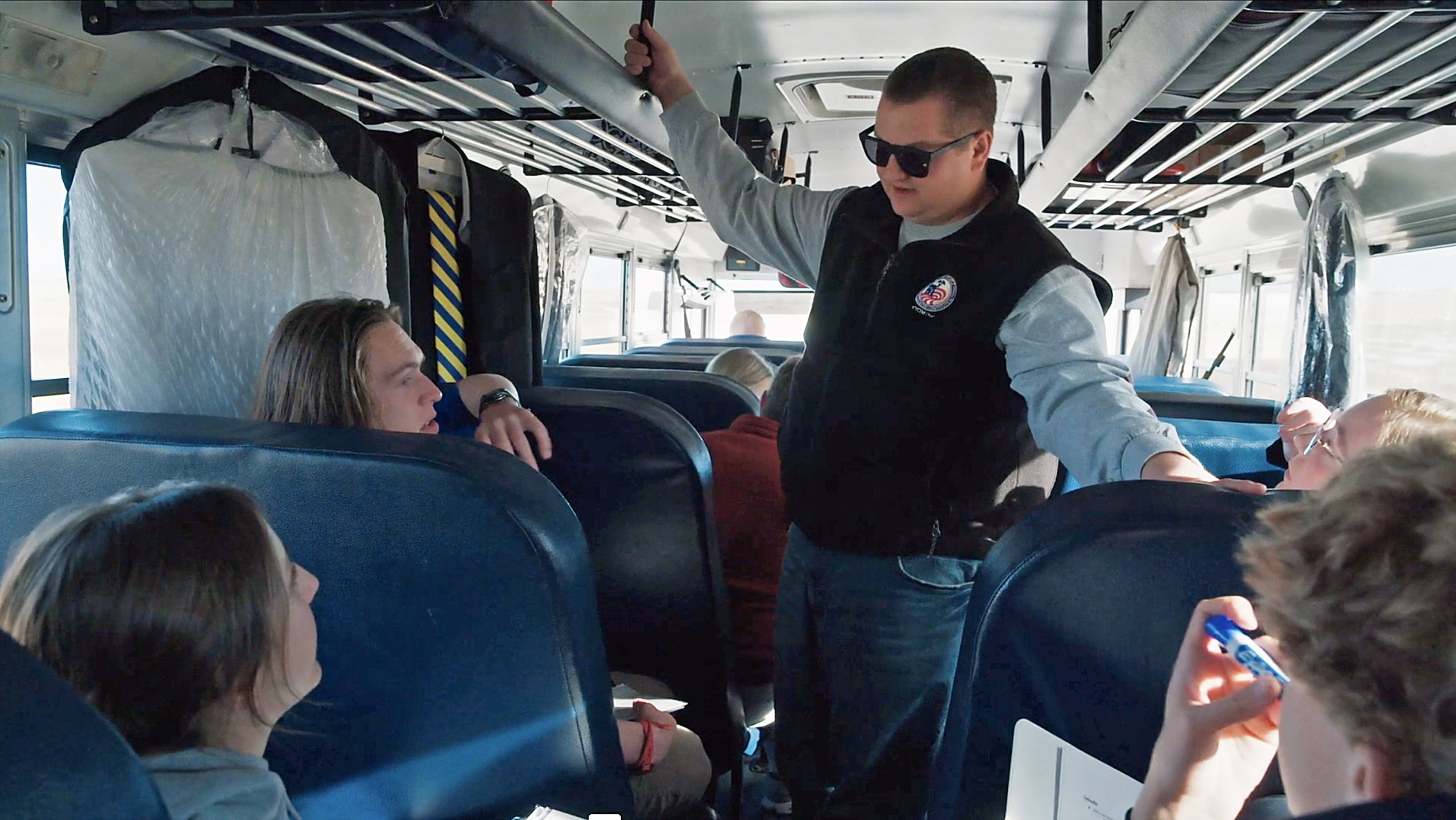
MIKE THOMAS: Ok, wave out the window we’re leaving. Listen up. I want you to relax and have fun till we get to Casper. But once we eat lunch, we’re fully engaged, understand? So if you want to go to sleep, or listen to music, or talk. . .
MIKE THOMAS (IN INTERVIEW): We’re trying to get kids to think.
MIKE THOMAS: How is the three-fifths compromise connected to the Electoral College?
STUDENT: They have more representation in the House so they have more members in the House.
MIKE THOMAS (IN INTERVIEW): It’s the best part of teaching We the People. It’s really getting kids to think about their own ideas about these different topics. And these are hard topics.
MIKE THOMAS: Which is why slavery didn’t end in 1808 like it was supposed to.
MIKE THOMAS (IN INTERVIEW): You got to do a lot of work on your own.
MIKE THOMAS: They screwed up big time.
MIKE THOMAS: And you got to figure out both sides because the judges are going to say, well, you said this, but what’s the other side’s going to say? So it’s not enough to just know your side. You have to know it all the way around
STUDENT: This is why the Senate is not representing the states and this is why the House should only. . .
CUTTER: Senators now, they are appealing just to their voters to get votes.
MIKE THOMAS (IN INTERVIEW): I think that teaching students to critically think about government. . .
HARPER: Who should regulate the second amendment?
MIKE THOMAS (IN INTERVIEW): . . . Helps them better find their way into society.
MIKE THOMAS: I think last time I checked. . .
MIKE THOMAS (IN INTERVIEW): I just want to create better citizens, better thinkers, more engaged citizens. That, to me, is much more important than anything else.
(END)
Citizen Nation: Preparing for Success
Intense practice, camaraderie and learning lift high school students on a journey toward state-level civics competitions.
In a charged season of preparation, high school teams push themselves to sharpen their knowledge and skills before a national civics competition. Students like Rohini, Alice, Avery and Skylar learn that true success lies in mastering their topics and preparing for anything. The students realize that win or lose, they’re growing into informed citizens. As Wyoming teacher Mike Thomas says, “I just want to create better citizens, better thinkers.”
This is an excerpt from ‘Citizen Nation,’ a four-part coming-of-age story that follows teenagers from across the U.S. with diverse personal and political backgrounds as they come together to compete in the nation’s premier civics competition, We the People. Watch the series.
The resources were funded in part by the Leonore Annenberg Institute for Civics Award from the Annenberg Public Policy Center at the University of Pennsylvania.
The We the People program is conducted by the Center for Civic Education.
Stay up to date. Subscribe to our newsletters.
- Series Creator: Bret Sigler
- Director: Singeli Agnew
- Supervising Producer: Veronika Adaskova
- Series and Episode Lead Editor: Anne Checler
- Field Producer: Emily Orr
- Field Producer: Wesley Harris
- Associate Producer: Cole Cahill
- Post Production Supervisor: Cullen Golden
 Grades
7-12
Grades
7-12