Transcript
Click here for the full video page and educator materials.
TEXT ON SCREEN:
ELKHART, INDIANA
HOME OF CLEO WRIGHT’S DAUGHTER
79 YEARS AFTER THE LYNCHING
NANNETTA FORREST (CLEO WRIGHT’S DAUGHTER): My mother, she was pregnant with me at the time that it happened. They tell me the people were so scared they were packing their luggage and they were getting out of there, and I don’t know if we left right away or not. But I do know one thing. My mother never left her mother and dad. Everywhere Grandma and Grandpa moved, that’s where Mama moved to.
I was, like, 13, 14 before I even found out. So, I really don’t know a whole lot to tell. They had, uh, an old show that used to come on called Strike It Rich.
ARCHIVAL (STRIKE IT RICH):
ANNOUNCER: It’s the show with a heart, Strike It Rich.
NANNETTA FORREST: Celebrities would go on and try to win money for, like, underprivileged people.
ARCHIVAL (STRIKE IT RICH):
HOST 1: Tom is veteran. His injury makes it impossible for him to do any hard, manual labor.
HOST 2: Well, let’s help him.
HOST 1: Well, all right.
NANNETTA FORREST: Grandpa told me, you can go there, Nan. And I said, go on there with what? And that’s when he pulled out this piece of paper. He told me that my father had been lynched, and that was my first time ever becoming aware of it.
I do wish I had got a chance to get to know him because I often wonder what type of person would I be today had he been in my life. Would I have been the same person? Would I have been a different person? And this is something I’ll never know.
Every now and then, people still bring it up about Cleo Wright getting lynched down South. Had it been done differently, went to court, had a trial or whatever, but it didn’t happen that way.
You did anything that didn’t go along with what they wanted you to go along with, they could lynch you.
TEXT ON SCREEN:
1893
TEXAS LYNCHING
1915
GEORGIA LYNCHING
1919
NEBRASKA LYNCHING
1920
UNKNOWN LYNCHING
NANNETTA FORREST: They didn’t think it was wrong because they didn’t, they didn’t get punished for it for one thing. No, they didn’t.
KEVIN MCMAHON (POLITICAL SCIENCE PROFESSOR, TRINITY COLLEGE): Before the lynching of Cleo Wright, there were 3,842 lynchings in the United States, and the Department of Justice had not fully investigated any of them.
MARGARET BURNHAM (LAW PROFESSOR, NORTHEASTERN UNIVERSITY SCHOOL OF LAW: Lynchings clearly violated state law. These were murders, the worst forms of murders.
ARCHIVAL (LYNCH MOB):
NEWS REEL: In the park a yelling mob of 10,000 white. . .
MARGARET BURNHAM: But the states weren’t prosecuting, and lynching was never a federal crime.
TEXT ON SCREEN:
1917
ANTI-LYNCHING PROTEST
1922
ANTI-LYNCHING PROTEST
1933
ANTI-LYNCHING PROTEST
KEVIN MCMAHON: There were movements to pass anti-lynching legislation, but it never became law. So, this is the first time the Department of Justice steps in saying, we’re going to prosecute you. Where in the past, they would just look the other way.
ARCHIVAL (FILM OF BOMBING FROM WORLD WAR II):
NEWSREEL: December 7, 1941.
KEVIN MCMAHON: The lynching of Cleo Wright happens a month and a half after Pearl Harbor.
ARCHIVAL (ANNUAL MESSAGE, 1941):
PRESIDENT FRANKLIN D. ROOSEVELT: Freedom means the supremacy of human rights everywhere. To that high concept, there can be no end, save victory.
CAROL ANDERSON: This war is being cast as a human rights war against tyranny, racial tyranny, against a regime that is predicated on Aryan supremacy, but there’s a problem. The problem is Jim Crow in the United States.
KEVIN MCMAHON: You have this war against a racist Nazi regime, and the United States is representing itself as a defender of democracy. And if it is a defender of democracy, how can you allow an individual who’s been accused of a crime to be taken from a jail and lynched?
CAROL ANDERSON: Japan looks up and is, like, see? Look at what they do to their own people. And so, the violence raining down on Black people in the United States becomes war propaganda for the Axis nations.
ARCHIVAL (RADIO TOYKO):
A rumor originating in a certain quarters in the United States claims…President Roosevelt…is some kind of a Ku Klux Klan…President Roosevelt also plays upon the loyalty of the colored people…The repeated treacheries against their race for the past years give them very little reason to love him.
KEVIN MCMAHON: This is a crisis of democracy being challenged by a serious foreign threat. And you need to say, well, what is democracy? What’s democracy for African Americans living in the South?
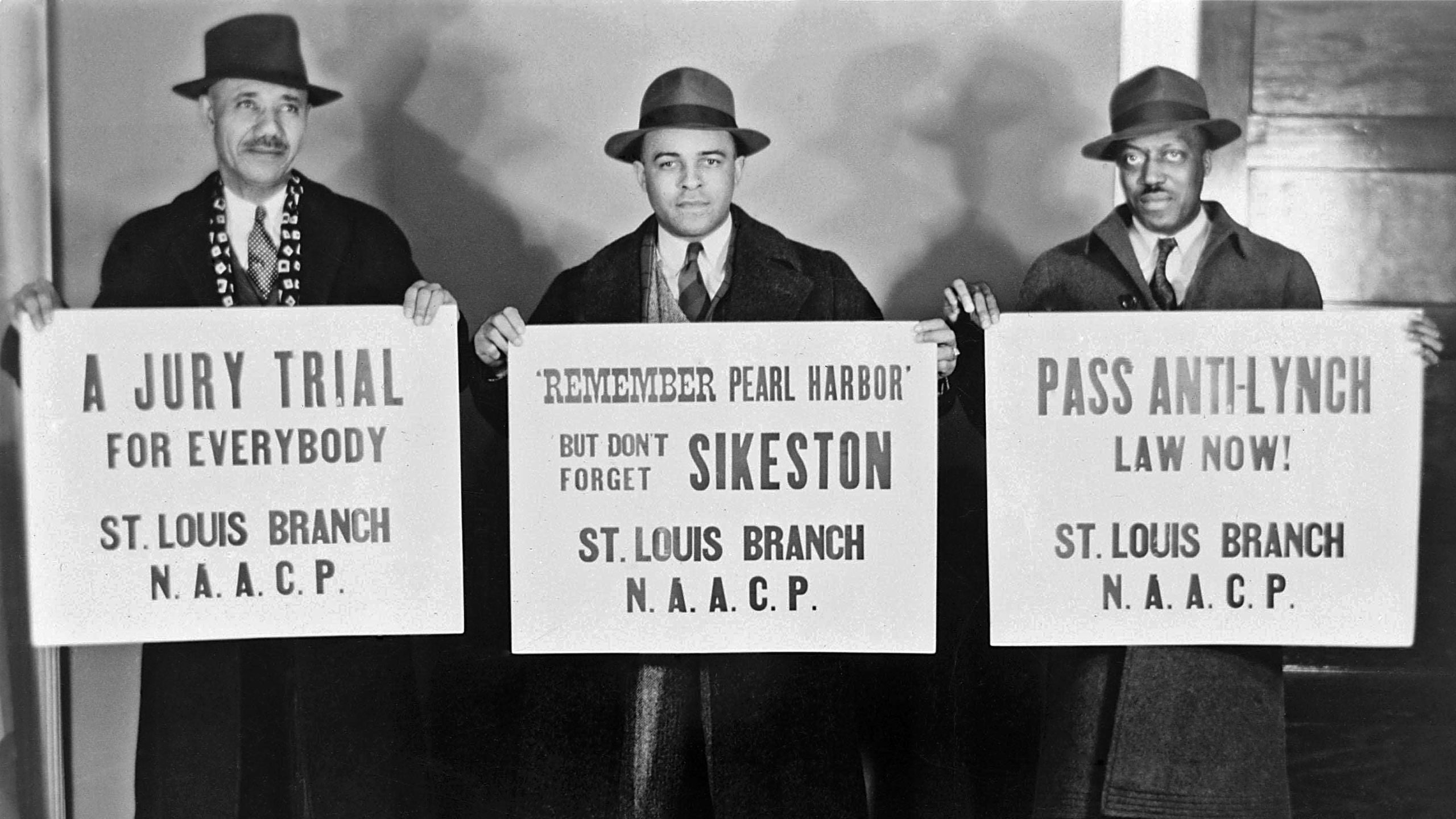
CAROL ANDERSON: You also had this agitation happening in the Black community of remember Pearl Harbor and Sikeston, Missouri. You had one of the premier Black newspapers in the nation launching what was called the Double V Campaign. The Double V Campaign was victory against fascists overseas and against fascists here in the United States. So, Black folks were making the connection that this war for freedom wasn’t just a war for freedom over there. It was for freedom here as well.
ARCHIVAL (SONG):
(LYRICS) If you people will listen to me, from my heart I prayed anew.
For we are Americans.
Praise the Lord.
For we are Americans.
Praise the Lord.
We are Americans.
Praise the Lord, praise his holy name.
MARGARET BURNHAM: After the Cleo Wright lynching, the political imperative to do something about this case was quite strong. So, the Justice Department began to look at two statutes that had been used in the immediate wake of the Civil War to see if they could be applied to lynching situations. Both of these statutes addressed activities to deprive an individual of his or her civil rights.
KEVIN MCMAHON: When you’ve been accused of a crime, you have a right, a federal right, to a trial, and what the Justice Department wants to say is the members of lynch mob have committed the crime of denying Cleo Wright his right to trial. They’ve determined that he is guilty and then carried out the punishment, which is death.
MARGARET BURNHAM: The federal government conducted a fairly wide-ranging investigation, and as investigators sought to find out who was in that mob, no one saw anyone. No one could remember seeing anyone else in that mob. The Justice Department took their case against the lynchers to federal court. The grand jury declined to indict. They rejected the argument that the existing federal statutes applied in a lynching case. So, not getting an indictment had a chilling effect on the federal government’s initiative to use these statutes to address lynching. It’s very, very unfortunate that this case failed. Had the Cleo Wright case been successful, those laws would have been muscular engines to address racial violence.
(END)
How Racial Propaganda was Used Against the United States in World War II
This excerpt explores the history of anti-lynching efforts in the U.S., and the failure by federal prosecutors to bring to justice anyone in the mob responsible for killing Cleo Wright in 1942.
Cleo Wright, a Black resident of Sikeston, Mo., was lynched by a mob on Jan. 25, 1942. His death came less than two months after Japan attacked Pearl Harbor, drawing the United States into World War II. Nazi Germany and Japan took advantage of racial violence in the U.S. as a way to point out its hypocrisy in fighting for human rights abroad but not at home. The Wright lynching led to the first attempt by the federal government to prosecute a lynch mob.
This is an excerpt from “Silence in Sikeston,” which is a co-production of Retro Report, WORLD and KFF Health News. To see more check out our “Silence in Sikeston” collection.
- Director / Writer: Jill Rosenbaum
- Reporter: Cara Anthony
- Editor: Cheree Dillon
- Editor: Brian Kamerzel
- Senior Producer: Karen M. Sughrue
 Grades
8-12
Grades
8-12

 1 Lesson Plan