Transcript
ARCHIVAL (1-17-18):
VICE PRESIDENT MIKE PENCE: Someone far more important than me: President Donald Trump.
BOB ELDER (ASSOCIATE PROFESSOR OF HISTORY, BAYLOR UNIVERSITY): Typically we think of presidents and vice presidents going together into the second term. That doesn’t always happen.
ARCHIVAL (MSNBC,2-7-22 ):
NEWS ANCHOR: Vice President Mike Pence, arguably Donald Trump’s most loyal yes man, has now split with the former president.
ARCHIVAL (CNN, 2-9-23):
NEWS ANCHOR: Trump called Mike Pence a very vulgar name.
ARCHIVAL (CNN, 5-23-22):
NEWS REPORT: Trump suggesting his former vice president is irrelevant and desperate.
BOB ELDER: In general, people believe the vice presidential pick in an election matters very minimally, but politics is always personal, and certainly John C. Calhoun’s vice presidency shows that it does matter who you pick for that role.
TITLE:
POLITICKING: A 19TH CENTURY CAMPAIGN SERIES
“THE VEEP”
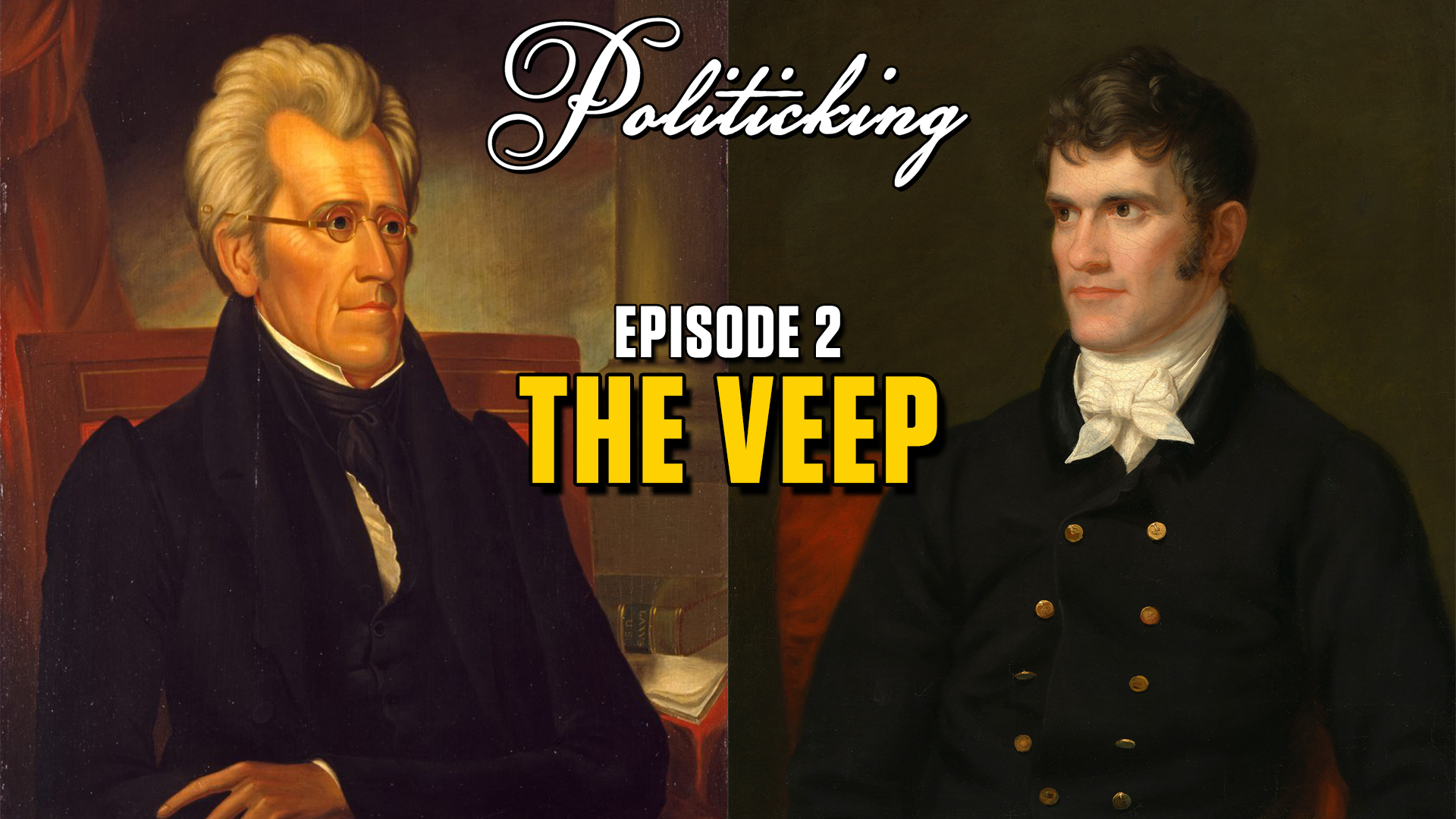
KIRSTEN WOOD (ASSOCIATE PROFESSOR OF HISTORY, FLORIDA INTERNATIONAL UNIVERSITY): As the hero of the battle of New Orleans, where the Americans beat the British, Andrew Jackson looks like a new kind of man. He has this charisma, this star quality in the print media of the day. Somebody who is not a member of the established elite. To many Americans, someone who is going to tear down some of the constraints that are holding them back – or so they imagined.
BOB ELDER: Average Americans are increasingly becoming part of the political process. Many states are dropping the property qualification for voting for the first time. Jackson is the one who rides that wave of popular participation.
KIRSTEN WOOD: The presidential field in 1824 was crowded. Jackson wins the popular vote, but not by enough to win the election outright. The vote gets put into the House, and then decided in favor of John Quincy Adams. Jackson’s voters feel like they’ve been cheated.
BOB ELDER: It becomes known as the Corrupt Bargain. Despite the fact that this was completely constitutional, there’s just this sense that the people had been betrayed.
If you had asked Americans in the first half of the 19th century which politicians had not yet been president but would be in their lifetimes, they probably would have named John C. Calhoun.
KIRSTEN WOOD: In the 1828 election, Calhoun is running to become vice president to Andrew Jackson. 1828 is going to be Jackson’s revenge, and that is indeed what happens.
BOB ELDER: The election is a landslide for Jackson and Calhoun, but, almost immediately after is the Peggy Eaton affair.
KIRSTEN WOOD: At the turn of the 19th century, Washington is basically a swamp with a few buildings, and some of those buildings are boarding houses, because the visiting congressmen need a place to stay. William O’Neale’s Franklin House is a combination of a boarding house and a tavern.
To understand the significance of Peggy O’Neale’s upbringing, we need to think about class and context. Peggy is helping out in all aspects of the business – helping serve drinks, for example. That contributes to the idea that – how could a barmaid be elevated to the rank of a cabinet secretary’s wife?
BOB ELDER: The rumor in Washington was the daughter of a well-known tavern innkeeper had begun an affair with a senator from Tennessee, John Eaton, a close friend of Andrew Jackson. Peggy had been married to this man named Timberlake in the Navy, and the story circulating was he had committed suicide because of this affair while he was on assignment.
Then Peggy married John Eaton. This provokes this social crisis in Washington, because Jackson makes John Eaton his secretary of war. Peggy is not only from a social class that many of the other cabinet members’ wives were not from, but there’s this cloud hanging over her about sexual impropriety and the circumstances of their marriage.
KIRSTEN WOOD: Floride Calhoun, the second lady of the United States, was an active political hostess in Washington life up to that point. She returns to South Carolina, interpreted as a slap in the face to the Eatons. The women in Washington snub Peggy Eaton. At times it almost sounds a bit like high school, something as simple as pulling your skirts away when she comes near you.
BOB ELDER: People begin telling Jackson – you should distance yourself from the Eatons because this doesn’t look good. But Jackson completely rejects this. He connects the Peggy Eaton affair to similar circumstances with his wife, Rachel. The accusation had been they had gotten married before Rachel was legally divorced from her previous husband. Rachel died right after the 1828 election, and Jackson believes it was the rumors about Rachel that caused her death. So the attacks on Peggy Eaton arouse this intense, fierce anger.
Unfortunately for Vice President John C. Calhoun, the woman who is most opposed to Peggy Eaton is his wife, Floride. It hits this crack that’s developing politically between Jackson and Calhoun over a tariff, and breaks it wide open.
KIRSTEN WOOD: Congress had passed a tariff, which had some hard consequences for Calhoun’s home state of South Carolina. And Calhoun authors, in secret, an essay arguing for the right of South Carolina or any state to nullify federal law. Calhoun authors this in secret because he knows full well that, as vice president of the United States, writing a document about how to break up the union is going to be unpopular with, among other people, President Andrew Jackson.
In Jackson’s eyes, it’s a betrayal. And so these two things coming from Calhoun, the Eaton affair on the social front and this question of states rights, these are irreconcilable differences, if you will.
BOB ELDER: The split results in a situation where Jackson’s cabinet will just completely disintegrate and Calhoun does eventually resign, the first vice president to do so.
KIRSTEN WOOD: With Jackson, to insult his personal dignity was also an attack on the office. Today, John C. Calhoun’s complex relationship with Andrew Jackson may help us ask questions about what makes entanglements of personal and political especially fraught and consequential.
(END)
Picking a Partner: The V.P. Relationship
The relationship between presidents and vice presidents is unique and often personal. Sometimes, internal divisions spill out into public life.
Personal conflicts have played a significant role in shaping U.S. political history. Almost 200 years before the falling out between President Donald Trump and Vice President Mike Pence, the American public was captivated by a scandal in Washington society and a feud over states’ rights that led to a bitter split between Andrew Jackson and John Calhoun.
- Producer / Editor: Matthew Spolar
- Graphics: Cullen Golden
- Additional Editing: Brian Kamerzel
 Grades
8-12
Grades
8-12
 1 Lesson Plan