
Transcript
ARCHIVAL (CBS19, 1-28-25):
NEWS REPORT: New this morning, a freeze on nearly all federal financial assistance.
ARCHIVAL (CBS NEWS, 3-26-25):
NEWS REPORT: Federal officials are cutting more than $ 11 billion from health organizations.
ARCHIVAL (WAVYTV10, 3-11-25):
NEWS REPORT: A billion dollars slashed from the Agriculture Department.
ARCHIVAL (PBS NEWSHOUR, 3-24-25):
NEWS REPORT: The Trump administration has moved to cancel or freeze trillions in federal funding.
NARRATION: The Trump administration’s unilateral cuts to federal spending in the first 100 days have sparked questions about just how broad the president’s powers are, and an obscure budget tool emerged as a flashpoint.
ARCHIVAL (CBS NEWS, 2-14-25):
NEWS REPORT: It appears that this is going to be some indefinite, uh, impoundment, as they say.
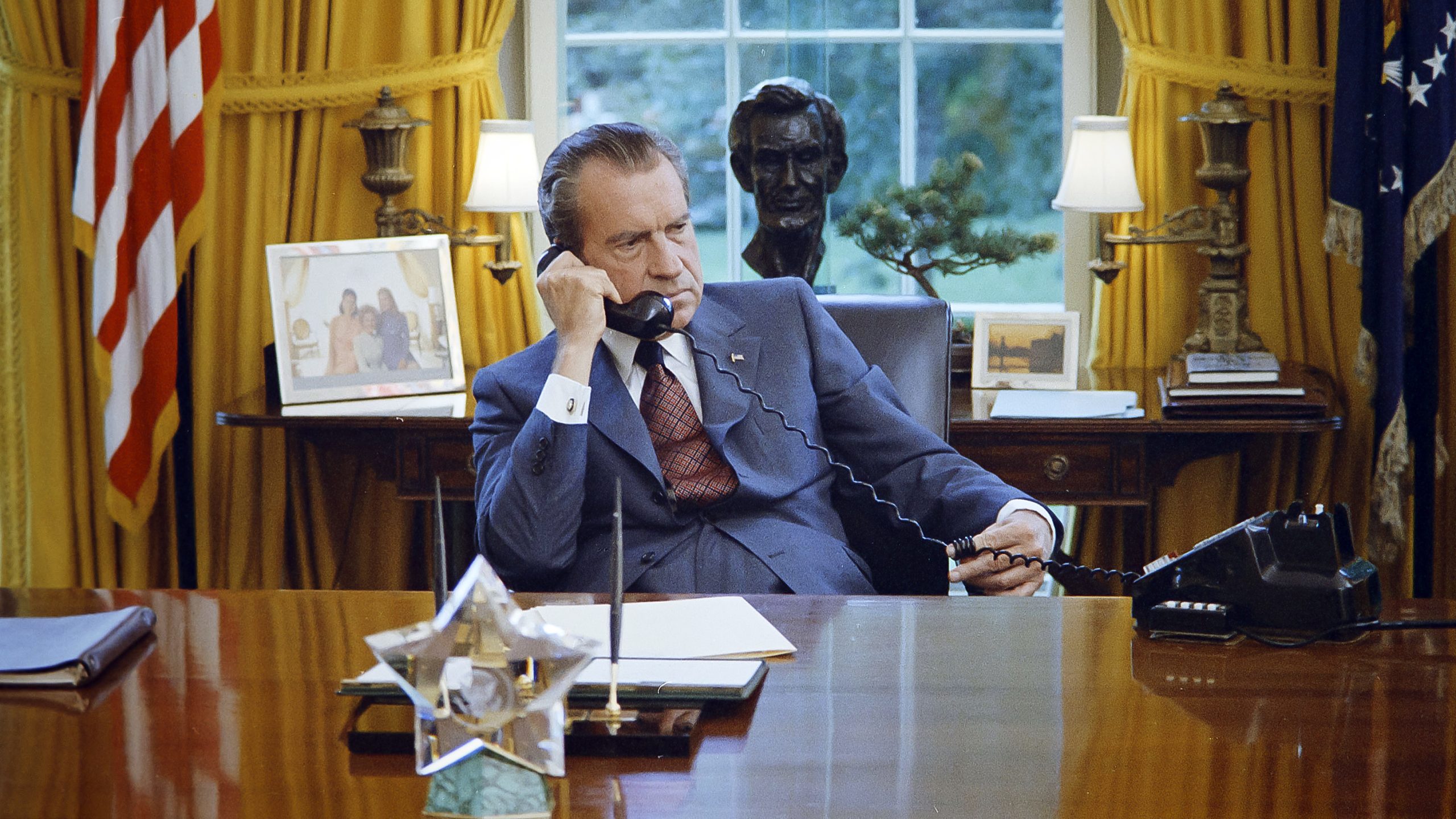
NARRATION: The last crisis over impoundment was over 50 years ago.
ARCHIVAL (CBS NEWS, 2-8-73):
NEWS REPORT: Mr. Nixon is absolutely determined to go ahead on impoundment and on the cutting back or out of some 100 domestic programs.
NARRATION: What can that history tell us about today’s fight?
TEXT ON SCREEN: OCTOBER 1972
ARCHIVAL (NIXON PRESIDENTIAL LIBRARY, 10-26-72):
NEWS REPORT: Mr. Nixon is lambasting Congress for going on what he called a spending spree. He promised to veto bills and withhold appropriations.
NARRATION: Nixon’s promise of fiscal restraint, made during his campaign for a second term, soon collided with the realities of a Democratically controlled Congress.
MATTHEW LAWRENCE (ASSOCIATE PROFESSOR OF LAW, EMORY UNIVERSITY SCHOOL OF LAW): That meant that if if Nixon wanted to reduce federal spending, Nixon couldn’t do it the constitutional way, which is to change the law to reduce the federal spending.
ARCHIVAL (ABC NEWS, 1-31-73):
PRESIDENT RICHARD NIXON: I will not spend money if the Congress overspends.
ARCHIVAL (NIXON PRESIDENTIAL LIBRARY, 1-31-73):
PRESIDENT RICHARD NIXON:The constitutional right for the president of the United States to impound funds is absolutely clear.
ARCHIVAL (CBS NEWS, 1-30-73):
NEWS ANCHOR: President Nixon’s refusal to spend the full appropriation for some programs has brought protest that he is usurping the power of Congress.
ELIZABETH HOLTZMAN (FORMER DEMOCRATIC U.S. REPRESENTATIVE, 1973-1981): Sitting in Congress, we saw a president out of control. President can’t do whatever the president wants to do.
ARCHIVAL (ASSOCIATED PRESS, 6-21-72):
ELIZABETH HOLTZMAN: People are tired of machine politics, the power of seniority is artificial. . .
NARRATION: Elizabeth Holtzman had just won a long-shot campaign for Congress, as Nixon was increasingly impounding funds for programs he disagreed with.
ELIZABETH HOLTZMAN: The refusal to spend money on programs that Congress has authorized by statute, by law – it’s improper under the Constitution and it tears our democratic fabric.
NARRATION: Presidents in the past, including Thomas Jefferson had spent less than the appropriated money, but in most cases that discretion had been authorized by Congress.
MICHAEL MCCONNELL (PROFESSOR OF LAW AND DIRECTOR, CONSTITUTIONAL LAW CENTER, STANFORD): For a very long time, really, until Richard Nixon, there was a norm that was quite powerfully held and understood that the president would use that discretion, that flexibility, only in service of Congress’s policy goals.
ELOISE PASACHOFF (PROFESSOR OF LAW, GEORGETOWN): What the Nixon administration did became known as policy impoundments, and it did it in a whole slew of domestic programs, again and again and again.
ELIZABETH HOLTZMAN: We were seeing the refusal to spend money on programs, a refusal to acknowledge what the Constitution created, which was to give Congress the power of the purse. Those refusals were a red light – flashing red light. They said: Tthis is a president who thinks he’s got all the power.
NARRATION: Billions of dollars were hanging in the balance for everything from education grants, to emergency disaster loans for Minnesota farmers.
ARCHIVAL (ABC NEWS, 2-21-73):
NEWS ANCHOR: Twelve mayors from cities large and small complained today that President Nixon’s plan to impound federal funds would bring ruin to their budgets and hardship to their people.
ROMAN GRIBBS (MAYOR OF DETROIT): Detroit citizens will lose jobs. They’ll return to the compensation lines or welfare rolls.
JOHN LINDSAY (MAYOR OF NEW YORK): No one can claim to be concerned about fighting crime when funds are cut for jobs and schools in our cities.
NARRATION: One of the projects caught in the crossfire was for a sewage treatment plant in New York along the Hudson River.
EVAN DAVIS (LAWYER AND DIVISION CHIEF, 1972-1974, CONSUMER PROTECTION DIVISION, CITY OF NEW YORK ): At that time, raw sewage was being dumped into the river, and so it was a very high environmental priority to clean up the Hudson, to stop dumping raw sewage into it, and you needed a treatment plan to do that.
NARRATION: Even after federal funding was secured through legislation passed over Nixon’s veto, Nixon proceeded to impound much of the money anyway.
EVAN DAVIS: We had been counting on the money. We obviously had worked with Congress to help get the bill passed. So it really pulled the rug out from under the city, and so we brought a lawsuit, filed a complaint.
ELOISE PASACHOFF: Dozens and dozens and dozens of states and localities and professional associations that were due to receive those funds sued.
ARCHIVAL (CBS NEWS, 4-2-73):
NEWS ANCHOR: A federal court of appeals in St. Louis ruled today that President Nixon acted illegally in refusing to spend highway construction funds.
ARCHIVAL (NBC NEWS, 11-21-73):
NEWS ANCHOR: More bad news for the White House today.
NARRATION: In case after case, federal judges ruled that the underlying laws gave firm spending directions that the Nixon administration had disregarded.
And on the legislative side, Congress was also mobilizing.
MATTHEW LAWRENCE: Congress realized it couldn’t always trust the president to kind of administer spending statutes faithfully.
ELIZABETH HOLTZMAN: Richard Nixon was not only attacking congressional prerogatives by refusing to spend money; this was all taking place against the backdrop of a vast, gigantic abuse of power.
ARCHIVAL (NBC NEWS, 5-9-74):
NEWS REPORT: Today the House of Representatives began its formal inquiry into the impeachment of President Nixon.
ELIZABETH HOLTZMAN: The Congress saw the danger to our democracy and said, we’ve got to create a system where a president cannot refuse to spend money that Congress passes.
ARCHIVAL (NBC NEWS, 7-12-74):
NEWS ANCHOR: At the White House today, President Nixon signed a new budget bill into law. The bill gives Congress much more authority over the national budget than it ever has had before.
NARRATION: The law put strict limits around impoundments and at the same time, it also established ways for the president to temporarily delay funds, or to cancel funds entirely – but doing so would ultimately require getting sign-off from Congress.
ELOISE PASACHOFF: The Impoundment Control Act was really designed to be a mechanism for a conversation between the president and the Congress, the idea being that maybe we do need an opportunity to cancel some spending, or, there’s good reasons why the president wants to delay some spending.
NARRATION: Meanwhile, the lawsuit over the sewage treatment funds had wound its way through the courts.
ARCHIVAL (ABC NEWS, 2-18-75):
NEWS REPORT: The Supreme Court today dealt a mortal blow to that power of impoundment.
ELOISE PASACHOFF: By the time it got to the Supreme Court, the Nixon administration had dropped any kind of constitutional claim, and the Supreme Court looked at the law and it said the way the law is written doesn’t provide you the authority not to spend the money, so you have to spend the money.
EVAN DAVIS: It was a vindication of the constitutional order of things. The president’s in charge of some things, but money, budgets: Congress. This litigation established that point over and over.
NARRATION: That hasn’t stopped presidents since from seeking more control over spending.
ARCHIVAL (CBS NEWS, 3-28-96):
PRESIDENT RONALD REAGAN: Give us the same tool that 43 governors have, a line item veto so we can carve out the boondoggles and pork.
PRESIDENT GEORGE H.W. BUSH: The line item veto is essential, and I need it now.
NARRATION: But it was President Bill Clinton who got it when the Line Item Veto Act was passed in 1996, which amended the Impoundment Control Act.
ARCHIVAL (CNN, 8-11-97):
NEWS REPORT: Clinton says it will save U.S. taxpayers millions of dollars by eliminating unnecessary spending.
NARRATION: But the Supreme Court again stepped in and ultimately struck it down.
ARCHIVAL (CBS NEWS, 6-25-98):
NEWS ANCHOR: The so-called line item veto power is unconstitutional.
NARRATION: Justice Antonin Scalia dissented in part with the opinion, but also sent a message about impoundment.
ELOISE PASACHOFF: He called the Nixon administration the Mahatma Gandhi of all impounders, and he said we settled that, there is no authority to impound.
ARCHIVAL (RIGHT SIDE BROADCASTING NETWORK, 5-1-24):
PRESIDENT DONALD TRUMP: To further crack down on rampant waste in the federal government, we’re going to bring back presidential impoundment authority.
NARRATION: But impoundment is back. . .
ARCHIVAL (RIGHT SIDE BROADCASTING NETWORK, 5-1-24):
PRESIDENT DONALD TRUMP: We have so much waste.
NARRATION: . . . and with it, attacks on the 1974 law that constrains it.
ARCHIVAL (6-20-23):
PRESIDENT DONALD TRUMP: I will do everything I can to challenge the Impoundment Control Act in court.
ARCHIVAL (SENATE HOMELAND SECURITY & GOVERNMENTAL AFFAIRS COMMITTEE, C-SPAN, 1-15-25):
SENATOR RICHARD BLUMENTHAL: Do you believe the Impoundment Control Act is constitutional?
RUSSELL VOUGHT: No, I don’t believe it’s constitutional. The president ran on that view, that’s his view.
NARRATION: Russell Vought, director of the White House Office of Management and Budget, or O.M.B., has been laying this groundwork for some time.
ELOISE PASACHOFF: There’s been this growing interest in impounding money. What they’re really trying to do is develop a constitutional theory that the president had the right to spend or not spend money in any way as he sees fit.
ARCHIVAL (CNN, 2-11-25):
RUSSELL VOUGHT: For 200 years, presidents had the ability to spend less than an appropriation if they could do it for less.
ARCHIVAL (6-20-23):
PRESIDENT DONALD TRUMP: Thomas Jefferson famously used this power.
ARCHIVAL (FOX BUSINESS, 2-11-25):
JOHN YOO (LAW PROFESSOR): Presidents from Thomas Jefferson on have exercised some kind of impoundment authority.
ELOISE PASACHOFF: They claim the idea that there’s a long tradition of presidential impoundment authority. But what the history does not show is that there is any kind of concerted effort to thwart the will of Congress in spending, and today I think what’s going on is kind of blanket efforts to thwart the will of Congress as written in law.
MICHAEL MCCONNELL: A freeze in and of itself is not illegal. When Congress appropriates money, that doesn’t mean that it has to be spent next Monday.
NARRATION: McConnell, who worked at O.M.B. during the Reagan administration and later served as a federal judge nominated by George W. Bush, stresses that the severity of the budget situation does call for action.
MICHAEL MCCONNELL: We are in a desperate spending situation. The deficit level is simply unsustainable.
NARRATION: However, he thinks there is a fine line.
MICHAEL MCCONNELL: We should cut a little bit of slack for efforts to cut spending, but not to the point of actual destruction of the separation of powers set forth in the Constitution. An appropriations bill is a law just like any other, and the president is not entitled to disregard laws. He enforces them all, and that includes appropriations.
ARCHIVAL (NBC NEWS, 5-22-25):
NEWS REPORT: The Republican-led House just approving the president’s massive budget bill. . . designed to serve. . .
NARRATION: At the same time, four months into Trump’s second term, he followed the established roadmap of working with Congress on a new bill to advance his sweeping domestic policy agenda.
But that doesn’t resolve the issue of the money previously appropriated that the administration already disrupted which went largely unchallenged by Congress.
ELIZABETH HOLTZMAN: The hope was that by giving Congress the power of the purse, that would give Congress a big check on what a president might do. But the Republican majority in both the House and the Senate has done nothing to check this. The courts have been the agency of check so far.
ARCHIVAL (WHAS11, 1-29-25):
NEWS REPORT: A federal judge has temporarily blocked the Trump administration’s order to freeze billions in federal funding.
NARRATION: Some judges have emphasized in early orders that spending authority rests with Congress . . .
ARCHIVAL (PBS NEWSHOUR, 2-10-25):
NEWS REPORT: You’re seeing a growing number of federal judges describe the president’s actions as overreach.
MATTHEW LAWRENCE: But these cuts, even if they don’t stick, are empowering the White House to coerce institutions because the threat of losing that funding is then a tool of power for the executive.
NARRATION: . . . And the administration has taken new steps to make its spending decisions less transparent, despite a law requiring that those actions be disclosed.
ELIZABETH HOLTZMAN: Our framers were very, very concerned about executive overreach. They had just overthrown the monarchy. They knew that if you gave the president unchecked and unbridled powers, we would lose our democracy, we’d be back in a monarchy. So there was a very, almost exquisitely designed, system of balances and checks.
ELOISE PASACHOF: What is so valuable about Congress’s appropriations power is that it has to happen every single year. Every single year, it’s the one regular opportunity for oversight that becomes law that the executive branch has to follow. And one of the purposes of the separation of powers is to protect the people and to protect the liberty of the people.
(END)
Who Controls the Purse? Presidential Power and the Fight Over Spending
The Trump administration is reviving a controversial budget tactic, putting a Nixon-era fight over presidential power and congressional authority back in the headlines.
In his second term, President Trump has attempted to freeze or cancel billions of dollars in federal spending, reviving a decades-old constitutional debate over who has the power of the purse. At the center of the conversation is impoundment, a presidential maneuver to withhold money Congress has already appropriated.
This short doc revisits the last major showdown over impoundment during the Nixon era, which ultimately led to the 1974 Impoundment Control Act. That legislation put strict limits around the practice, clarified the balance of federal powers, and created a formal process for when and how a president can delay or cancel spending. As legal scholar Michael McConnell of Stanford explains, “An appropriations bill is a law just like any other, and the president is not entitled to disregard laws.”
Former Congresswoman Elizabeth Holtzman (D-N.Y.), who battled Nixon on this issue, underscored that point. “The refusal to spend money on programs Congress authorized – it’s improper under the Constitution and it tears our democratic fabric,” she told us.
With federal courts now reviewing the president’s recent actions, legal scholars and historians point to the Nixon-era clash as a precedent. As Georgetown law professor Eloise Pasachoff told us, “What they’re really trying to do is develop a constitutional theory that the president had the right to spend or not spend money in any way as he sees fit.”
This ongoing dispute highlights how questions of budget control and executive power remain unsettled. At stake is how public funds are managed, and which branch of government has the power to decide.
- Producer/Narrator: Sarah Weiser
- Editor: Heru Muharrar
 Grades
9-12
Grades
9-12

 1 Lesson Plan


