
Transcript
NARRATION: Last December, every newborn in the nation began to be screened for a rare genetic disease called severe combined immunodeficiency, or SCID. It was a groundbreaking moment.
HEATHER SMITH (ADVOCATE FOR SCID FAMILIES): Babies that are picked up at birth with SCID have a 94 percent chance of successfully going on and leading a normal life.
NARRATION: But the achievement might never have been possible were it not for the story of one little boy.
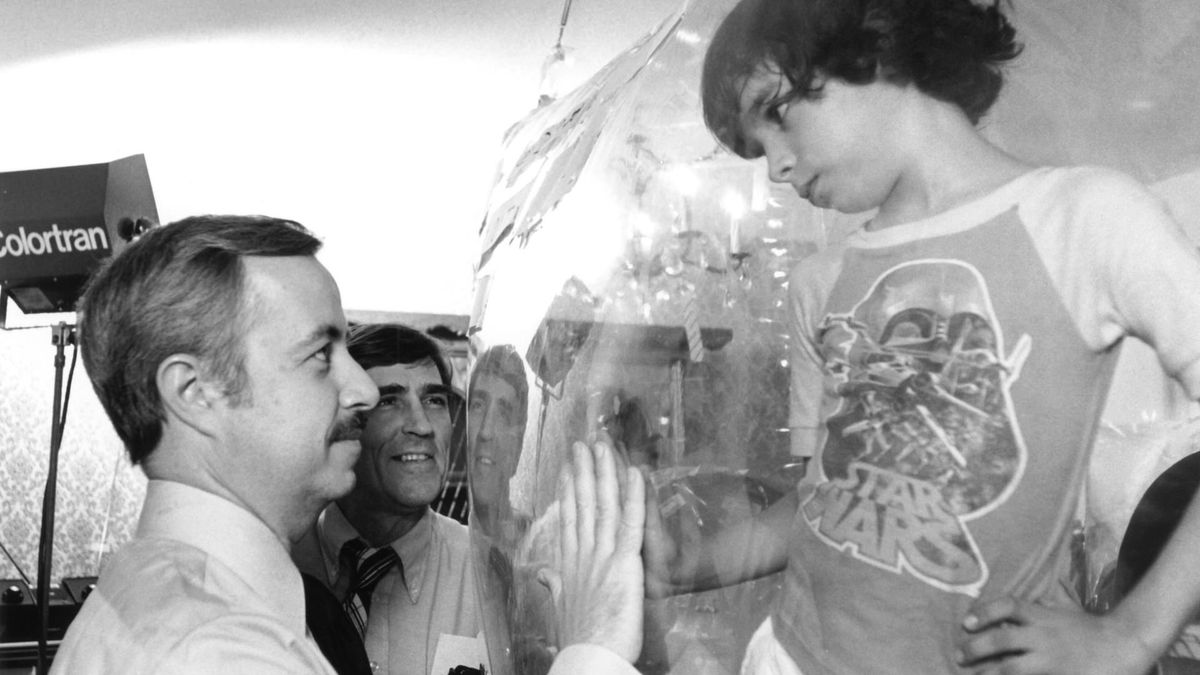
CAROL ANN DEMARET (DAVID VETTER’S MOTHER): David was born September 21, 1971. I heard the first sounds of life, and he was placed in an isolator, in a bubble that was a few feet from me. We thought that the immune system was just slow to develop. There was never any plan to keep David in there – in the bubble – indefinitely.
NARRATION: The sterile bubble was the brainchild of doctors who feared the worst: severe combined immuneodeficiency, a rare genetic defect that had taken the life of David’s brother the year before. But it fell short of a cure.
CAROL ANN DEMARET: It was a gradual realization that his immune system was not going to spontaneously function. So I trusted science would find an answer for us next year, then the next year.
ARCHIVAL (NBC, 2-25-75):
NEWS REPORT: This 3-year-old boy you see in that picture has spent his entire life in a plastic bubble.
ARCHIVAL (CBS, 6-25-73):
NEWS REPORT: To expose him to the air would be to kill him.
ARCHIVAL (NBC, 2-25-75):
NEWS REPORT: His food, clothes and toys have to be sterilized and placed inside the bubble with sterile rubber gloves.
NARRATION: As the years passed with no solution…
ARCHIVAL (CBS, 11-3-77):
NEWS REPORT: Since his birth six years ago, David has lived in a plastic world.
NARRATION: America tuned in to watch the milestones of his curious life unfold.
ARCHIVAL (CBS, 11-3-77):
NEWS ANCHOR: The scientists who sent men to the moon have achieved another first. They have found a way to open up the world of a small Houston boy who has spent his life inside a sterile bubble.
ARCHIVAL (ABC, 11-3-77):
REPORTER: That he was excited by his newfound freedom is obvious from the NASA film. David wanted to do everything.
WOMAN: I think the best portrayal of his reaction is when he held up his hands, the fascination of seeing his hands in the small gloves for the first time.
REPORTER: Now it is possible for him to play catch with his sister and dream of even more.
NARRATION: The nightly news was just the start. Soon, his story took on a life of its own.
ARCHIVAL (BOY IN THE BUBBLE TRAILER, 1976):
ANNOUNCER: John Travolta is the boy in the plastic bubble.
CAROL ANN DEMARET: David was unique, and people pay attention things that are unique. When he was about 9 years old he looked at me and he said, well, I’m a star, I don’t have to clean my bubble. And I thought he meant like a star in heaven, and I said oh yes you are because you light up my life. And he said, well, not that kinda star. I’m famous.
NARRATION: But David’s predicament brought him more than fame.
CAROL ANN DEMARET: Certain things would filter back about the ethics involved in keeping a boy in this germ-free environment.
ARCHIVAL (CBS, 6-25-73):
REPORTER: What about the day he says I want out of here, and you can’t let him out?
ARCHIVAL (UNIVERSITY OF VIRGINIA, MEDICINE AND SOCIETY CONFERENCE,1975):
MAN: I’m not sure that the quality of life which has been created for David is, is going to very long be a very desirable one for him.
CAROL ANN DEMARET: To keep a child isolated, unable to touch, or feel or smell or enjoy sounds cruel, perhaps. What did they expect us to do, take David out of the bubble, which would have been certain death?
ARCHIVAL (BAYLOR COLLEGE OF MEDICINE):
TEACHER (SPEAKING TO DAVID): Tell me the letters.
DAVID VETTER: I, P, O, P. I try to do my best in school.
TEACHER: I know you do.
WILLIAM T. SHEARER, 1937-2018 (DAVID VETTER’S IMMUNOLOGIST): We all knew that a day would come when a decision would have to be made, either in or out. Everybody knew that this isolator system just couldn’t continue forever.
NARRATION: David had grown into an adolescent without a clear road forward. But medical advances were cause for hope.
CAROL ANN DEMARET: They were having success with bone marrow transplant from an unmatched donor. Everything seemed to come into play. He would be free or we would go back to square one.
ARCHIVAL (ABC, 10-21-83):
DR. RALPH FEIGIN: At 3 a.m. David did receive a bone marrow transplant administered by Dr. Shearer.
ARCHIVAL (NBC, 10-21-83):
NEWS ANCHOR: The new bone marrow, which comes from his sister, could spur his body into developing an immune system.
WILLIAM T. SHEARER: Everything was just fine. His blood pressure stayed good.
CAROL ANN DEMARET: There was nothing different, except New Year’s Eve, there was an elevation in temperature, and the next day it elevated again.
ARCHIVAL (ABC, 2-8-84):
NEWS ANCHOR: Today David has been removed from his bubble for the first time in his life, but the reason for his freedom is not good news.
ARCHIVAL (NBC, 2-21-84):
NEWS ANCHOR: David, the 12-year-old boy who lived in a plastic bubble until two weeks ago, is listed in critical condition tonight.
CAROL ANN DEMARET: Unforeseen things happened, and that’s what we live with.
ARCHIVAL (CBS, 2-23-84):
DR. WILLIAM T. SHEARER: David was always joking. He said something to the effect that, here we have all of these tubes and all of these tests, and nothing’s working, and I’m getting tired. He said, why don’t we just pull all of these tubes out and let me go home?
ARCHIVAL (ABC, 2-23-84):
NEWS ANCHOR: Twelve years ago in this country, a very unusual baby was born. He died last night, two weeks after emerging into a world his body could not tolerate.
NARRATION: Carol Ann vowed that David’s life would not be in vain.
R. MICHAEL BLAESE (IMMUNE DEFICIENCY FOUNDATION): David’s story was repeated before the Congress as a way of putting a face and a name to the problem and helping people understand why it’s important to fund research.
NARRATION: Dr. Michael Blaese, a gene therapy pioneer, has been studying immune deficiency diseases for more than five decades. He says that in the years that followed David’s death, progress in bone marrow transplantation alone offered most children a virtual cure.
R. MICHAEL BLAESE: We know that if transplantation is done sometime in the first three months that the chances of cure is in the range of 95 percent.
NARRATION: But quick diagnosis was key.
ARCHIVAL (HEATHER SMITH HOME MOVIES):
There’s Brandon. Brandon Michael. He’s one hour old. He’s exactly one hour old.
HEATHER SMITH: Brandon looked like a healthy, normal baby at birth.
ARCHIVAL (HEATHER SMITH HOME MOVIES, 1993):
Brandon’s got his pacifier and he’s trying to put it back in his mouth. He was eight weeks old yesterday and he’s almost three months old. Oh, bless you. He’s just sneezing.
ARCHIVAL (HEATHER SMITH HOME MOVIES, 1993):
Hi, baby!
HEATHER SMITH (BRANDON DAHLEY’SMOTHER): Until he became about six months of age and came down with what we thought was his first cold.
ARCHIVAL (HEATHER SMITH HOME MOVIES, 1993):
Yesterday Heather had to take Brandon in to the doctor because he didn’t feel good.
HEATHER SMITH: We had no family history of any kind of serious conditions, so really, we were hoping that whatever it was that Brandon had, he was going to be able to fight and get over. Unfortunately instead of getting better, he got progressively worse.
NARRATION: Within days, she was rushing Brandon to the hospital.
HEATHER SMITH: His fingernails were blue. His lips were blue. It was quite obvious that he was struggling to breathe.
NARRATION: But, for three weeks, doctors couldn’t figure out what was wrong with the child.
HEATHER SMITH: It was after the skin biopsy came back that they first told us they thought he had SCID. They explained to me a little bit more – we don’t put babies in bubbles any more, but what we do for them to treat this is a bone marrow transplant. However, they said at that point that Brandon was just way too sick, we’ve done everything that we can for him, and unfortunately we’re going to have to turn the machines off. All the family came in and took their turns saying goodbye.
R. MICHAEL BLAESE: If you can identify the patient and get them treated you essentially cure them, almost all of them. But once they have that infection, that first infection, success rate drops substantially. It’s a problem of rare disease. Patients get missed.
NARRATION: Most pediatricians still couldn’t recognize the signs of SCID. Awareness of the disease had receded along with David Vetter’s story, replaced in the public’s mind by an image that had only the vaguest connection to the boy who had once captivated the nation.
ARCHIVAL (CLIP FROM SEINFELD):
ACTOR 1: What are you looking at? Never seen a kid in a bubble before?
ACTOR 2: Course I have, come on. My cousin’s in a bubble.
ARCHIVAL (THE SIMPSONS):
You will be living in this bubble. It’s clear plastic so the world can see how normal you are. Ha ha ha.
NARRATION: Such portrayals were painful to the parents of immune-deficient children. But they had one unexpected upside: publicity.
HEATHER SMITH: That was very hurtful. But our driving focus is newborn screening to let the world know that this is a condition that’s still taking our babies’ lives every day.
NARRATION: The death of Heather Smith’s first child had taught had her that early detection was essential. Forewarned, her second baby was given a landmark bone marrow transplant while still in the womb.
Taylor is now 24 years old and has just graduated from college.
HEATHER SMITH: And to look at him, you’d have no idea that he has a condition called severe combined immune deficiency.
NARRATION: Today, gene therapy is at the forefront of treating the disease.
ARCHIVAL (NBC):
NEWS REPORT: Doctors take out the patient’s bone marrow and replace their defective gene with a healthy copy, then re-infuse the cells back into the patient.
NARRATION: In 2008, advocates like Heather Smith helped push Wisconsin to begin screening all newborns for severe combined immune deficiency. In fits and starts, other states followed suit, leading to the realization that this genetic defect was more common than generally thought.
HEATHER SMITH: David’s story is still helping people today, 30 years later.
NARRATION: And not just as a symbol. Important medical advances resulted from studying the young boy. From the discovery of the damaged gene that causes the most common form of SCID to another revelation.
ARCHIVAL (CBS, 5-1-85):
NEWS ANCHOR: The little Houston boy provided a vital missing link between a common viral infection and the development of cancer.
NARRATION: The final tragedy of David’s life was that the transplant had initially worked. But unbeknownst to doctors, the donor’s bone marrow contained remnants of an old virus which, when transferred into David’s immune-compromised body, triggered an aggressive cancer.
It was the first time this connection had been observed.
WILLIAM T. SHEARER: What he gave us was a powerful lesson in many areas of medicine and just in life itself. David was a very courageous boy.
CAROL ANN DEMARET: I always thought at some point when David left the bubble that he would be a researcher himself and would help mankind that way.
ARCHIVAL (VETTER FAMILY ARCHIVE):
DAVID VETTER: Hi, mom.
CAROL ANN DEMARET: It turned out that he is helping mankind, but in a different way.
(END)
The Surprising Legacy of the Boy in the Bubble
Newborns today are tested for genetic and immune disorders that might not be apparent at birth. The tests evolved from the treatment of a patient with a rare diagnosis who became known as “the Boy in the Bubble.”
The press said that David Vetter was born into a world he could not touch. And there was no truer statement in 1971 when, as an infant, he was placed inside the protective plastic bubble that had been specially built to seal it off. The outside world was toxic to the child, who suffered from a rare genetic defect so nefarious that it could turn even the slightest cold into a death sentence. But, despite this separation, the little boy’s fishbowl life turned him into a symbol of hope and determination for the generation of Americans who watched his story evolve.
View full episodes at PBS.org/RetroReport.
- Producer: Kit R. Roane
- Associate Producer: Victor Couto
- Editor: Jeff Bernier
 Grades
7-12
Grades
7-12


 1 Lesson Plan
