
Transcript
ARCHIVAL (FOX NEWS, 9-11-23):
MAN: It’s absurd and immoral for teachers to call boys girls and girls boys.
ARCHIVAL (FOX NEWS, 6-23-21):
CHANTING: Do your job! Do your job!
STEVE INSKEEP (NPR HOST AND AUTHOR, “IMPERFECT UNION”): A culture war is a battle over how we live.
ARCHIVAL (NBC NEWS, 7-28-23):
CHANTING: Protect trans kids! Protect trans kids!
STEVE INSKEEP: When we talk about the red and blue divide in the United States, very often we’re talking about cultural differences. . .
ARCHIVAL (FOX NEWS, 6-23-21):
NEWS ANCHOR: Wokeness teaching in schools and in corporate training.
STEVE INSKEEP:. . . as opposed to war and peace abroad or the economy. But the idea of fighting over symbols – a fear that the other side is trying to fundamentally change the country – goes way, way back.
TITLE:
POLITICKING: A 19TH CENTURY CAMPAIGN SERIES
“CULTURE WAR””
STEVE INSKEEP: John Charles Frémont: We run into his name today all over the place without perhaps realizing who he was. Tesla cars, manufactured in Fremont, California. In Wyoming, mountain climbers climb up Fremont Peak. There is a Fremont, New York, Fremont, Nebraska. The names are everywhere. And they are signs of a time when John Charles Frémont was possibly the most famous living American.
LAUREN HAUMESSER (AUTHOR, “THE DEMOCRATIC COLLAPSE”): As the country expanded westward by annexing land, John Frémont’s life moved westward along with it. He led a number of expeditions out West.
STEVE INSKEEP: He wrote these official U.S. Army reports, but he wrote them almost like novels. That put him at the center of this larger American narrative, and his reports became the equivalent of bestselling books, read all across the United States.
LAUREN HAUMESSER: Those new Western territories created real issues in the American political system. It raised this question of whether that land should have slavery or shouldn’t have slavery. The Whig Party ultimately collapsed over the slavery issue, and the Democratic Party had conflict within it. This opened a lane for the creation of the Republican Party, which was anti-slavery. And when it ran its first candidate, John Frémont, in 1856, it unleashed a culture war.
STEVE INSKEEP: One of John’s symbols was his wife. Jessie Frémont was the daughter of a very powerful United States senator. She was a very attractive political figure, and it was suggested by Republicans at first that this was a brilliant innovation and really great. People on the other side immediately turned that into a disadvantage.
LAUREN HAUMESSER: They said she was the one who was really wearing the pants in the relationship, and represented this radical women’s rights agenda.
STEVE INSKEEP: The argued Jessie Frémont is trying to upend the entire order of society.
LAUREN HAUMESSER: Slavery was the issue in American politics, but gender and race are intertwined. If Southerners are arguing a man is at the head of a household and has control over his wife, his children and his slaves, if somebody questions the gender issue then that also leads them to question the slavery issue. They implied because his wife was so independent, Frémont was emasculated by that: He couldn’t control his wife and he couldn’t control the country. Also, he parted his hair in the middle. At the time only women parted their hair in the middle. It made him too womanly.
STEVE INSKEEP: The increase in the number of daily newspapers, fed by a nationwide telegraph network and spread by railroad trains, meant that people were getting a lot more political commentary in their face all the time, whipping up fear, demonizing the other side. Immigration was part of that. Frémont was the son of a French immigrant. France was a Catholic country, and so Frémont’s political opponents began spreading the false story that he himself was a member of this alien religion controlled by the pope, it was said, who were plotting to take over America.
LAUREN HAUMESSER: The Republicans were not refraining from participating in this culture war. Compared to John Frémont, who was young and had this beautiful wife, Democratic candidate James Buchanan was a bachelor. There were questions about why a 60-something-year-old man in the 1850s had never once married. There’s some speculation about whether James Buchanan was, in fact, gay. He argued he was married to the Constitution and voters could trust him because he wouldn’t be distracted by a woman like John Frémont.
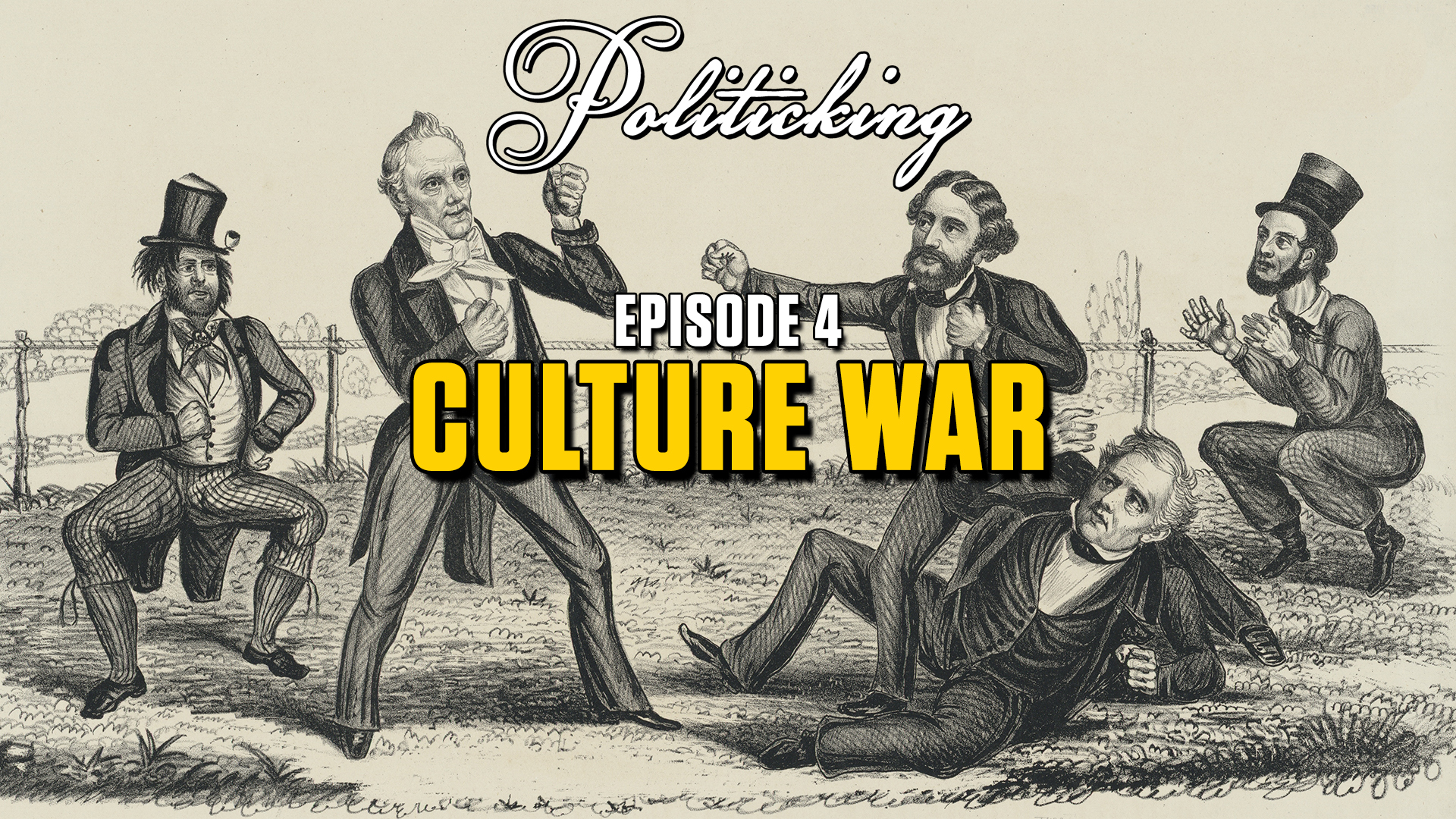
STEVE INSKEEP: There’s a cartoon that represents the whole Democratic case that Frémont was going to profoundly change society.
LAUREN HAUMESSER: There is a Catholic priest, a really offensively portrayed free Black man, a socialist demanding all land be distributed equally, a women’s rights activist smoking a cigar — which was a very unfeminine thing to do — and a free-love activist portrayed as being really skinny, which at the time was unattractive, and she’s inviting Frémont to join their group.
STEVE INSKEEP: In order to elect an anti-slavery president, Republicans had to win virtually all the Northern states. They did not. It’s hard in retrospect, without exit polls or anything else, to prove exactly what turned a particular election. But we know that Democrats raised immense fear about cultural change, and they prevailed.
LAUREN HAUMESSER: 1856, for Democrats, was a bit of a hollow victory for two reasons. One was that they elected James Buchanan, who is now roundly considered the worst president in American history, and it opened up a broader culture war that contributed to the Civil War.
STEVE INSKEEP: The Civil War and its aftermath ended slavery. It did not end, at all, many of the cultural battles that flashed up in that time.
LAUREN HAUMESSER: In the 1850s, the Republicans were thought of as more progressive. Now today, obviously, that’s flipped. Culture wars remain an incredibly powerful force in American politics. They draw people in and they force people to choose sides.
(END)
The Culture Question: How Hot-Button Issues Divide Us
Culture wars have a long and divisive history in American politics, with gender, race and religion continuing to inflame public opinion.
To trace the roots of America’s culture wars, we look back at the 1856 election, where issues of slavery, gender, and religion fueled political conflict. John Frémont, famed for his role in the westward expansion of the United States, was the first presidential candidate nominated by the newly-formed Republican Party. As the campaign unfolded, he and his wife became lightning rods for cultural debate. Explore how the aftershocks from that period continue to shape modern American politics.
- Producer / Editor: Matthew Spolar
- Additional Editing: Brian Kamerzel
 Grades
8-12
Grades
8-12

 1 Lesson Plan
