
Transcript
ARCHIVAL (NBC NEWS, 5-10-90):
NEWS REPORT: The pill went on the market for the first time, and soon there was a sexual revolution around the world.
ARCHIVAL (CBS NEWS, 5-9-75):
NEWS REPORT: The pill has become far and away the most widely used means of contraception.
CLAUDIA GOLDIN (ECONOMIC HISTORIAN, HARVARD UNIVERSITY): It was an incredibly disruptive technology. It separated sex from reproduction in a simple-to-use and very effective way.
ARCHIVAL:
Start taking your pills on day five.
NARRATION: The pill was approved in 1960, and its impact on American women’s lives is still being felt more than six decades later.
DOROTHY FINGER: This picture is in front of a dorm at Cornell. It’s of me and my husband, who came to see me in the fall of my junior year.
NARRATION: When Dorothy Finger was in college in the early 1960s, birth control, which often didn’t work, was illegal for unmarried people in most states.
DOROTHY FINGER: You weren’t supposed to have sex. You weren’t supposed to be doing anything.
ELAINE TYLER MAY (HISTORIAN, UNIVERSITY OF MINNESOTA): The shame of an unwanted pregnancy was very severe …
ARCHIVAL (MCGRAW HILL FILM, 1958):
MARY: Jeff, isn’t that Eileen?
ELAINE TYLER MAY: …and would ruin a young woman’s reputation.
ARCHIVAL (MCGRAW HILL FILM, 1958):
JEFF: It sure is, baby and all.
MARY: Gee, I haven’t seen her since she left school.
ELAINE TYLER MAY: The stigma against sex out of marriage was very, very intense, and so, you got married.
CLAUDIA GOLDIN: The expectation was that you would get married, and so women and men in that era were getting married at pretty young ages.
DOROTHY FINGER: I was 21. I went to summer school after my junior year so that we could get married in February of 1965, and I was able to graduate. Did I have a fully formed identity? I don’t think I did. I think I was still sort of floundering with what I wanted to be, who I could be, because I was so young.
NARRATION: Dorothy was not alone. At the time, over 90 percent of American women got married at a median age of 20 years old. Women made up only 38 percent of the workforce, and most of those who worked had female-dominated jobs, like sales clerks and secretaries.
ARCHIVAL (UNITED STATES ARMY, 1950):
NARRATOR: With no major responsibilities, girls like Joan use their jobs as lucrative intervals between school and marriage. Their incomes are seldom high, but then neither are their job ambitions.
KAREN BENJAMIN GUZZO (DEMOGRAPHER, UNIVERSITY OF NORTH CAROLINA): We didn’t have widespread availability of contraception, so it was pretty common to start having kids right after having gotten married. That was the expectation. You had kids, and that was your job as a woman in many cases.
NARRATION: The average woman had three or four children.
CLAUDIA GOLDIN: You then put off the investments that you might have wanted to make in yourself. It’s going to affect your eventual job and career, it’s going to affect how you view your future.
NARRATION: But a birth control revolution was starting. In 1960, the pill was approved. It was nearly 100 percent effective, and largely restricted to married women. By 1965, one-third of them were on the pill.
ARCHIVAL (CBS NEWS, 5-9-75):
NEWS REPORT: Dorothy Finger has been taking the pill for eight years. She and her attorney husband Ken, carefully plan the arrival of their three children.
DOROTHY FINGER: It’s at your option, and you make the choice, and it’s not just waking up one morning and finding out that you’re going to have a baby that you weren’t counting on.
DOROTHY FINGER: It was freedom. It made possible planning my life and how I could control when I had kids. I only wanted three. That was it, because three was enough, and I wanted to have some kind of career.
KAREN BENJAMIN GUZZO: The introduction of the pill revolutionized how we think about having children. It was not just something that happened to you, but that something you should be planning for.
ARCHIVAL (ABC NEWS, 9-3-68):
NEWS REPORT: Pope Paul’s recent encyclical on birth control is continuing to cause controversy.
NARRATION: There was opposition to the pill, most notably from the Catholic Church and from women concerned its high level of hormones would cause health problems.
ARCHIVAL:
WOMAN ANSWERING THE PHONE: Hi, may I help you? O.K., this is for birth control?
NARRATION: Nevertheless, it didn’t take long for the pill’s impact to be felt.
ARCHIVAL (NBC NEWS, 3-25-73):
NEWS REPORT: Last year, the United States had the lowest birth rate in its history, about two babies per family.
ARCHIVAL (NBC NEWS, 8-26-70):
WOMEN MARCHING: Power, power to the women, the women power . . .
ELAINE TYLER MAY: The pill emerged at a time when the feminist movement was gaining momentum and women were insisting on new opportunities that had not been available before. So it was really revolutionary, in terms of women’s lives.
NARRATION: With her family set, Dorothy went to law school.
DOROTHY FINGER: It was always in the back of my mind. When they opened the Pace Law School and the first class was starting, I was in my 30s, and they took in a whole group of women like me, some older, and we had our own little study group.
NARRATION: If the pill changed the horizons of married women, its impact was even bigger after 1972 when the Supreme Court removed restrictions on birth control for unmarried women.
ARCHIVAL: (“ROWAN AND MARTIN’S LAUGH-IN,” NBC):
PRIEST: One thing you can say about the pill: If you don’t take it, before long you may be counting your blessings.
NARRATION: The pill was suddenly everywhere, from country songs . . .
ARCHIVAL:
LORETTA LYNN (SINGING SONG “THE PILL”): I’m making up for all those years, since I’ve got the pill.
NARRATION:. . . to TV’s top-rated Mary Tyler Moore Show.
ARCHIVAL (“THE MARY TYLER MOORE SHOW,” CBS):
WOMAN: Don’t forget to take your pill.
MARY TYLER MOORE: I won’t.
CLAUDIA GOLDIN: One of the first things that the pill does is it enables women and men to put off marriage. That breathing space is incredibly important.
NARRATION: Economic historian Claudia Goldin won a Nobel Prize for her studies of women and work. She found that soon after they could access the pill, college-educated women delayed marriage by nearly three years.
ARCHIVAL (GOVERNMENT PUBLIC SERVICE ANNOUNCEMENT)
NARRATOR: Want time to become yourself before you become a parent?
CLAUDIA GOLDIN: Young women then could say, I’m going to invest in my education now.
ARCHIVAL (GOVERNMENT PUBLIC SERVICE ANNOUNCEMENT):
NARRATOR: An effective birth control method can give you that time.
CLAUDIA GOLDIN: It changed their occupations. It changed their view of who they were, what their futures were going to be.
PAMELA WEBER (PHYSICIAN): Mom, did you know you wanted three kids? Three kids seem like a lot for a working parent.
DOROTHY FINGER: Yeah, it was a lot, but more than that would have been out of the question.
NARRATION: For Dorothy Finger’s daughter, Pamela Weber, and her generation, family planning was routine.
ARCHIVAL (CBS NEWS, 5-9-75):
NEWS REPORT: Dorothy Finger has been taking the pill for eight years.
PAMELA WEBER: When I saw it the first time, I just thought it was funny that it was newsworthy, talking about my mother working and planning children.
(SHOWING A PHOTO ALBUM) These are pictures of me at Union College. I was there from ’89 to ’93. This is me with my parents.
NARRATION: Pam went to college set on becoming a doctor.
PAMELA WEBER: I didn’t think at all at that time about marriage and future family. My primary focus was on my career and getting into medical school.
(POINTING AT A PHOTO OF HER DAUGHTERS) She’s a psychologist. She’s in commercial real estate.
Almost all of my friends were on the pill, and certainly nobody worried that they couldn’t go to a graduate program or get a job because they might have a kid. That would be almost laughable if we were talking about it. It just didn’t come up in conversation.
NARRATION: They were part of an enormous shift, as American women poured into professions previously dominated by men.
CLAUDIA GOLDIN: If we think about the enrollment that was female, for medical, it was about 10 percent in about 1968 or so. Just 20 years later, it’s 40 percent. If we think about law, it begins at 5 percent; 20 years later, it’s 40 percent.
PAMELA WEBER: We got married my first year of residency, November 15th, 1997.
NARRATION: The nature of marriage, and women’s economic dependence on it, also changed.
PAMELA WEBER: My husband was like – go work, make money, contribute, be my equal. A woman coming into a relationship who has a job and is confident and strong and independent is, you know, someone’s either going to like or not like.
NARRATION: Pam and her husband eventually did have a family.
(SHOWING A PHOTO ALBUM) This is our first family trip to Disney. So we went, Noah was 2 and Sydney was 5. I was 29 when I had my first child and 32 when I had my second. It just gave me time to put the hardest part of my training behind me.
NARRATION: Today, women outnumber men in graduate and professional schools, including law, medicine and dentistry. At the same time, fewer than 40 percent of Americans of childbearing age are married.
KAREN BENJAMIN GUZZO: What’s changed over time is that women are able to support themselves. If you go back 50, 60 years ago, you know, women really did need to get married.
NARRATION: They’re also not having as many children. In the late 1950s the average woman had 3.7 children. Today, the fertility rate is at an all time low, with the average woman having fewer than 1.6 children. That’s below what’s needed to replace the population, leading to fears of an aging society.
KAREN BENJAMIN GUZZO: People look at childbearing as something they want to fit into their life – I want to find a job I care about or at least feel really stable, and then I’ll think about having children.
NARRATION: In fact, the only group increasing their childbearing is women over 40. While part of the reason is economic, it’s also a result of a long trend that began with the pill…something many take for granted today.
DOROTHY FINGER: It gives women control, when they’re going to have babies and with whom they’re going to have babies. They’re not getting married so young, and I don’t think that’s a bad thing. I think it’s better to know yourself a little better and not be doing things just because. So it’s a different, different world.
(END)
The Birth Control Pill, Approved in 1960, Helped to Reshape Modern America
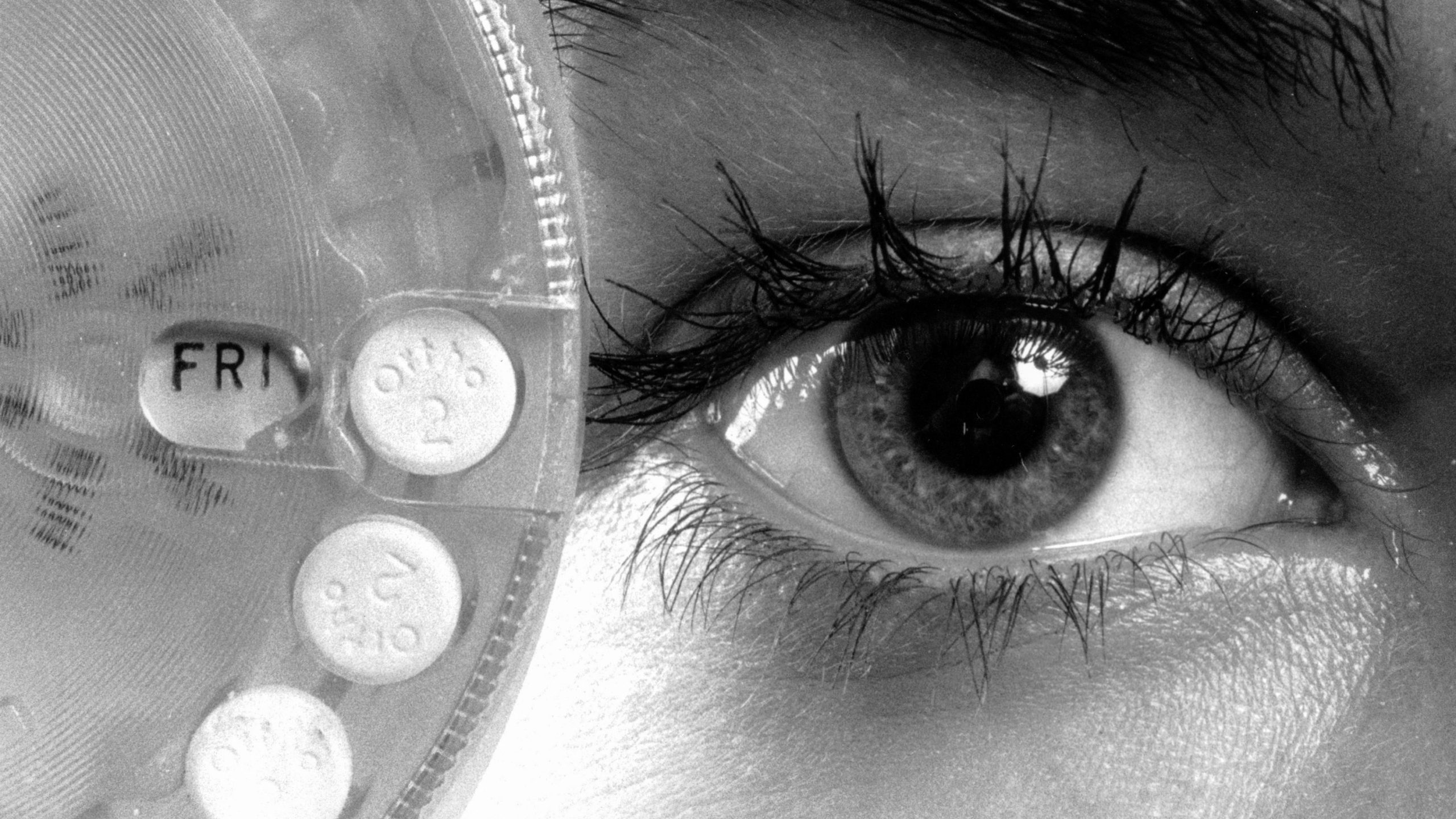
The introduction of the birth control pill in 1960 had a profound political, economic and social impact on modern America.
The contraceptive pill, approved in 1960, had a profound political, economic and social impact on modern America. The pill gave many women something earlier generations lacked: the ability to plan when to have children. Before it became available, many women married young and had children soon after, often with limited control over timing.
As access expanded, so did options. In 1965, the Supreme Court’s decision in Griswold v. Connecticut established a constitutional right to privacy for married couples seeking contraception, a protection later extended to unmarried people. More women delayed marriage, stayed in school longer and entered professional careers.
Today, the effects are still playing out. American women now marry and give birth at later ages, families tend to be smaller, and women have become a dominant presence in graduate schools and professions. The pill brought changes that continue to shape how Americans think about work, relationships and family.
- Producer: Jill Rosenbaum
- Editor: Brian Kamerzel
 Grades
9-12
Grades
9-12


 2 Lesson Plans

