
Transcript
TEXT ON SCREEN:
December 20, 1989
ARCHIVAL (CBS NEWS, 12-20-89):
NEWS REPORT: By dawn’s early light in Panama, U.S. soldiers supported by tanks and aircraft are on the attack.
NARRATION: It was the largest American military operation since the Vietnam War. Around 25,000 troops invaded Panama to hunt down its leader, General Manuel Noriega, who was once an important U.S. ally.
ORLANDO PÉREZ (PROFESSOR OF POLITICAL SCIENCE, UNIVERSITY OF NORTH TEXAS AT DALLAS): Noriega never believed that the United States would ever come to get him. He felt invulnerable.
ARCHIVAL (CBS NEWS, 1-4-90):
NEWS REPORT: Under cover of darkness, U.S. helicopters take General Manuel Noriega from the Vatican Embassy in Panama.
ARCHIVAL (NBC NEWS, 1-5-90):
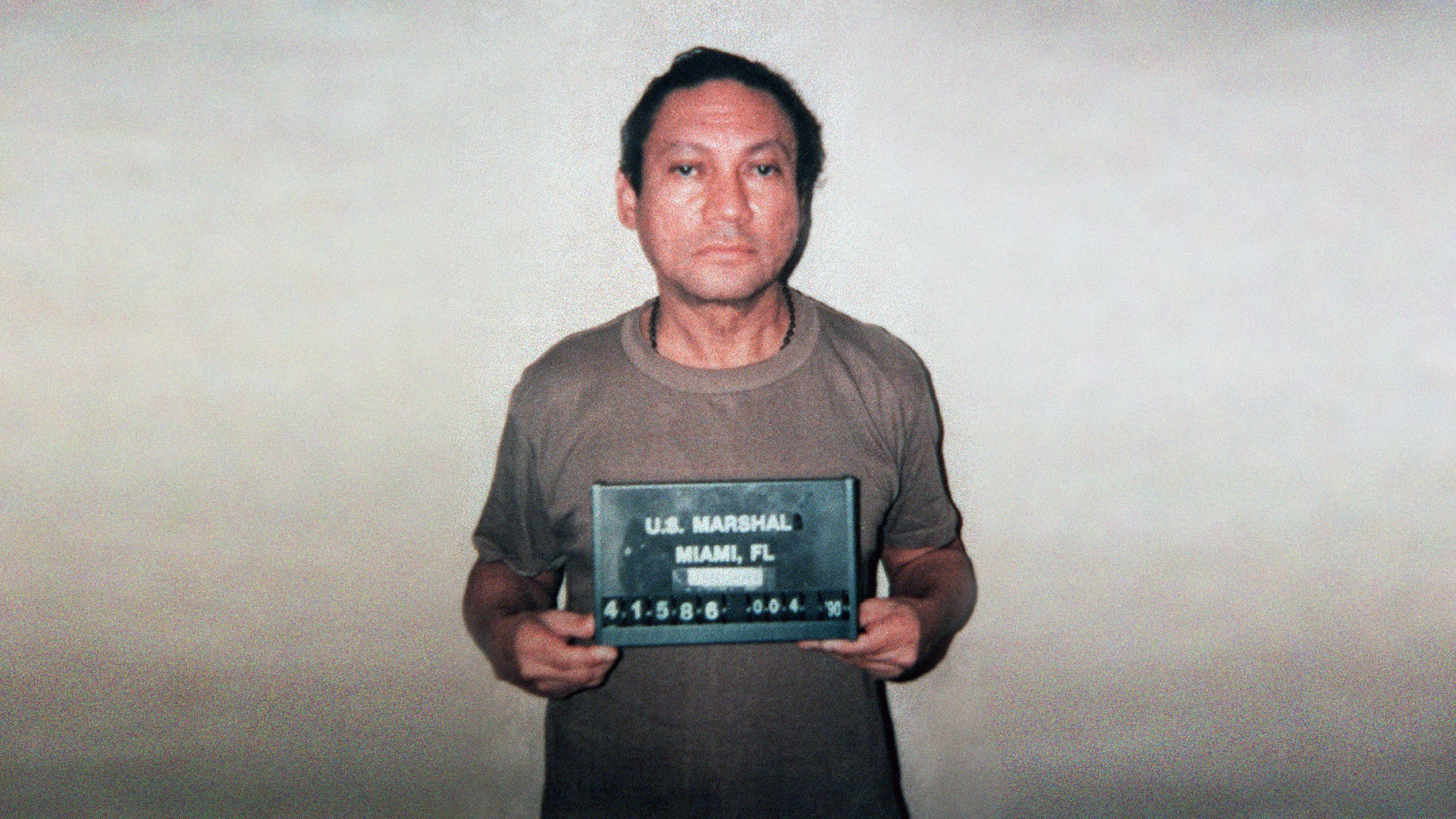
NEWS REPORT: He’s gone from maximum leader of Panama to U.S. federal prisoner number 41586.
NARRATION: It’s a story that’s become relevant again today because of the Trump administration’s policies in Latin America.
ARCHIVAL (ABC NEWS, 1-4-26):
NEWS REPORT: Ousted Venezuelan President Nicolás Maduro and his wife arrived in New York, facing federal narco-terrorism charges.
NARRATION: In the early 1980s, billions of dollars of cocaine was being smuggled into the U.S. each year, mostly by Colombian drug cartels, fueling an out-of-control drug epidemic.
ARCHIVAL (CBS NEWS, 4-25-88):
NEWS REPORT: Police, freeze! Violence in the streets, chaos on the borders and money pouring out of this country into the coffers of the drug lords.
NARRATION: Stopping the flow of drugs was a top priority of the Reagan administration, and one of its allies was Manuel Noriega, the de facto leader of Panama, who gave the U.S. intelligence on the cartels. . .
ARCHIVAL (ASSOCIATED PRESS, 5-6-88):
DRUG ENFORCEMENT AGENCY AGENT: Target now 1-1-0.
NARRATION: . . . and helped intercept shipments of cocaine.
ARCHIVAL (ASSOCIATED PRESS, 5-6-88):
DRUG ENFORCEMENT AGENCY AGENT: Down about 2,000 feet below us.
ORLANDO PÉREZ: Because of its geographical position, Panama was a transit zone for weapons or drugs, and Noriega worked with the D.E.A. to help the U.S. fight them.
NARRATION: But at the same time, Panama’s secretive banking laws made it an easy place for drug traffickers to launder money. One of them was Steven Kalish.
STEVEN KALISH (AUTHOR, “THE LAST GENTLEMAN SMUGGLER”): I flew down to Panama with approximately $3 million and I met two individuals and they offered me a package of banking services and money laundering services. They said I had to meet their partner to get his approval. And so I asked who it was, and they said it was General Manuel Noriega.
NARRATION: Kalish quickly saw that Noriega was leading a double life. Despite his modest salary, he lived a lavish lifestyle.
STEVEN KALISH: He loved to talk about women. In fact, I think the three things we talked about most were women, money and buying things. Jets, helicopters, planes. I personally paid him $300,000 as a gift, and then I explained that I specifically wanted to find a place I could feel safe away from the prying eyes of the U.S. government. So I said I had about $100 million I wanted to launder through Panama, and I wanted to live here.
NARRATION: Noriega wasn’t just laundering money, as federal prosecutor Richard Gregorie discovered after investigators got a tip about a planeload of cocaine on its way to Florida.
RICHARD GREGORIE (FORMER CHIEF ASSISTANT U.S. ATTORNEY, SOUTHERN DISTRICT OF FLORIDA): The pilot crash landed it on I-75, which is a major highway. The man ran out, left the plane there with the 400 kilos of dope and hid himself in the underbrush of the Florida Everglades.
NARRATION: The pilot said he worked with Noriega. Evidence began to mount that Noriega was secretly protecting the Colombian cartels and helping them ship drugs to the U.S.
RICHARD GREGORIE: He was getting his cohorts to cover up a lot of the activity that was going on, and there is absolutely no question that he was playing both sides.
NARRATION: It was nearly unprecedented to file criminal charges against the leader of a foreign country. Gregorie met with D.E.A. officials to discuss the case but says he was surprised by how a senior intelligence official reacted.
RICHARD GREGORIE: He called me aside and said to me, what the heck are you doing? Noriega is a major help to us. What are you doing this for? I began to-to realize that I was fighting two-two battles here. One was the dope dealers and making sure that my evidence was sufficient, and the second was the intelligence community.
NARRATION: It would eventually emerge that some in the intelligence community already knew about the drug trafficking allegations, but Noriega had been working with the C.I.A. for decades and secretly helped the U.S. fight the communist Sandinistas in Nicaragua.
ORLANDO PÉREZ: The C.I.A. saw Noriega as an asset in its hemispheric counterinsurgency efforts.
NARRATION: The former head of the D.E.A. said the agency never tried to stop Gregorie from pursuing his case. And before long the news media started to expose Noriega.
ARCHIVAL (CBS NEWS, 6-12-86):
NEWS REPORT: Relations with Panama are under a new cloud tonight. U.S. government and intelligence sources reportedly linked General Manuel Antonio Noriega to drug trafficking, gun running and money laundering.
ORLANDO PÉREZ: He was an operative that the C.I.A. paid to provide information at the same time that he was also providing information to the Cubans, to the Nicaragua Sandinistas and to the cartels. So he was in many ways a double agent, if you will, basically double crossing the U.S.
NARRATION: Congress held hearings on drug trafficking in Central America. One of their witnesses was Steven Kalish, who had been arrested and decided to cooperate with investigators.
STEVEN KALISH: I end up having to testify on national television about my association with General Manuel Noriega.
ARCHIVAL (CBS NEWS, 1-28-88):
NEWS REPORT: Thirty-five year-old Steven Kalish told a Senate committee how he greased the wheels during his first meeting with the general.
STEVEN KALISH: I placed $300,000 cash in my briefcase. As the meeting broke up, I left the briefcase in his office and began to exit the room.
NARRATION: Noriega was also implicated in the murder of a political opponent, and his connections to the Reagan administration, including Vice President and former C.I.A. director George H.W. Bush, were becoming a political liability.
ORLANDO PÉREZ: There’s a famous photograph that surfaced that showed Noriega meeting with George H.W. Bush. The situation just became untenable for the United States.
NARRATION: In 1988, Gregorie filed charges against Noriega for drug trafficking and money laundering.
RICHARD GREGORIE: This was a major political issue and there was one point where our federal government had made an agreement to send Noriega to Spain and turn Panama back over to more legitimate leadership. That’s an offer that was made without even consulting us, and Noriega turned it down. He didn’t take the offer.
ARCHIVAL (REUTERS, 2-12-88):
GENERAL MANUEL NORIEGA (TRANSLATED FROM SPANISH): I now tell the Americans to stop threatening me, because death doesn’t scare me.
NARRATION: Noriega annulled a national election, and his government declared that the U.S. and Panama were at war. Then, in December 1989, an off-duty U.S. Marine was killed after a confrontation with Panamanian soldiers at a military checkpoint. For the new U.S. president, George H.W. Bush, it was the last straw.
ARCHIVAL (CBS NEWS, 12-20-89):
PRESIDENT H.W. BUSH: Last night I ordered U.S. military forces to Panama. The goals of the United States have been to safeguard the lives of Americans, to defend democracy in Panama, to combat drug trafficking, and to protect the integrity of the Panama Canal Treaty.
NARRATION: The bulk of the fighting lasted just a few days, and U.S. forces easily overwhelmed Panamanian defenses. Twenty-three Americans and around 500 Panamanians were killed, according to the U.S. military. Noriega hid inside the Vatican embassy.
ARCHIVAL (CBS NEWS, 1-4-90):
NEWS REPORT: The U.S. Army bombarded him with rock music. Washington let it be known that even his bank accounts in Europe were frozen.
ORLANDO PÉREZ: They blasted really loud rock music. I guess we can blame Guns ‘n’ Roses for getting him out.
NARRATION: Noriega was brought to the U.S., where he was eventually sentenced to 40 years in prison. His conviction was upheld by a federal appeals court in what became one of the leading cases about whether foreign officials can be prosecuted in the United States.
But the invasion proved controversial.
ARCHIVAL (FILM ARCHIVES, 1989):
Get down on the floor! We’re U.S. Marines!
NARRATION: It was denounced by the U.N. as a violation of Panamanian sovereignty and international law. While the U.S. argued that the president has the power to ignore international law and capture criminal suspects abroad.
ARCHIVAL (CBS NEWS, 7-10-92):
PRESIDENT GEORGE H.W. BUSH: I think it’s a good thing, and I think the main thing is, it sends a message to the drug lords that they’re going to be brought to justice.
TEXT ON SCREEN:
January 3, 2026
Venezuela
NARRATION: That precedent remains relevant today. It was cited by the Trump administration when it sent the military to arrest Venezuelan president Nicolás Maduro on drug trafficking and other charges. He has pleaded not guilty.
Noriega spent 20 years in a U.S. prison and was sent back to Panama in 2011, where he was convicted of murder, corruption and other charges. He died in 2017 while serving his sentence.
ORLANDO PÉREZ: The United States often exercises an approach to regional relations that is short-sighted. We had to know that he was violent, that he was using his position to enrich himself, and to double-deal with those who we considered enemies. But the short-term interests prevailed.
(END)
How a Central American Ally Became the Target of a U.S. Military Invasion
Once a key U.S. ally, Panama’s Manuel Noriega became the target of an invasion and historic prosecution.
From the late 1960s through the 1980s, Manuel Noriega was a valuable U.S. strategic partner who became the de facto ruler of Panama. His long (and secret) relationship with the C.I.A. was rooted partly in Cold War priorities, including U.S. efforts against Nicaragua’s Sandinista government.
Reports began to emerge that prosecutors were building a case against Noriega, alleging that he was helping international drug traffickers move cocaine and launder money. As evidence mounted, U.S. officials faced a difficult question: Should a strategically useful ally be treated as a criminal defendant?
This Retro Report examines the investigation that led to Noriega’s indictment, the 1989 U.S. invasion of Panama, and the legal precedent created when a foreign leader was brought to the United States to stand trial.
Through interviews with investigators, historians and witnesses, the film explores the competing priorities of foreign policy, law enforcement and national security, and how those tensions shaped one of the most consequential U.S. interventions in Latin America.
- Producer: Scott Michels
- Editor: Brian Kamerzel
 Grades
9-12


 3 Lesson Plans