Transcript
MARY BETH TINKER (PETITIONER IN TINKER V. DES MOINES STUDENT FREE SPEECH ADVOCATE): I was raised to speak up about things, to speak up about peace, and to speak up for things that were not fair that were going on – that even a child has something to say.
TITLE: Students Speak Out
ARCHIVAL:
NEWS REPORT: This flat, open country provides a haven for the enemy.
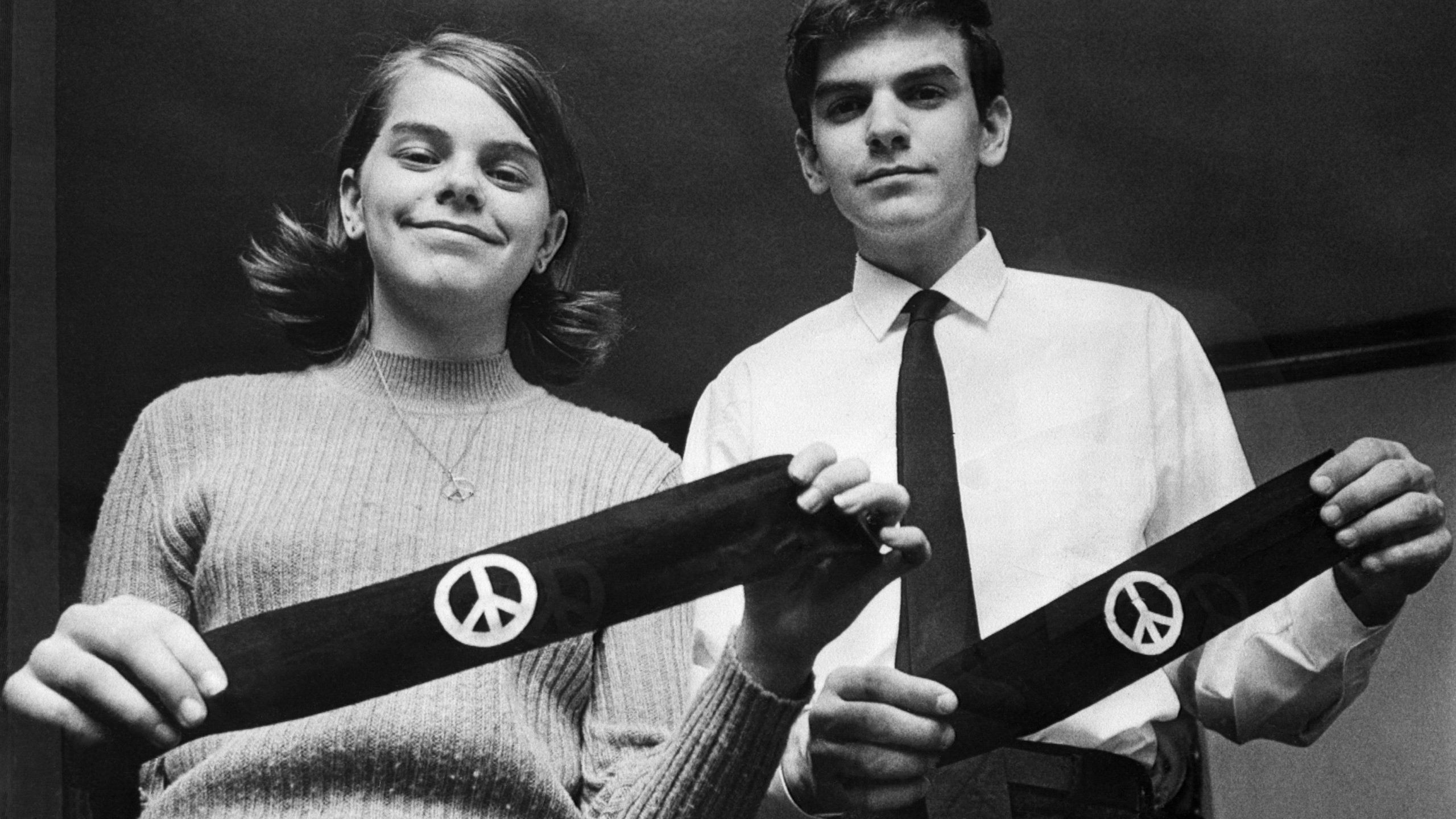
MARY BETH TINKER: When I was 10 years old, the Vietnam War was building up, and it was on the news more and more, and so we would talk about the war at dinner, and so that’s when the idea of black armbands came up. We decided to wear them to school to mourn for the dead in Vietnam and to say that there should be a truce.
Some students at Roosevelt High School ran with the idea and signed up about 50 kids to wear black armbands. But the day before, we were planning to wear the black armbands to school, we heard that there would be a rule that if any student wore one, they would be asked to take off the armband, and if they refused, they would be suspended.
Now, that was ironic, because the school district allowed black armbands if you were sad about the football game. But the principals called together a hasty meeting and made a rule against black armbands. And then we had a real moral dilemma, because I wasn’t a rule breaker, and all of us, we didn’t know what to do.
And so a small group of us, about 10 kids, decided we would be willing to be suspended if that’s what it took to speak up and express our feelings and our grief about the war that Christmas time.
We were also passing out this statement that says, “we mourn for the dead in Vietnam” and to call for a Christmas truce. So we passed that out the day that we were suspended. Here’s my suspension notice, I found that in a box in the basement a while back. There were five students suspended.
And so we went back to the school and the school board voted against us, and so the A.C.L.U. said, well we’re going to have to take this to court.
Some people got really mad at us. Someone threatened to bomb our house on Christmas Eve. Someone threw red paint at our house. People loved to call us communists.
This is one of the many postcards and mail that we got, criticizing us for speaking up for peace. We just thought it was crazy. We didn’t hate anybody. Our actions came from love. We wanted to stop the war, stop the killing.
As a child, it was very confusing to be attacked and threatened – to have our lives threatened for speaking up. But it was extraordinary times.
ARCHIVAL (CBS EVENING NEWS, 2-24-69):
NEWS ANCHOR: The Supreme Court today endorsed the right of student protest so long as the protest does not disrupt order or interfere with the rights of others. The court said students do not leave their freedoms of speech and expression at the school door.
MARY BETH TINKER: It was 1969, February 24th, when we won the case. The Supreme Court ruled by 7 to 2 that schools should not be enclaves of totalitarianism. That is in the ruling. And one of my favorite parts of the ruling is that students are persons under our Constitution with the rights and responsibilities of persons.
This case, Tinker v. Des Moines, it’s considered a landmark case – a precedent case that other cases build on – because it’s a fairly simple message. It says that youth should have a say, and that education includes talking about things you care about. This case affirms young people’s right to have a say about their lives.
CAMERON SAMUELS (CO-FOUNDER OF STUDENTS ENGAGED IN ADVANCING TEXAS): When I was in my senior year of high school, my school district pulled dozens of books. These are just a handful that Katy I.S.D. had pulled off the shelves.
In response, I decided to speak up at a school board meeting and call to light this censorship and how it affected myself, as a transgender student, and my peers.
I was the only student in the room, but my peers began to join me in organizing on social media against this effort, and we decided that we were going to distribute banned books to actually get these books in the hands of students that no longer had access.
There were threats and intimidation. Facebook messages and other rhetoric was targeted at students like myself. But we stood our ground. We outlined that we were within our rights. Tinker v. Des Moines was what allowed us to distribute these books.
That decision revolutionized the way that students walk about in our schools. Without demanding a seat at the table, we aren’t going to get anywhere.
ARCHIVAL CLIP (9-20-19):
STUDENT: We’re the generation set to inherit this beautiful planet and its like. . . .
MARY BETH TINKER: It’s important for young people to have a say in their lives because the schools and our society are stronger when young people are able to contribute their ideas and their energy.
ARCHIVAL (7-11-20):
STUDENT: And I am the founder of the Black student union.
MARY BETH TINKER: The lesson of the Tinker case is: Speak up. Stand up. Whatever it is that you care about, learn your rights and practice them.
(END)
Civics Skills: How Students Stood Up for the Right to Protest
Understand students’ rights that are protected by the First Amendment.
In the landmark decision in Tinker v. Des Moines, the Supreme Court ruled that a symbolic protest, where public school students wore armbands, was protected under the First Amendment. Where should schools draw the line between students’ rights and the school’s need to maintain order?
The resources were funded in part by the Leonore Annenberg Institute for Civics Award from the Annenberg Public Policy Center at the University of Pennsylvania.
- Producer: Kit R. Roane
- Editor: Heru Muharrar
- Co-Producer: Cole Cahill
- Production Assistant: Bradley Sandiford
- Production Assistant: Diego Trevino
 Grades
9-12
Grades
9-12
Grades
6-12
Grades
9-12
Grades
9-12
Grades
6-12