
Transcript
ANTHONY DERAS: I’m Anthony Deras. I’m from Bridgeport, Connecticut, and I attend school at Trumbull High School. I’m a senior.
TITLE: How to Build an Evidence-Based Argument
ANTHONY DERAS: A food desert is a community where its inhabitants often lack access to supermarkets near them, and because of that, they don’t have fresh, healthy food, and instead they’re opting into more unhealthy sources, like convenience stores or fast food restaurants.
I had some idea of what my argument on food deserts was. Specifically it poses a detrimental impact on these communities that tend to be food deserts. I definitely experienced the impacts of food deserts. When I was a kid, I had a lot of cavities. I also had health issues that you see related to food deserts. In order to try to get other people to listen to what you’re saying, especially if they don’t have that personal connection, I think that it’s important to truly demonstrate all aspects of the argument, and to present them with credible sources.
TEXT ON SCREEN:
Gather Evidence
ANTHONY DERAS: The key is to look at multiple sources so that way you know that you’re not just inheriting someone’s bias on a particular issue. Universities, government websites – those are all amazing websites and sources that you can learn information from.
TEXT ON SCREEN:
socialwork.tulane.edu
hsph.harvard.edu
canr.msu.edu
usda.gov
nih.gov
hhs.gov
ANTHONY DERAS: In regards to what sources I use to look at the impact of food deserts, I really looked at a lot of medical review journals and studies on food deserts, and I truly tried to comprehend what they were doing. But you also have to look at how do they conduct the study? Is it a reliable study? Does it accurately depict what point you’re trying to make?
TEXT ON SCREEN:
Support Your Argument
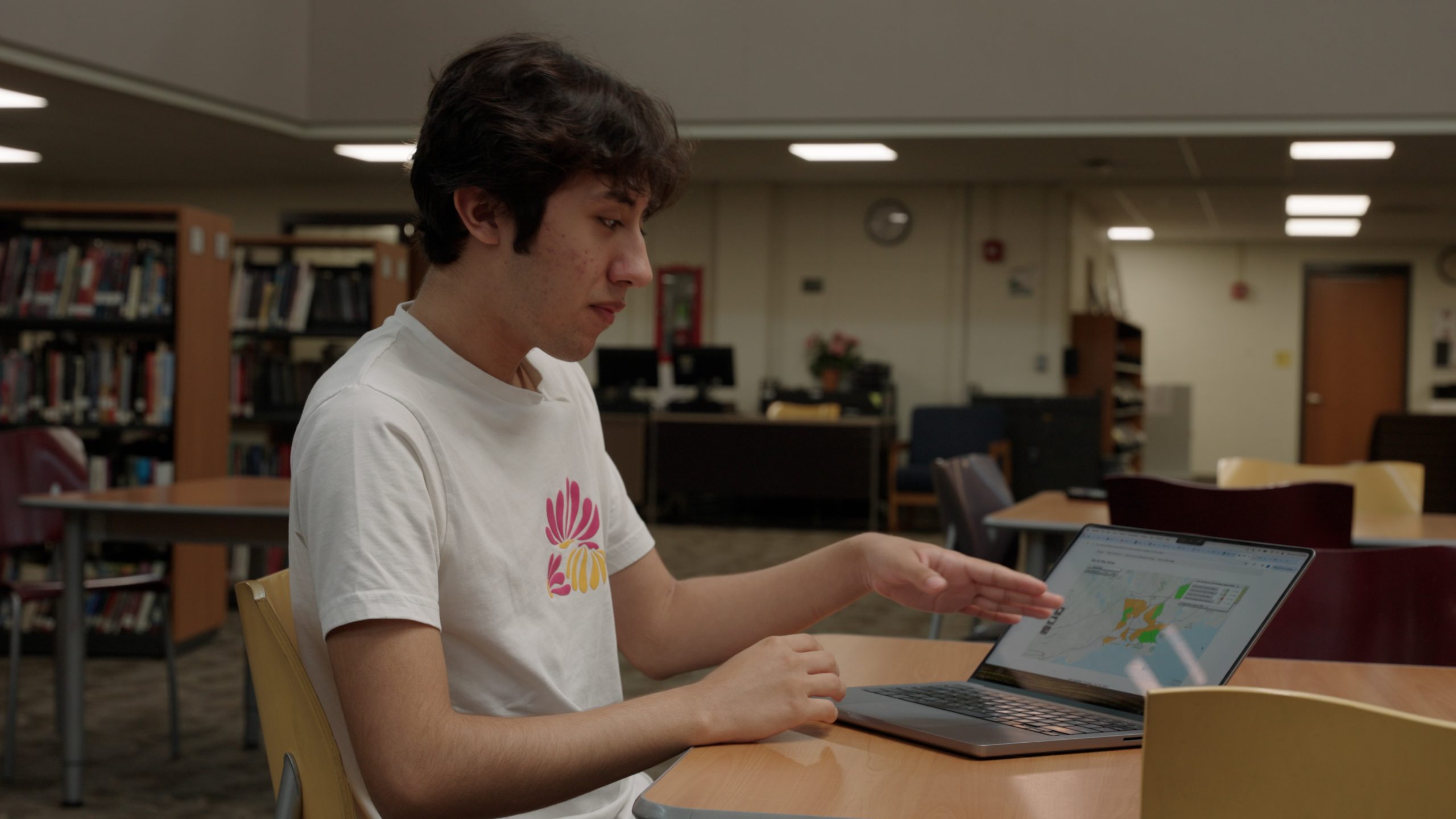
ANTHONY DERAS: So as we can see based off the food atlas from the U.S.D.A., if we were to look at a community like Bridgeport, there a lot of specific regions, or tracts as they refer to them. The atlas is essentially a map that shows you where food deserts are in America. Specifically, it color-codes it in the sense that it has different dots of where communities are relative to the nearest supermarket. And so it truly shows you how these things kind of fit into perspective. And I think it’s especially useful for someone who might not necessarily have had the experience of seeing food deserts where they live.
I knew that Bridgeport was a food desert going into the research. However, truly seeing the map displayed on Bridgeport truly solidified that and helped support my points. If you were to map out food deserts, you know, across America, you often see a correlation between food deserts and low-income communities of color, and oftentimes that’s because the healthy food is more expensive, and historically speaking, healthy supermarkets have been in more predominately white, wealthy areas.
TEXT ON SCREEN:
Present Your Findings
ANTHONY DERAS: Often, the resounding answer that I found looking at these sources is that we’re experiencing a negative impact in food deserts in regards to health, where people living in food deserts have all these health issues because they don’t have access to healthy food near them.
When I was actually delivering this presentation, I was surrounded by a lot of my peers who may have come from wealthier towns, like Trumbull or Monroe, and what I found was after I delivered my presentation, a lot of them were just shocked. They couldn’t even put into words the amount of shock that they experienced because, you know, it’s something that they’ve never seen before. And so I found that oftentimes, citing your sources is an effective way to get your point across.
Truly being presented with the evidence in your face leaves you with no other reaction but – oh, wow, this is something that’s actually happening.
(END)
Civics Skills: Evaluate Sources to Build an Argument
A student demonstrates how he gathers evidence and identifies credible sources while doing research.
Want to improve students’ research game? Sharpen skills with this short video, where a high school student shows how he finds credible sources and sorts fact from misinformation. Watch as he goes step by step through his research process and shares tips on how to gather solid evidence.
The resources were funded in part by the Leonore Annenberg Institute for Civics Award from the Annenberg Public Policy Center at the University of Pennsylvania.
- Producer: Emily Orr
- Editor: Brian Kamerzel
- Co-Producer: Wesley Harris
- Associate Producer: Cole Cahill
 Grades
9-12
Grades
6-12
Grades
9-12
Grades
9-12
Grades
6-12
Grades
9-12

 1 Lesson Plan
