Transcript
TROY SENIK (AUTHOR, “A MAN OF IRON”): A gaffe is quite simply a blunder, when a person says something they are not supposed to. In 2012, you’ve got Barack Obama getting raked over the coals for . . .
ARCHIVAL (C-SPAN, 7-13-12):
BARACK OBAMA: If you’ve got a business, that – you didn’t build that. Somebody else made that happen.
TROY SENIK: And Mitt Romney for . . .
ARCHIVAL (AUDIO, MOTHER JONES, 9-18-12):
MITT ROMNEY: There are 47 percent who are with him, who are dependent on government, who believe that they are entitled to healthcare, to food, to housing.
TROY SENIK: And then this strange meta moment where Romney is asked by a reporter:
ARCHIVAL (2012):
PHIL RUCKER: What about your gaffes?
TROY SENIK: We often think of gaffes as something that has to issue from the mouth of the candidate, but it can be just as damaging to have a gaffe from a surrogate. These are people you can’t control, and if they say the wrong thing in the wrong moment, it can be poison to the campaign.
TITLE:
POLITICKING: A 19TH CENTURY CAMPAIGN SERIES
“THE GAFFE”
TROY SENIK: When people think of the Gilded Age, they usually think of an era dominated by the fantastically wealthy, this big industrial expansion.
MARK SUMMERS (PROFESSOR OF HISTORY, UNIVERSITY OF KENTUCKY): That’s when we get movies, that’s when we get the electric light bulb, that’s when we get the telephone, root beer, Coca-Cola, and It looks wonderful. But what gilded means is a substance that’s covered with a golden filament, but the inside is made of basic materials like lead.
Business and politics have a holy alliance in those days. People are elected to Congress because you give it off to the highest bidder.
TROY SENIK: The same sorts of anxieties that we have today about the big tech companies. There’s a sense that these fortunes are dangerous. These people have too much control.
MARK SUMMERS: After the Civil War, Republicans won every presidential election through 1880. Again and again, they’re waving the bloody shirt, reminding people the Democrats are the party of treason, of war against our country.
TROY SENIK: But the American public is getting fatigued with the Republican Party being the pro-business party. There’s a lot of corruption seeping in. They’ve nominated a candidate, James G. Blaine, who has a long history of allegations of being cozy with railroad interests, for example.
MARK SUMMERS: You have Democrats marching and shouting, “Blaine, Blaine, James G. Blaine, Continental liar from the state of Maine.”
TROY SENIK: So Grover Cleveland is really the man that the moment demands. From the very first moment of his political career, as the sheriff in Erie County, New York, it’s very clear that this is a man who can’t be bought. That day and age, sheriffs almost everywhere — it was known as a corrupt position. You took the job because there was money the sheriff’s office collected. Some of it went into the sheriff’s pocket.
Grover Cleveland comes into office and is so fastidious about making sure that taxpayer money is taken care of, that when they are delivering wood to the sheriff’s office, he’s making sure to count it out. When he runs for president in 1884, he walks around with the nickname Grover the Good. How many politicians in history are going to get a nickname like that?
MARK SUMMERS: But then, 10 days after Cleveland is nominated, a newspaper comes out. It involved him in a liaison with a woman by the name of Maria Halpin, out of which came a child. And the story goes that when Maria Halpin got a little troublesome, arranged to have her locked in an insane asylum and have the child taken away from her.
TROY SENIK: Even today, we don’t know how accurate these stories are. Nevertheless, his strength was perceived to be this reputation for integrity. This is something that cuts Grover Cleveland to the quick. This seems like an incredible boost to the campaign of James G. Blaine.
MARK SUMMERS: At the end of the campaign, it’s very close and everybody agrees – if Blaine can carry New York, he’s going to win. About a week before Election Day, Blaine attends a reception of ministers in the Fifth Avenue Hotel in New York.
TROY SENIK: There’s a problem with this event: Nobody knows which minister is actually supposed to get up and speak. So unfortunately as it turns out, they give the honor to the oldest minister in the crowd, a gentleman by the name of Samuel Burchard, and the problem is not that he is a bad speaker. The problem is he has a knack for a memorable phrase, and the memorable phrase he uses is “Republicans do not want to be associated with the party of rum, Romanism and rebellion.”
MARK SUMMERS: He’s suggesting that Democrats are the party of drinkers, they’re the party of Confederates and they’re the party of Catholics. It’s a religious slur, and this is lethal because Blaine had been making a pitch and a bid to win over Irish Catholic votes in New York.
TROY SENIK: It doesn’t help if a surrogate is slandering Catholics where there was a critical mass of Catholics, and was going to likely determine the election.
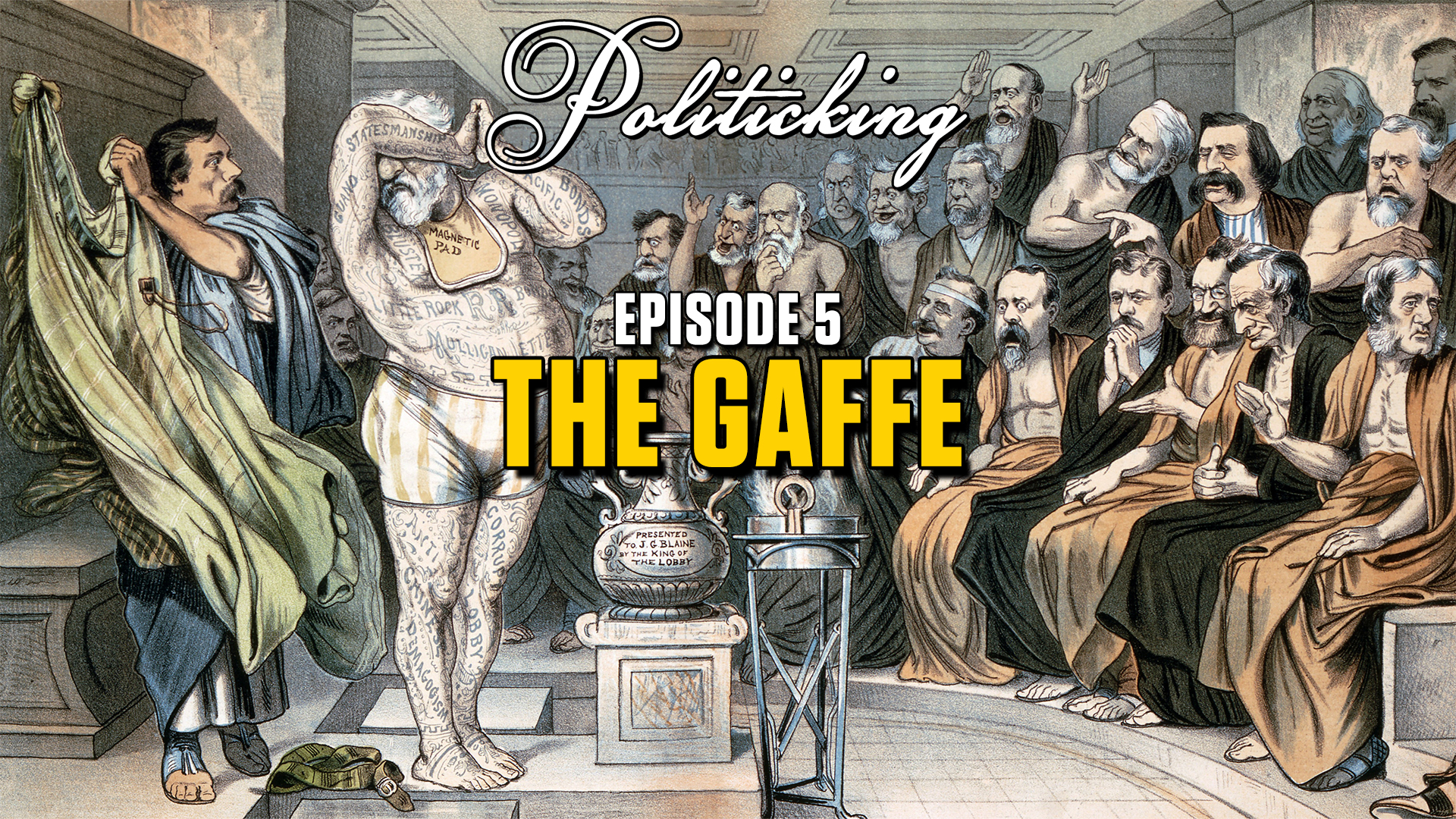
MARK SUMMERS: The same night, he attends a fundraising banquet of businessmen at Delmonico’s, the richest and most fabulous restaurant in all New York, and the New York World prints a cartoon of this.
TROY SENIK: They’re no paparazzi shots in the late 19th century. So it’s the power of the artist’s pen here to vivify a scene.
MARK SUMMERS: It says this guy is going to be in the pockets of big money. That cartoon is devastating, even though a lot of the people weren’t even at the banquet. A week later, Blaine loses New York by just about a thousand votes.
ARCHIVAL (2004):
HOWARD DEAN: …And Michigan! And then we’re going to Washington, D.C. to take back the White House. Yeah!
ARCHIVAL (CBS NEWS, 9-30-04):
JOHN KERRY: I actually did vote for the $87 billion, before I voted against it.
ARCHIVAL (2008):
GEORGE BUSH: In the battle of Iraq, the United States and our allies have prevailed.
TROY SENIK: A lot of the damage from gaffes did not come from the gaffe itself. It came from walking around, head bowed, apologizing constantly thereafter. What Trump did was have no sense of shame whatsoever when any of these things happen.
ARCHIVAL (THE TONIGHT SHOW STARRING JIMMY FALLON, NBC, 2015):
JIMMY FALLON: I was thinking about this the other day: Have you ever apologized? Ever?[Audience laughter]
DONALD TRUMP: I fully think apologizing’s a great thing but you have to be wrong. If you’re not wrong, like for instance they wanted me… No, it’s true.
MARK SUMMERS: It’s a different world of media, and after a while if you begin to say, well, what’s the gaffe of the day? It’s not going to have that kind of effect anymore.
(END)
Campaign Missteps: Gaffes on the Trail
Political gaffes have shaped elections from the Gilded Age to today.
Gaffes have cast a shadow on many U.S. elections, from the tense final days of the battle between Grover Cleveland and James G. Blaine in 1884 to modern-day missteps that spread like wildfire across the Internet. Amid our ever-changing media environment, discover how a single phrase or blunder can end up dominating our political discourse, from the 19th century to today.
- Producer / Editor: Matthew Spolar
- Additional Editing: Heru Muharrar
 Grades
8-12
Grades
8-12
 1 Lesson Plan