

This essay is a finalist in the 2024 Retro Report Civic Engagement Challenge, a student contest supported by the William and Flora Hewlett Foundation.
By Ayesha Murtaza
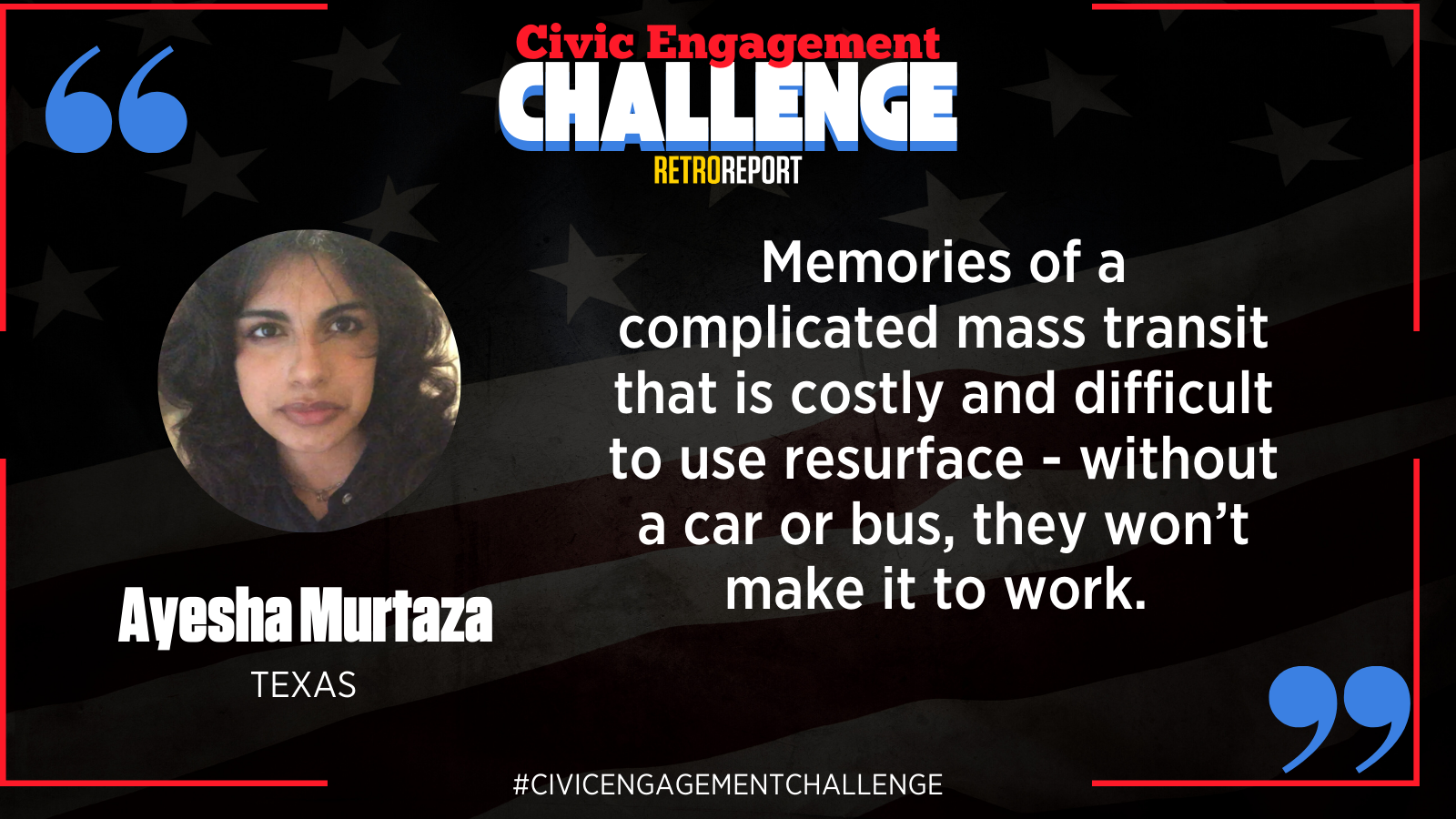
In the sweltering heat, a bustling Houstonian treks from marsh to concrete jungle, the blazing sun hot on their back. Memories of a complicated mass transit that is costly and difficult to use resurface – without a car or bus, they won’t make it to work. They sigh, looking up at that blazing sun – hoping this problem won’t be forgotten.
In Urban Houston, the ability to walk is near impossible. Instead, according to the 2022 U.S. Census American Community Survey, “90 percent of Houstonians own a car,”a statistic that is widely necessitated due to the lack of a mass transit system. Though there are existing mass transportation systems, such as the METRORail and METROLift, they function quite poorly due to a number of inconveniences: infrequent routes, lack of connection to suburbs, and limited reach to name a few. As an urban city, this comes with a plethora of drawbacks. This makes it incredibly difficult for those not having a car, not having gas money, or not having a reliable car constantly at risk of unable to function in such a demanding environment.
However, regardless of whether a Houstonian has access to a car or not, the cost of transportation to and from a regular work and school commute is costly. According to understandinghouston.org, “49 hours stuck in Houston traffic in 2020, averaging out to $1,097 in fuel and lost time,” which considers the individual waste of a single Houstonian. Now, shifting that perspective to that of a global cost, houstonpublicmedia.org says simply being stuck in traffic is “costing the U.S. about $166 billion a year, while the amount of wasted fuel adds up to about three billion gallons annually.”This only considers the cost of being stuck in traffic.
Now, according to the 2022 U.S. Census American Community Survey, the average commute time for Houston-area towns “ranged from about 44 minutes in Montgomery to 21 minutes in West University Place.” To and from work, five days a week.
As a low-income high-school student, I’ve noticed the equitable disparity between students who have access to transportation versus those who don’t. On one hand, a student will be able to go to school, attend music or dance rehearsals, and volunteer; on the other hand, a student will walk nearly 2 hours a day to attend required public education, and often have to miss those rehearsals and opt to not volunteer. But my experience isn’t something unexpected – the high costs associated with car ownership, such as insurance, maintenance, fuel, apply extreme pressure and unrealistic expectations for low-income families. In a city where public transit is difficult to access, these costs further exacerbate financial instability and creates an obstacle for having a job: creating an obstacle for living.
This time, let’s not forget the Houstonian Transit problem.
