
Lesson Plan: Two Decades of War in Afghanistan – Teaching With Primary Sources (Scaffolded Writing Resources)
 Grades 7-12
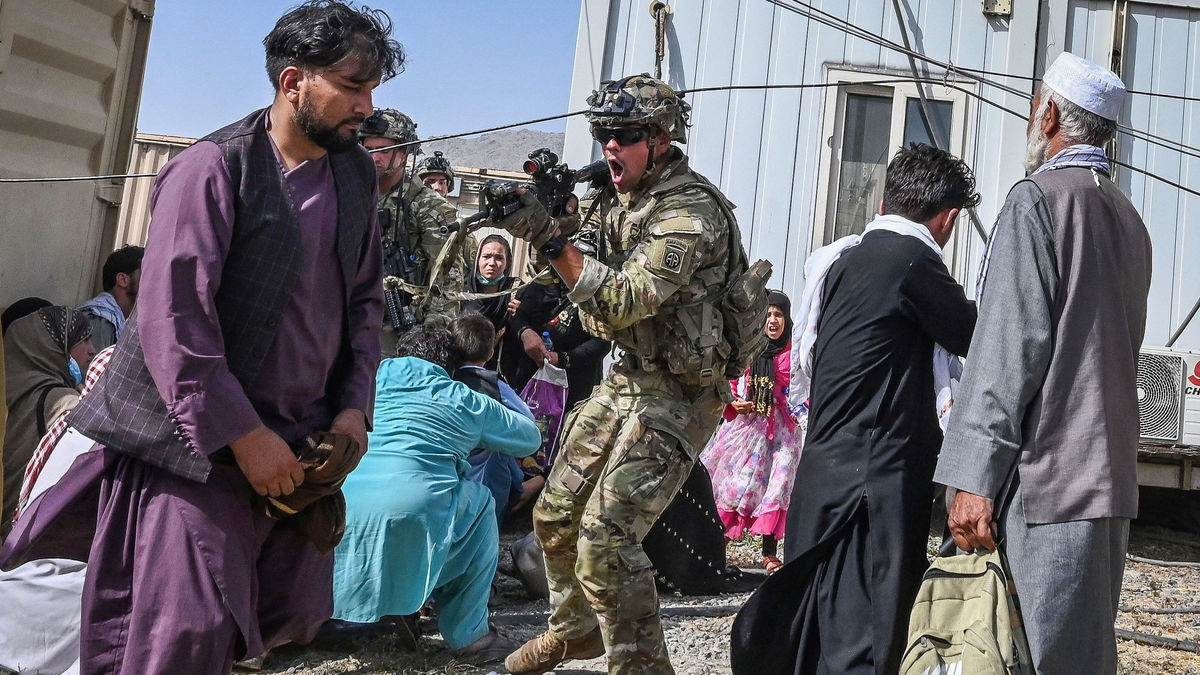
Within weeks of the attacks of 9/11, US troops invaded Afghanistan and bombed Taliban military installations. By the end of 2001, the Taliban regime was no longer in power. Instead of withdrawing, the objectives of the military shifted, involving the US in what would become the longest war in its history. After 20 years, the US troops were forced into a hasty and chaotic withdrawal, with the Taliban retaking power.



Subjects:
U.S. History
Grade Level:
7-12
Lesson Duration:
-
Two 40-55 minute class periods
Essential Questions:
-
Did the U.S. war in Afghanistan achieve its mission?
-
What were the primary objectives of the US military campaign in Afghanistan after 9/11?
-
How did the US strategy shift from the initial focus of removing the Taliban to nation-building?
Lesson Objectives:
Students will:
-
Develop a position and present a viewpoint based on historical evidence.
-
Decide if the US military should have left Afghanistan after the initial goal was realized by watching a video, answering questions, completing an outline and drafting a paragraph.
Materials:
-
Retro Report video “How the Military Response to 9/11 Led to Two Decades of War in Afghanistan” (Transcript)
-
Paragraph Outlines
Key Vocabulary:
-
Terrorism: The unlawful use of violence and intimidation, especially against civilians, in the pursuit of political aims.
-
Taliban: Tn Afghan political and militant movement that is composed of Islamic fundamentalists who enforce a strict interpretation of Sharia law. They controlled Afghanistan in the 1990s and returned to power in 2021.
-
Sharia law: A set of Islamic laws that govern a Muslim’s religious practices and daily life, derived from the Quran, the Sunnah, and the Hadith, which are the sayings and deeds of the Prophet Muhammad.
-
Al Qaeda: An Islamist militant organization led by Sunni jihadists, who see themselves as the leaders of a global revolution to unite the Muslim world under a single leader.
-
Jihad: A holy war rage for Islam as a religious duty
Procedure:
-
Review: Post the following question and have students work in small groups to brainstorm the actions taken by the US after 9/11 to prevent future attacks.
Following the attacks on 9/11, how did the United States respond to protect its citizens and to prevent future attacks? Possible responses include:
-
Immediate Actions:
-
-
A national state of emergency was declared.
-
Rescue and recovery efforts were started at Ground Zero and the Pentagon.
-
The government focused on providing support to victims and their families.
-
-
-
The Department of Homeland Security was created to unify security agencies, bringing multiple federal agencies under the control of one department.
-
Security measures were enhanced at airports:
-
-
Passenger screenings were implemented.
-
Baggage checks became more rigorous.
-
Items allowed in carry-on luggage were restricted.
-
Stricter identification requirements.
-
-
-
The Patriot Act was enacted, expanding the government’s surveillance powers to monitor possible terrorist activity, raising concerns about civil liberties.
-
The War on Terror began when the US launched military operations in Afghanistan to target those responsible for the 9/11 attacks.
-
-
-
Guided Instruction: Have students watch the “How the Military Response to 9/11 Led to Two Decades of War in Afghanistan ” video.
-
This can be done as a whole class, or individually on computers or using the EdPuzzle platform.
-
The video guide and question sheet poses two guiding questions for the whole video, along with several sentence stems that students can complete as they watch.
-
After reviewing responses, and highlighting exemplary answers, the teacher will distribute the scaffolded outlines to students.
-
-
Outline and Writing Prompt: Each version of the outline has the same writing prompt. For this activity, students will respond to the following prompt: Did the U.S. war in Afghanistan achieve its mission?
-
Demonstrate how responses on the video guide and question sheet could be used to craft topic and concluding sentences.
-
Guide students through creating categories and details on their version of the Outline form.
-
Depending on time and classroom set-up, students can work together or independently to turn their categories and details into full sentences.
-
Be sure to emphasize that each detail can be more than one sentence.
-
-
-
Primary Source Analysis: Have students complete one or more of the Primary Source Analysis activities provided for this lesson.
-
Students are encouraged to draw upon one or more primary sources to support their answer and evidence while constructing their outline.
-
-
Outline Construction: Have students complete whichever scaffolded outline they were given.
-
Paragraph Construction: Using the outline that students completed, have them construct their full paragraph.
To learn more about the evidence-based instructional methodology used here for teaching writing, see: The Hochman Method | The Writing Revolution
About the Author:
Tomi Crouch has been teaching for 18 years. She has taught both Social Studies and English at the high school level and she has taught US History at Central Virginia Community College. She is currently employed as the entire Social Studies department at Blue Ridge Juvenile Detention Center in Charlottesville, VA, where she teaches grades 6-12. Tomi has been a member of the Teacher Advisory Council for the American Civil War Museum for 13 years, where she has aided in writing educational materials and presented professional development courses. She has also worked several summers at Thomas Jefferson’s Monticello in the Education Department and has been a Retro Report Ambassador for three years.
Standards
College, Career, and Civic Life (C3) Framework for Social Studies
- D1.5.6-8. Determine the kinds of sources that will be helpful in answering compelling and supporting questions, taking into consideration multiple points of views represented in the sources.
- D2.Civ.2.9-12. Analyze the role of citizens in the U.S. political system, with attention to various theories of democracy, changes in Americans’ participation over time, and alternative models from other countries, past and present.
- D2.Civ.5.9-12. Evaluate citizens’ and institutions’ effectiveness in addressing social and political problems at the local, state, tribal, national, and/or international level.
- D2.Civ.13.9-12. Evaluate public policies in terms of intended and unintended outcomes, and related consequences.
- D2.His.1.9-12. Evaluate how historical events and developments were shaped by unique circumstances of time and place as well as broader historical contexts.
- D2.His.4.9-12. Analyze complex and interacting factors that influenced the perspectives of people during different historical eras.
- D2.His.5.9-12. Analyze how historical contexts shaped and continue to shape people’s perspectives.
- D2.His.14.9-12. Analyze multiple and complex causes and effects of events in the past.
- D3.1.6-8. Gather relevant information from multiple sources while using the origin, authority, structure, context, and corroborative value of the sources to guide the selection.
- D3.3.6-8. Identify evidence that draws information from multiple sources to support claims, noting evidentiary limitations.
- D4.1.6-8. Construct arguments using claims and evidence from multiple sources, while acknowledging the strengths and limitations of the arguments.
Common Core Literacy Standards
- CCSS.ELA.LITERACY.RI.11-12.3: Analyze a complex set of ideas or sequences of events and explain how specific individuals, ideas, or events interact or develop over the course of a text.
- CCSS.ELA.LITERACY.RH.11-12.7: Integrate and evaluate multiple sources of information presented in diverse formats and media (e.g., visually, quantitatively, as well as in words) in order to address a question or solve a problem.
