
Lesson Plan: The Korean War – Teaching With Primary Sources (Scaffolded Writing Resources)
 Grades 9-12
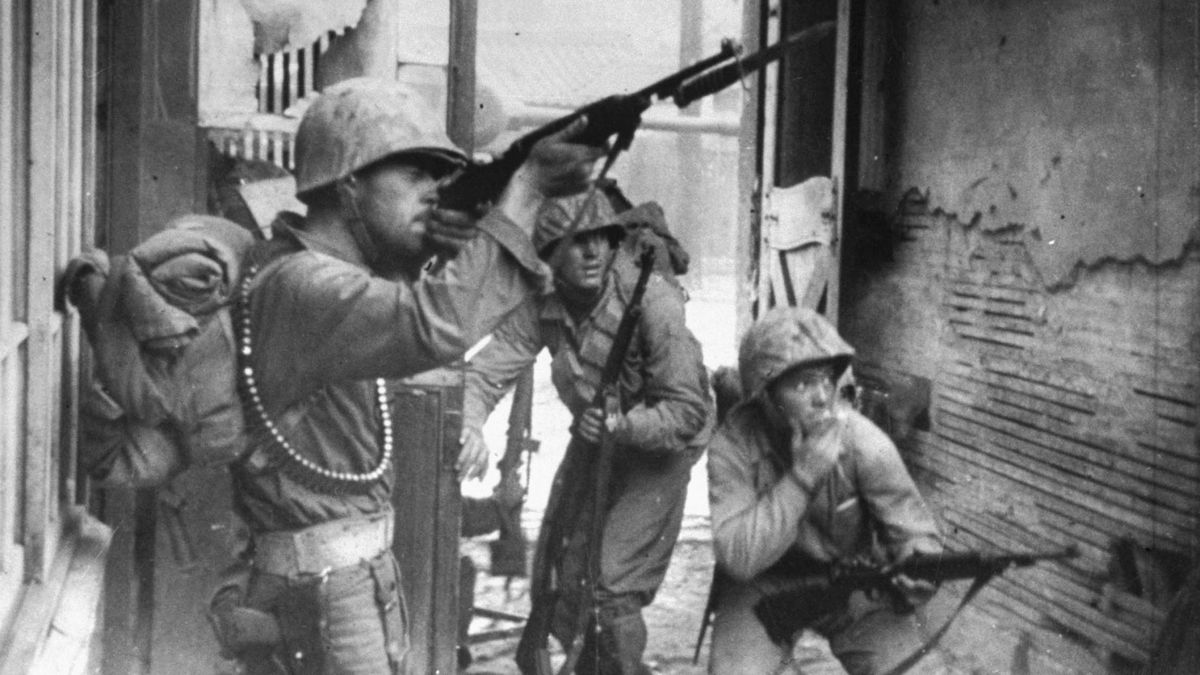
In the summer of 1950, Communist North Korea invaded the U.S. backed Democratic South Korea. Only five years after the devastation of WWII, U.S. President Harry Truman had a decision to make. As students view this video they will learn how President Truman’s use of presidential power in the Korean War has influenced U.S. foreign policy and military engagements around the world today.



Subjects:
U.S. History, Civics/Government
Grade Level:
7-12
Lesson Duration:
-
Two 40-55 minute class periods
Essential Questions:
-
How has Truman’s decision not to seek a formal declaration of war from Congress affected the power of an American president to wage war and commit troops to battle?
Lesson Objectives:
Students will:
-
Develop a position and present a viewpoint based on historical evidence.
-
Explain how the transition from formal declarations of war by Congress to the use of UN police actions
Materials:
-
Retro Report video “How the Korean War Changed the Way the U.S. Goes to Battle” (Transcript)
-
Paragraph Outlines
Key Vocabulary:
-
Communism: a political and economic system where the state owns the means of production and distribution, and the people share the benefits of labor equally
-
United Nations: an international organization formed after World War II, that works to promote peace, security, and human rights around the world
-
Declaration of war: a formal act by which one country announces existing or impending war activity against another. In the United States this requires formal approval by Congress.
-
Police action: isolated military undertaking that does not require a declaration of war by Congress
-
Truce: a temporary agreement between two or more parties to stop fighting or arguing
Procedure:
-
Review: This lesson is likely to be used either in a Civics/Government class when addressing the separation of powers or expansion of a branch’s power. It may also be used in a U.S. History class when discussing the growth of American power following the second World War, the Cold War, or the Korean War.
-
Guided Instruction: Have students watch the “How the Korean War Changed the Way the U.S. Goes to Battle” video.
-
This can be done as a whole class, or individually on computers or using the EdPuzzle platform.
-
The video guide and question sheet poses two guiding questions for the whole film, along with several sentence stems that students can complete as they watch.
-
After reviewing responses, and highlighting exemplary answers, the teacher will distribute the scaffolded outlines to students.
-
-
Outline and Writing Prompt: Each version of the outline has the same writing prompt. For this activity, students will respond to the following prompt: How has Truman’s decision not to seek a formal declaration of war from Congress affected the power of an American president to wage war and commit troops to battle?
-
Demonstrate how responses on the video guide and question sheet could be used to craft topic and concluding sentences.
-
Guide students through creating categories and details on their version of the Outline form.
-
Depending on time and classroom set-up, students can work together or independently to turn their categories and details into full sentences.
-
Be sure to emphasize that each detail can be more than one sentence.
-
-
-
Primary Source Analysis: Have students complete one or more of the Primary Source Analysis activities provided for this lesson.
-
Students are encouraged to draw upon one or more primary sources to support their answer and evidence while constructing their outline.
-
-
Outline Construction: Have students complete whichever scaffolded outline they were given.
-
Paragraph Construction: Using the outline that students completed, have them construct their full paragraph.
About the Author:
Michelle Nystel is an educator in a rural public school in Iowa. She has been an educator for 11 years in the areas of K-12 talented and gifted, special education and social studies. Michelle is also a Retro Reports Ambassador as well as a Founding Forward Teacher Ambassador.
Standards
College, Career, and Civic Life (C3) Framework for Social Studies
- D1.5.6-8. Determine the kinds of sources that will be helpful in answering compelling and supporting questions, taking into consideration multiple points of views represented in the sources.
- D2.Civ.2.9-12. Analyze the role of citizens in the U.S. political system, with attention to various theories of democracy, changes in Americans’ participation over time, and alternative models from other countries, past and present.
- D2.Civ.5.9-12. Evaluate citizens’ and institutions’ effectiveness in addressing social and political problems at the local, state, tribal, national, and/or international level.
- D2.Civ.13.9-12. Evaluate public policies in terms of intended and unintended outcomes, and related consequences.
- D2.His.1.9-12. Evaluate how historical events and developments were shaped by unique circumstances of time and place as well as broader historical contexts.
- D2.His.4.9-12. Analyze complex and interacting factors that influenced the perspectives of people during different historical eras.
- D2.His.5.9-12. Analyze how historical contexts shaped and continue to shape people’s perspectives.
- D2.His.14.9-12. Analyze multiple and complex causes and effects of events in the past.
- D3.1.6-8. Gather relevant information from multiple sources while using the origin, authority, structure, context, and corroborative value of the sources to guide the selection.
- D3.3.6-8. Identify evidence that draws information from multiple sources to support claims, noting evidentiary limitations.
- D4.1.6-8. Construct arguments using claims and evidence from multiple sources, while acknowledging the strengths and limitations of the arguments.
Common Core Literacy Standards
- CCSS.ELA.LITERACY.RI.11-12.3: Analyze a complex set of ideas or sequences of events and explain how specific individuals, ideas, or events interact or develop over the course of a text.
- CCSS.ELA.LITERACY.RH.11-12.7: Integrate and evaluate multiple sources of information presented in diverse formats and media (e.g., visually, quantitatively, as well as in words) in order to address a question or solve a problem.
