
Lesson Plan: The Debate Over Independence
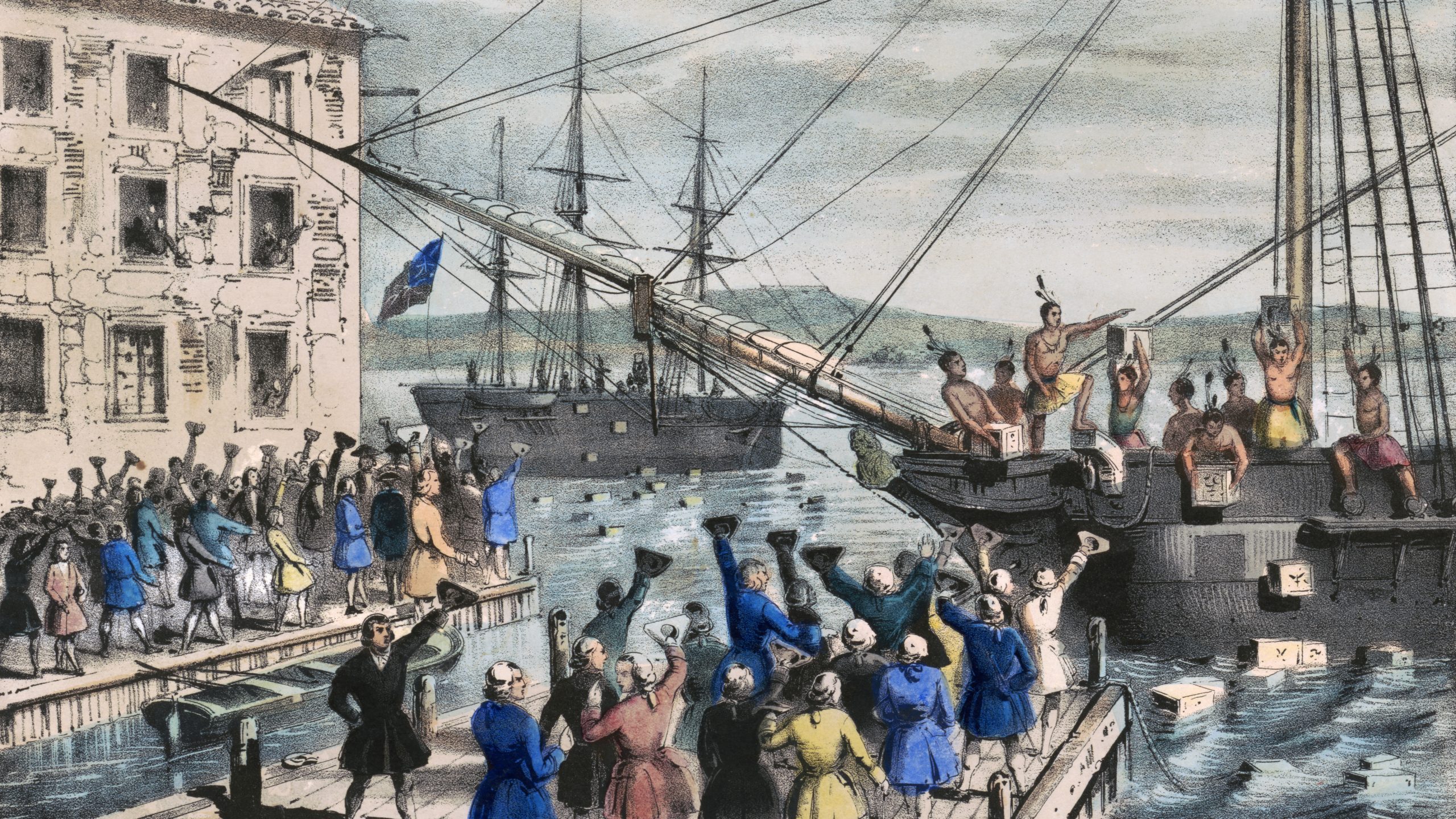
In the years leading up to the American Revolution, many colonists still considered themselves loyal British subjects, even as tensions with Great Britain continued to grow. The Boston Tea Party and the British government’s harsh response pushed colonists toward greater resistance and eventually armed conflict. The decision to declare independence was far from certain, however, as many colonists believed there were strong reasons to remain connected to the British Empire. This lesson invites students to examine the uncertainty of the period by analyzing the competing arguments, pressures and risks that shaped how colonists responded to the growing conflict.
Subjects:
U.S. History
-
This overview could be used at the beginning of a unit on the American Revolution to introduce students to the growing tensions, uncertainty and resistance that led the colonies toward independence.
Grade Level:
7-9
Lesson Duration:
-
One or two class periods, depending on whether students complete the extension activity.
Essential Questions:
-
Should the American colonists have declared independence from Great Britain?
-
Was the American Revolution inevitable, or could the colonies and Great Britain have avoided war?
Lesson Objectives:
Students will:
-
Analyze, categorize, and rank political, economic, and social arguments for and against independence using historical evidence from multiple perspectives.
-
Develop and defend a historical argument using evidence.
-
Write a persuasive historical editorial from the perspective of a colonial citizen.
Materials:
-
Retro Report video “When Is History Happening? From the Boston Tea Party to the Battlefield” (Transcript)
-
Student Activity handout with links
-
Optional Tug of War Arguments (see #3a.)
Procedure:
-
Hook (3-5 minutes) Have students read excerpts from the correspondence between John and Abigail Adams in 1774, while John served in the Continental Congress, and answer the related questions on the Activity handout. Students should determine that John Adams is proposing the question: Should the colonies become independent or remain a part of the British empire? Abigail Adams is reflecting on the uncertainty that the growing conflict is creating among the people. Students may be directed to discuss the statements with a partner to come to a consensus.
-
Video Viewing (10 Minutes): Students will watch the Retro Report video and respond to the guided prompts available on the Activity document.
-
Analysis (20-25 Minutes) Divide students into groups of two or three. Inform students that they are everyday American colonists in 1775, without knowledge of what may happen in the future. With that perspective in mind, students should explore the essential question: Should the American colonists have declared independence from Great Britain? by analyzing various arguments on each side. Students should examine the 10 arguments about independence on the activity document. They should read each argument, determine if the argument supports staying with the British or breaking away, and rank the strength of each argument on a scale of 1-5 (5 being the strongest). Students may use the same number for multiple arguments. This can be completed alone or with partners, with students reserving the right to disagree with rankings after small group discussion. Students should also be prepared to defend their rankings during the class discussion.
-
If you’d prefer to have small groups (or the class) physically maneuver arguments on a tug of war line, print, laminate, and cut out a set of the Tug of War Arguments (page 1) for each group. The charts on page 2 may be copied and pasted onto the Student Activity handout in place of the 10 argument charts as desired.
-
-
At the end of the ranking and discussion, each individual should place the argument titles and rankings on a comparison chart on their activity document. After examining their rankings, students should choose a side by placing an X on a spectrum, symbolizing where they see the result of the “tug of war” is the winner. In other words, which side has the strongest evidence to support its side?
-
Class Debrief (10 Minutes) Draw a physical spectrum across a whiteboard, with “Break from Britain” on one end and “Stay with Britain” on the other. Have students place a sticky note with their name along the spectrum to reflect their opinion. Facilitate a class debrief using these potential guiding questions:
-
Which arguments were strongest on each side? In other words, which arguments are the “anchor” for the tug of war teams?
-
Which arguments were the weakest for each side?
-
Which side seemed more risky?
-
Dr. Chervinsky states that colonists felt immense anxiety. For the arguments ranked as a 4 or 5, ask students what one word comes to mind to describe the emotion it may have caused a colonist (Fear, Anger, Resistance, etc.)
-
Why might ordinary colonists struggle with this decision?
-
Did your knowledge of what actually happened influence your decision? Why or why not?
-
Extension Activity:
-
Persuasive Letter: Students can write a persuasive letter from the perspective of a colonial citizen in 1775. In their letter, students must argue either for remaining loyal to Great Britain or for declaring independence. They should use evidence and arguments discussed during the lesson to support their position while demonstrating an understanding of the uncertainty, fears, and tensions colonists faced at the time. Students should address their letter to a family member, friend, newspaper editor, or colonial leader and attempt to persuade the reader to agree with their viewpoint.
About the Author:
Chuck Taft teaches eighth-grade American History at University School of Milwaukee. He is president of the Wisconsin Council for the Social Studies.
Standards
College, Career, and Civic Life (C3) Framework for Social Studies
-
D2.His.1.6-8. Analyze connections among events and developments in broader historical contexts.
-
D2.His.3.6-8. Use questions generated about individuals and groups to analyze why they, and the developments they shaped, are seen as historically significant.
-
D2.His.4.6-8. Analyze multiple factors that influenced the perspectives of people during different historical eras.
-
D2.His.11.6-8. Use other historical sources to infer a plausible context for things written or created in the past.
-
D2.His.14.6-8. Explain multiple causes and effects of events and developments in the past.
-
D2.His.15.6-8. Evaluate the relative influence of various causes of events and developments in the past.
-
D2.His.16.6-8. Organize applicable evidence into a coherent argument about the past.
Common Core Literacy Standards
-
CCSS.ELA-LITERACY.RH.6-8.1: Cite specific textual evidence to support analysis of primary and secondary sources.
-
CCSS.ELA-LITERACY.RH.6-8.2: Determine the central ideas or information of a primary or secondary source; provide an accurate summary of the source distinct from prior knowledge or opinions.
-
CCSS.ELA-LITERACY.RH.6-8.6: Identify aspects of a text that reveal an author’s point of view or purpose (e.g., loaded language, inclusion or avoidance of particular facts).
-
CCSS.ELA-LITERACY.WHST.6-8: Write arguments focused on discipline-specific content.
