
Lesson Plan: The Rise and Collapse of the Berlin Wall
 Grades 6-12
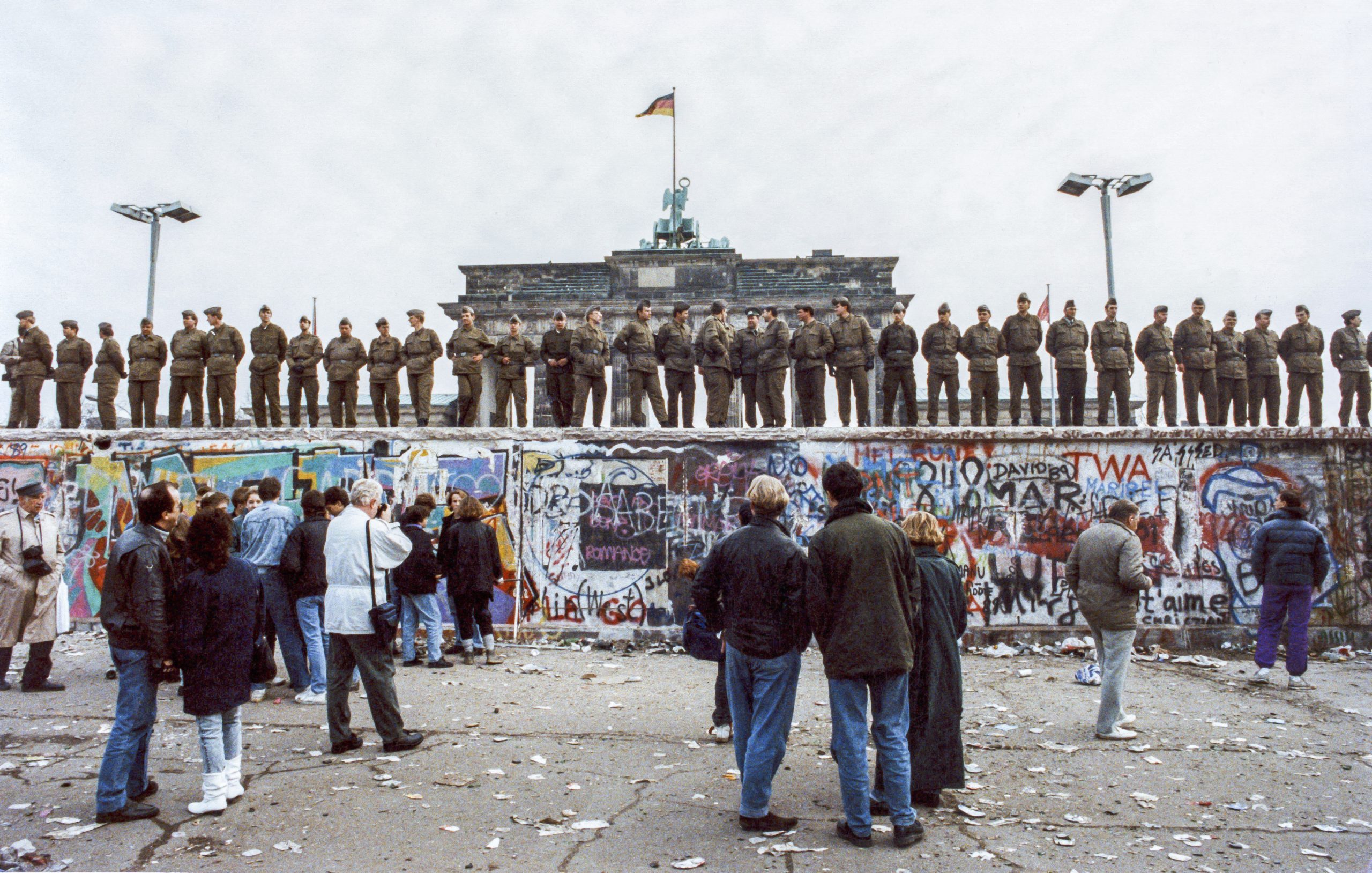
The Berlin Wall stood for nearly three decades as the defining symbol of the Cold War, physically and ideologically splitting a city into the communist-controlled East and the democratic West. Through the voices of people on both sides of the wall, this short documentary shows how the East German government enforced the border, and how ordinary Berliners pushed back or found ways to escape or adapt. This lesson provides context for students to understand how the wall’s construction, lifespan and eventual fall affected the lives of German citizens.



Subjects:
(AP) Human Geography, Geography, World History, U.S. History, Sociology
-
The Berlin Wall is the focus of this lesson as it becomes a way to integrate spatial analysis from AP Human Geography, the geopolitical shifts studied in World History, a concrete example of Cold War foreign policy in U.S. History, and the structural societal changes found in Sociology.
Grade Level:
6-12
-
Scaffolding/differentiation may be needed for younger grades. For example:
-
Simplify the Essential Question: How did the construction of a fortified boundary change the spatial interaction and migration patterns within the city of Berlin? to: How do physical barriers change the movement of people and the way a city is organized?
-
Provide sentence starters for the 5-sentence emotional response prompts in the song analysis.
Lesson Duration:
2 classes/periods (of a traditional 45-60 minute class period)
Essential Questions:
-
What factors contributed to the rise and eventual collapse of the Berlin Wall as a symbol of global geopolitical tension?
-
How did the construction of a fortified boundary change the spatial interaction and migration patterns within the city of Berlin?
-
How did the existence of the Berlin Wall shape United States diplomatic and military priorities during the Cold War?
-
How do physical barriers affect social structures and the lived experiences of individuals within a society?
Lesson Objectives:
Students will:
-
Synthesize multiple perspectives to explain the causes of the Berlin Wall’s collapse.
-
Analyze how the Berlin Wall affected German citizens during its construction, lifespan and eventual fall.
-
Analyze the physical features of the Berlin Wall (the “Death Strip,” towers, and wire) to determine how these features solidified them as a fortified boundary.
-
Compare how different forms of expression (e.g., political speeches, music, and personal testimony) influenced public perception and political change during the Cold War.
-
Evaluate the impact of popular music written because of the construction of the wal when it was a physical barrier, and during the time period of its collapse.
Materials:
-
Retro Report video “Berlin Wall: The Rise and Collapse of a Cold War Symbol” (Transcript)
-
Student Activity handout
-
In pictures: remembering the Berlin Wall 30 years on | History Extra
-
Vocabulary Slide Deck – Select “File>Make a Copy” to eliminate, edit or reorder
-
Optional: select “File>Print>2 pages per sheet.” Then, print, laminate (optional), and cut out the slides – they act as cards.
-
-
Song Analysis: Popular Music and the Berlin Wall – Links provided electronically; if printing packets for student use, they will need to be provided access to the linked YouTube videos or watch the videos as a class.
-
Ronald Reagan: Brandenburg Gate Speech | United States Marine Corps University
Procedure:
-
Distribute the Student Activity handout and have students analyze one of the provided photos by utilizing the See, Think, Wonder protocol. Then have students imagine that they awoke one morning to find a wall through their neighborhood. How would daily life (school, family, friends) be affected? What would be their first concern/reaction? Invite students to share their answers with the class as time allows.
-
Direct students to the Vocabulary section and inform them that they are to work with a partner to review and sort the terms from the Vocabulary Slide Deck into three categories to understand the lifecycle of the Berlin Wall: The Cause (Why the Berlin Wall was built), The Experience (While the Berlin Wall stood), The Aftermath (After the Berlin Wall Fell).
-
Review answers as a class.
-
The Cause: Containment, Social Control, Sovereignty, Iron Curtain
-
The Experience: Fortified Boundary, Brinksmanship, In and Out Group, Proxy Enemy
-
The Aftermath: Relic Boundary, Spatial Interaction
-
Students may incorrectly think the “Iron Curtain” is the Berlin Wall. Clarify, as needed, that the “Iron Curtain” was the ideological and physical boundary dividing Europe into two separate areas — communist East and democratic West — from 1945 to 1991, while the Berlin Wall (1961–1989) was the most visible, concrete symbol of this divide, specifically separating East and West
-
-
Have students watch the Retro Report video “Berlin Wall: The Rise and Collapse of a Cold War Symbol” (Transcript) and answer the following:
-
Why is the Berlin Wall considered “an iconic symbol of the Cold War?”
-
In the summer of 1961, why did the Soviet and East German leadership build the barrier between East and West Berlin?
-
According to Peter Keup, what was he taught about the United States in school, and how did that compare to the “stories” he heard about the Western world?
-
What were three tactics employed by East Berlin to stop defections to West Berlin?
-
What decision, made by Harald Jager at the Bornholmer Strasse border crossing, was an immediate cause of the fall of the Berlin Wall?
-
What physical evidence remains in Berlin as a reminder of the Berlin Wall?
-
-
After the video, review students’ responses as needed and help them synthesize by reviewing the following as a class:
-
Identify the primary reason the East German government felt the Wall was a “success” at the time.
-
Define Mikhail Gorbachev’s policies of perestroika and glasnost. According to the video, how did these two policies change the Soviet Union’s “harsh approach” and lead to the events of Nov. 9, 1989?
-
Describe the human error that led to the opening of the Berlin Wall.
-
-
Using the Song Analysis section of the Activity handout, students will read the lyrics, and watch videos of or listen to songs associated with the Berlin Wall. They will then answer the prompts below, citing lyrics that support their answers and explaining where appropriate. This may be done individually or as a class.
-
Next, students will analyze Reagan’s Brandenburg Gate speech. They will read the Analysis prompts on the Activity handout to understand the goal of their search, scan the provided “Supporting Excerpt Selections” and determine the best match, cite the evidence by copying and pasting the specific excerpt from the speech that answers the prompt, and explain in their own words why this quote matters to understanding the Berlin Wall. Finally, they should skim the full Ronald Reagan: Brandenburg Gate Speech to check their responses.
-
Why was the Brandenburg Gate chosen for this speech? (Excerpt C: “It is here in Berlin where the wall emerges most clearly; here, cutting across your city, where the news photo and the television screen have imprinted this brutal division of a continent upon the mind of the world.”)
-
How does Reagan use the appearance of the two Berlins to argue against communism? (Excerpt D: “In the West today, we see a free world that has achieved a level of prosperity and well-being unprecedented in all human history. In the communist world, we see failure, technological backwardness, declining standards of health, even want of the most basic kind, too little food.”)
-
Why does Reagan compare the Wall to a scar, and what does this suggest about the wellbeing of the city? (Excerpt F: “Standing before the Brandenburg Gate, every man is a German, separated from his fellow men. Every man is a Berliner, forced to look upon a scar. . . . As long as this scar of a wall is permitted to stand, it is not the German question alone that remains open, but the question of freedom for all mankind.”)
-
Reagan claims the wall is not for protection. Find the quote where he identifies what the wall is an “instrument” for. (Excerpt E: “But there remain armed guards and checkpoints all the same: still a restriction on the right to travel, still an instrument to impose upon ordinary men and women the will of a totalitarian state.”)
-
What famous command does Reagan give to prove that the Soviets want peace? (Excerpt A: “General Secretary Gorbachev, if you seek peace, if you seek prosperity for the Soviet Union and Eastern Europe, if you seek liberalization: Come here to this gate! Mr. Gorbachev, open this gate! Mr. Gorbachev, tear down this wall!”)
-
Who or what does Reagan claim is the winner in this conflict? (Excerpt B: “After these four decades, then, there stands before the entire world one great and inescapable conclusion: Freedom leads to prosperity. Freedom replaces the ancient hatreds among the nations with comity and peace. Freedom is the victor.”)
-
-
Optional Review: Have students revisit the vocabulary terms to provide examples of each term as it relates to the Berlin Wall.
-
Fortified Boundary: The Berlin Wall itself, which was made of concrete, barbed wire, and guard towers. It was designed to stop East Berliners from fleeing to the West.
-
Spatial Interaction: Western radio broadcasts and the music from the 1987 David Bowie concert crossing over the wall to reach listeners in the East.
-
Social Control: The use of armed guards, checkpoints, and the police to restrict travel and impose the will of the totalitarian state.
-
Proxy Enemy: The division of Germany into East (Soviet Union) and West (United States) during the Cold War.
-
Relic Boundary: The modern-day remains of the Berlin Wall, such as the East Side Gallery. It served as a historical marker rather than a functional border.
-
Iron Curtain: The vast system of barriers that divides the entire continent of Europe, with the Berlin Wall serving as its most visible symbol.
-
Sovereignty: The Marshall Plan and the U.S. military presence in West Berlin aimed at preventing the further spread of Soviet Communism in Europe.
-
Containment: The struggle of East Germany to maintain authority as its citizens looked toward Western freedom.
-
Brinksmanship: The deployment of missiles by the Soviets and the subsequent counter-deployment of nuclear weapons by the Western alliance.
-
In and Out Group: The cultural and political divide between “Wessis” (West) and “Ossis” (East) created by decades of living under opposing government systems.
-
-
Students will wrap up the lesson using the Connect, Extend, Challenge strategy. Connect: How did the ideas and information in this video connect to what you already know about the Cold War/ Berlin Wall? Extend: How did this video extend or broaden your thinking about how boundaries affect people’s daily lives? Challenge: What new questions did this lesson raise for you?
Extension Activity:
-
Write a constructed response that compares and contrasts the four songs used in the lesson.
-
Optional Vocabulary Review: Split the class into two groups – one side will represent East Berlin while the other represents West Berlin. The instructor should stand in the middle of the room to represent a barrier (the Berlin Wall). To make it more visually convincing, put two tables of a row of desks in between the East and West. The instructor will move to the West side of “the Berlin Wall” with a device cued up to play David Bowie’s song, “Heroes.” Tell students that they are to listen and offer “choral responses” to questions as a class.
-
Point at “the Berlin Wall” and say: “It is June of 1987. This is the barrier between the Communist East and the Democratic West. In the center is the ‘Death Strip’ manned by guards, dogs, boats, machine guns, etc. What term can we use to describe the physical wall and ‘Death Strip?’” The choral response from the class should be: “Fortified Boundary.”
-
The instructor will turn their back on the East and point their device at the West groups and start the song, “Heroes” by David Bowie. The instructor should slowly walk the length of the “Wall,” making sure to keep the device pointed towards the West, where they are the only ones hearing the music. At about the halfway point of the song, the instructor will walk to the “Wall” and turn towards the groups in the East. They will turn the device playing the music towards the East and turn the volume up for a few seconds. After the song has played for a few seconds at the higher volume, the instructor should lower the volume and say: “In 1987, popular singer/songwriter, David Bowie was part of a large concert held at the Reichstag in West Berlin. During the concert, he instructed his road crew to turn the speakers to face the Berlin Wall and the East during this song, called “Heroes.” Word had spread to East Berliners that Bowie might do this and had gathered near the Berlin Wall on the Eastern side. When the crowd swelled, the East Berlin Stasi (Secret Police) began to beat the peaceful crowd.” Ask: “He is using his voice to pull people away from the government’s rules. What do we call a force that divides people and pulls a state apart?” The students should be able to be called upon individually or in a choral response “Centrifugal Force.”
-
Next, the instructor should hold the device where the entire class can see it but now play the music towards the East and say: “I am in the West. My device is in the West. Can you in the East hear it? What is the term for the movement of sound across a space?” The students should be able to be called upon individually or in a choral response “Spatial Interaction.”
-
The instructor should then say: “The government wants to stop this, but are not able to do so. What power are they losing? The students should be able to be called upon individually or in a choral response “Social Control.”
-
The instructor should then state that the ‘Wall” is opening, and ask for choral responses to the following: “David Bowie’s concert was an example of dividing the loyalties of the East Berliners away from their government’s wishes and rules. The concert would be described as a….?” Student Response: Centrifugal Force. Instructor: “When the East Berlin government lost the ability to block their citizens from the music and its ideas, they were losing….?” Student Response: Social Control. Instructor: “We now know that the actual Berlin Wall no longer stands. However, its former track is marked by a brick path. This is an example of a ….?” Student Response: Relic Boundary.
-
About the Author:
David Kendrick teaches AP Human Geography, American Government/Civics, and U.S. History at Loganville High School in Georgia. He is vice president of the National Council for the Social Studies and serves on the board of trustees for the Georgia Council for the Social Studies.
Standards
College, Career, and Civic Life (C3) Framework for Social Studies
-
D2.His.5.9-12: Analyze how historical contexts shaped and continue to shape people’s perspectives.
-
D2.His.14.6-8. Explain multiple causes and effects of events and developments in the past.
-
D3.3.6-8. Identify evidence that draws information from multiple sources to support claims, noting evidentiary limitations.
-
D4.1.6-8. Construct arguments using claims and evidence from multiple sources, while acknowledging the strengths and limitations of the arguments.
-
D4.4.6-8. Critique arguments for credibility.
-
D4.6.6-8. Draw on multiple disciplinary lenses to analyze how a specific problem can manifest itself at local, regional, and global levels over time, identifying its characteristics and causes, and the challenges and opportunities faced by those trying to address the problem.
-
D2.Geo.2.9-12. Use maps, satellite images, photographs, and other representations to explain relationships between the locations of places and regions and their political, cultural, and economic dynamics.
-
D2.Geo.5.9-12. Evaluate how political and economic decisions throughout time have influenced cultural and environmental characteristics of various places and regions.
-
D2.His.1.9-12. Evaluate how historical events and developments were shaped by unique circumstances of time and place as well as broader historical contexts.
-
D2.His.3.9-12. Use questions generated about individuals and groups to assess how the significance of their actions changes over time and is shaped by the historical context.
-
D3.1.9-12. Gather relevant information from multiple sources representing a wide range of views while using the origin, authority, structure, context, and corroborative value of the sources to guide the selection.
AP Human Geography Course and Exam Description
-
Topic 4.1: Introduction to Political Geography
-
Skill 4.A: Identify the different types of information presented in visual sources.
-
PSO-4.A: For different types of political entities, identify the attributes that help define them.
-
-
Topic 4.2: Political Processes
-
Skill 3.E: Explain what maps or data imply or illustrate about geographic principles, processes, and outcomes.
-
PSO-4.B: Explain the processes that have shaped contemporary political maps.
-
-
Topic 4.3: Political Power and Territoriality
-
Skill 5.B: Explain spatial relationships across various geographic scales using geographic concepts, processes, models, or theories.
-
PSO-4.C: Describe the concepts of political power and territoriality as used by geographers.
-
-
Topic 4.4: Defining Political Boundaries
-
Skill 1.D: Describe a relevant geographic concept, process, model, or theory in a specified context.
-
IMP-4.A: Describe types of political boundaries used by geographers.
-
-
Topic 4.5: The Function of Political Boundaries
-
Skill 5.D: Explain the degree to which a geographic concept, process, model, or theory effectively explains geographic effects across various geographic scales.
-
IMP-4.B: Explain the nature and function of international boundaries.
-
-
Topic 4.6: Internal Boundaries
-
Skill 5.A: Identify the scales of analysis presented by maps, quantitative and geospatial data, images, and landscapes.
-
IMP-4.C: Explain the nature and function of international and internal boundaries.
-
-
Topic 4.7: Forms of Governance
-
Skill 2.A: Describe spatial patterns, networks, and relationships.
-
IMP-4.D: Define federal and unitary states. IMP-4.E: Explain how federal and unitary states affect spatial organization.
-
-
Topic 4.8: Defining Devolutionary Factors
-
Skill 3.E: Explain what maps or data imply or illustrate about geographic principles, processes, and outcomes.
-
SPS-4.A: Explain the factors that lead to devolution of states.
-
-
Topic 4.9: Challenges to Sovereignty
-
Skill 5.C: Compare geographic characteristics and processes at various scales.
-
SPS-4.B: Explain how political, economic, cultural, and technological changes challenge state sovereignty.
-
-
Topic 4.10: Consequences of Centrifugal and Centripetal Forces
-
Skill 5.C: Compare geographic characteristics and processes at various scales.
-
SPS-4.C: Explain how the concepts of centrifugal and centripetal forces apply at the state scale.
-
Common Core Literacy Standards
-
CCSS.ELA-LITERACY.RH.9-10.1: Cite specific textual evidence to support analysis of primary and secondary sources, attending to such features as the date and origin of the information.
-
CCSS.ELA-LITERACY.RH.9-10.2: Determine the central ideas or information of a primary or secondary source; provide an accurate summary of how key events or ideas develop over the course of the text.
-
CCSS.ELA-LITERACY.RH.9-10.3: Analyze in detail a series of events described in a text; determine whether earlier events caused later ones or simply preceded them.
-
CCSS.ELA-LITERACY.RH.9-10.4: Determine the meaning of words and phrases as they are used in a text, including vocabulary describing political, social, or economic aspects of history/social science.
-
CCSS.ELA-LITERACY.RH.9-10.6: Compare the point of view of two or more authors for how they treat the same or similar topics, including which details they include and emphasize in their respective accounts.
-
CCSS.ELA-LITERACY.RH.9-10.7: Integrate quantitative or technical analysis (e.g., charts, research data) with qualitative analysis in print or digital text.
-
CCSS.ELA-LITERACY.RH.9-10.9: Compare and contrast treatments of the same topic in several primary and secondary sources.
