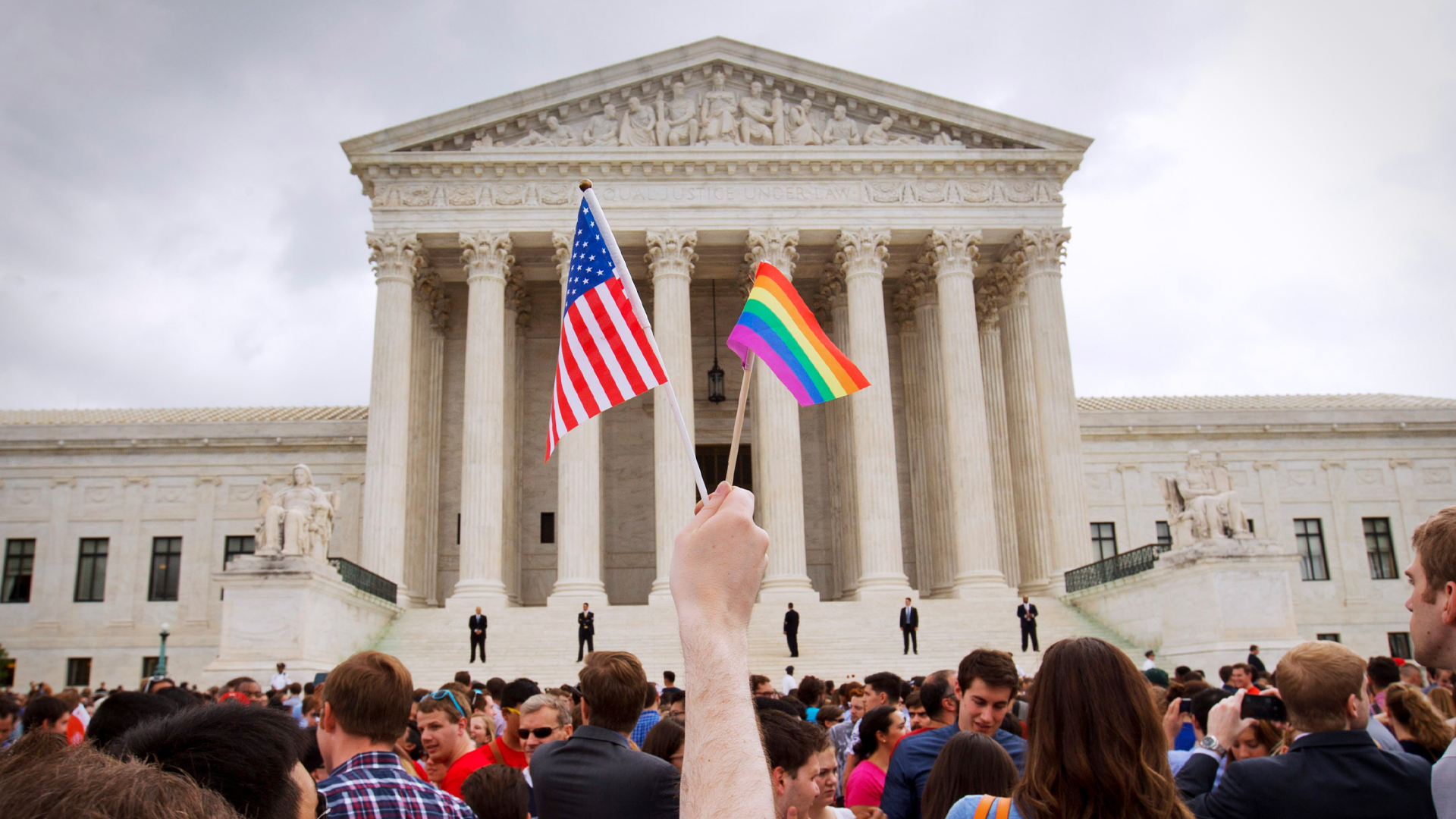
Lesson Plan: Key Moments in LGBTQ+ History
LGBTQ+ rights in the United States were won — and sometimes lost — through decades of protests, court cases, and hard-fought legal change. In this lesson, students will explore an interactive map tracing the key moments and places in that history, from early activist movements to landmark Supreme Court rulings.
Subjects:
U.S. History, Civics/Government
Grade Level:
9-12
Lesson Duration:
1 class period
-
This activity is designed to be a starting point for examining the history of LGBTQ+ rights in the United States.
Essential Questions:
-
How have recognized rights for LGBTQ+ individuals in the United States changed over time?
-
What factors (such as activism, court decisions, or public opinion) drive social and legal change?
-
What makes a historical event a turning point?
-
Why is it important to study multiple perspectives and moments when understanding a social movement?
Lesson Objectives:
Students will:
-
Identify and describe key events in the history of LGBTQ+ rights in the United States.
-
Organize historical events chronologically across multiple decades.
-
Explain how specific events expanded or restricted rights for LGBTQ+ individuals.
-
Analyze patterns and changes over time in the fight for LGBTQ+ rights.
-
Make and support a claim about the most important turning point using evidence from multiple events.
Materials:
-
Interactive Map: Key Moments in LGBTQ+ History | Retro Report
-
Student Activity handout
-
This lesson may be used with the following Retro Report videos (and their lessons). Select “File>Make a Copy” to add video reflection questions to the activity handout.
-
“How the Supreme Court Ruling in Obergefell v. Hodges Legalized Same-Sex Marriage” (Transcript) – Sample question: How would you describe the impact of the Obergefell v. Hodges decision on the American legal and social landscape?
-
“Transgender Rights: A Decades-Long Struggle for Equality” (Transcript) – Sample question: How does the video describe the evolution of the legal status of transgender individuals over time, and what specific policy issues remain a subject of debate today?
Procedure:
-
In this activity, students are introduced to an interactive map that contains content related to the history of LGBTQ+ rights in the United States. To begin, have students discuss their first impressions of the map, details they notice, and list questions that may arise. It is important that they notice the key in the lower right-hand corner; this will help with deciphering the color code and icons.
-
The bulk of the activity will be students looking at the content and choosing events to write about. They are to select an event from each decade; some decades have more events than others.
-
Put the dates/events in chronological order
-
Explain what happened without just copying/pasting from the map
-
Explain how this expanded or restricted rights
-
-
Conclude the activity by having students select one of their events as the “most important turning point” in LGBTQ+ history. They need to use information from the map to defend their claim in their short answer response.
Extension Activities:
-
Select an event from the map for a research mini-project. Highlight things that led up to and possibly caused the selected event, as well as the after-effects of the event. Present findings to the class or use the additional content to engage in a Socratic seminar over the progress of LGBTQ+ rights in the United States.
-
Students must use at least two sources from the provided list. These have been selected to provide accurate, school-appropriate information. It would be recommended that teachers create an even more specific list of resources if needed for their classrooms. Key Moments in LGBTQ+ History (Retro Report); Library of Congress (primary sources, historical context); National Archives (documents and exhibits)
-
Questions to guide research: What event did you choose? Which two factors helped lead to this event? What happened immediately afterward? How did this event affect rights or public awareness?
-
-
Ask students to consider any additional “key moments” that should be on the map, and if so, briefly justify the inclusion or decide what that would replace if there could only be a certain number of “key moments” included.
About the Author:
Laura McFarren is a Social Studies teacher with 23 years of experience teaching American History, Government, Civics and World History. She currently serves as a representative on the board of directors of the National Council for the Social Studies and is involved in professional development and leadership through Retro Report, iCivics and the Kansas Department of Education.
Standards
College, Career, and Civic Life (C3) Framework for Social Studies
-
D2.His.1.6-8. Analyze connections among events and developments in broader historical contexts.
-
D2.His.2.6-8. Classify series of historical events and developments as examples of change and/or continuity.
-
D2.His.3.6-8. Use questions generated about individuals and groups to analyze why they, and the developments they shaped, are seen as historically significant.
-
D2.His.14.6-8. Explain multiple causes and effects of events and developments in the past.
-
D3.1.6-8. Gather relevant information from multiple sources.
-
D4.1.6-8. Construct arguments using claims and evidence from multiple sources.
Common Core Literacy Standards
-
CCSS.ELA-LITERACY.RH.9-10.2. Determine the central ideas of a source and summarize how key events develop over time.
-
CCSS.ELA-LITERACY.RH.11-12.2. Determine central ideas and provide an accurate summary of complex sources.
-
CCSS.ELA-LITERACY.RH.9-10.3. Analyze how and why individuals, events, or ideas develop and interact over time.
-
CCSS.ELA-LITERACY.RH.9-10.7. Analyze various accounts of a subject told in different mediums (e.g., interactive maps).
-
CCSS.ELA-LITERACY.WHST.9-10.1 and 11-12.1. Write arguments focused on discipline-specific content using evidence.
-
CCSS.ELA-LITERACY.WHST.9-10.2. Write informative/explanatory texts to examine and convey complex ideas.
-
CCSS.ELA-LITERACY.WHST.11-12.2. Write informative texts that synthesize multiple sources.