
Lesson Plan: Breaking Away From British Rule
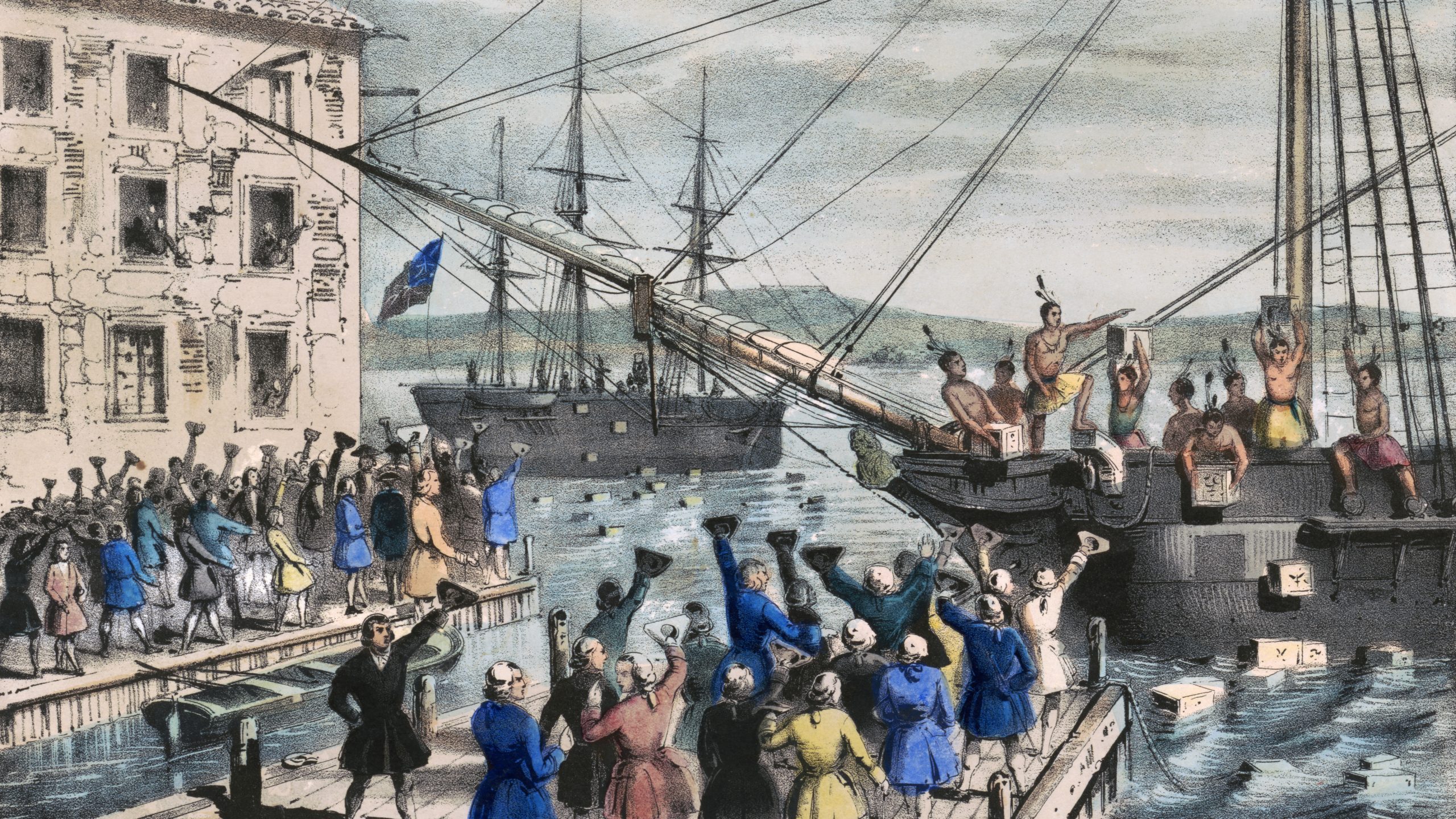
The Boston Tea Party marked a major escalation in the growing conflict between Great Britain and its American colonies. In response to the protest, Parliament passed the Intolerable Acts. This lesson examines how Britain responded to challenges to its authority in North America and compares those responses to later independence movements within the British Empire.
Subject:
World History, U.S. History, Civics
-
This lesson focuses on World History and Britain’s reaction to other independence movements. The historical thinking skills and extension can be applied to U.S. History. For Civics, a focus on how a government and its people interact would align with standards.
Grade Level:
6-12
-
A note: the primary source text could be modified for lower grades or struggling readers
Lesson Duration:
45-60 minutes
Essential Questions:
-
How might countries react to independence movements?
-
Why might some revolutions succeed while others may not?
Lesson Objectives:
Students will:
-
Compare and contrast the British Parliament’s response after the Boston Tea Party to other movements toward independence.
-
Evaluate primary sources to construct and support an argument.
-
Compare and contrast the British government’s response to the American independence movement with its response to movements in Canada, India, and Kenya.
Materials:
-
Retro Report video “When Is History Happening? From the Boston Tea Party to the Battlefield” (Transcript)
-
Student Activity handout
-
“The Coercive (Intolerable) Acts of 1774” | Caroline Eisenhuth for George Washington’s Mount Vernon
-
The King’s speech to both houses of Parliament, on the 30th of November, 1774. Together with their addresses to his Majesty. | Library of Congress
-
Queen Victoria on the British North America Act, February 1867. | The Canadian Encyclopedia
-
Internet Modern History Sourcebook British Government Statement: Policy In India, 1946. | Fordham University
-
Harold Macmillan, British Prime Minister, 3 February 1960; to the South African Parliament, Cape Town. | The University of Pau and Pays de l’Adour
Procedure:
-
Distribute the Student Activity handout and have the students engage in a Think–Pair–Share by responding to the prompts below. Students should discuss responses with a partner and be prepared to share with the class. Responses may include: Colonists were mad at the taxes imposed by Britain. Britain was taxing colonists to pay down debt from the French and Indian War. Students may share information on famous war battles like Bunker Hill, Lexington and Concord, Saratoga, and Yorktown. Common misconceptions may include: All colonists wanted independence, the Revolutionary War just started, with no events prior.
-
List what you know about the Boston Tea Party.
-
How did the British government punish the colonies?
-
What comes to mind when you think of the American Revolutionary War? (Think about who was fighting, why they were fighting, or how long it lasted).
-
What countries can you think of that gained independence in a way similar to the United States?
-
-
Have students watch the Retro Report video and respond to the questions:
-
What did the British Parliament react to the Boston Tea Party?
-
What did John Adams predict in April 1774 regarding the longevity of the conflict between the colonies and Britain?
-
According to Ray Raphael, what specifically caused the Boston Tea Party to be the major “turning point” of the revolution?
-
Were the colonists all in agreement about their goals?
-
Why did many Loyalists hesitate to support leaving the British Empire? What did they fear losing?
-
Why do resistance movements often feel like they may fail before they succeed, if they do?
-
-
Have students read “The Coercive (Intolerable) Acts of 1774” and answer questions about the British Parliament’s response to the Boston Tea Party.
-
Scaffolding ideas for the reading: Chunk the text or rewrite in a simpler format. When looking at primary and secondary sources, you could also create a two-column reading with the original text in one column and a grade-level, paraphrased version in the second column.
-
What did the Massachusetts Government Act do?
-
What did the Act for the Impartial Administration of Justice do?
-
What did the Quartering Act do?
-
What did these three acts do to the colonists?
-
Salutary neglect, or benign neglect, was a policy by Great Britain that was a hands off approach. How did these acts change from being “hands off” to “hands on,” and how do you think colonists would react?
-
-
Students will next read the 1774 address by King George III to Parliament. Analyze the text by answering the question: What specific actions are the colonists taking, and why does King George III view them as a threat to the British Empire? (Based on this excerpt, how did the British Crown perceive the growing colonial resistance, and what were the stated justifications for intervening?) This can be done individually or in pairs. Consider reading aloud or preteaching vocabulary you’d highlight such as resistance (fighting back), disobedience (breaking rules), and unwarrantable (unjustified).
-
“ IT gives me much concern, that I am obliged, at the opening of this Parliament, to inform you, that a most daring spirit of resistance, and disobedience to the law still unhappily prevails in the Province of the Massachusetts Bay, and has in divers parts of it broke forth in violences of a very criminal nature. These proceedings have been countenanced and encouraged in other of My Colonies and unwarrantable attempts have been made to obstruct the commerce of this kingdom by unlawful combinations. I have taken such measures, and given such orders, as I judged most proper and effectual for carrying into execution the laws which were passed in the last session of the late Parliaments the protection and security of the commerce of Subjects, and for the restoring and preserving order and good government, in the Province of the Massachusetts-Bay; and you may depend upon my firm and stedfast resolution to withstand every attempt to weaken or impair the supreme authority of this Legislature over all the dominions of my Crown; The maintenance of which consider as essential to the dignity, the safety, and the welfare of the British empire; assuring Myself, that, while I act upon these principles, I shall never fail to receive your assistance and support
-
-
Summarize the King’s feelings and attitude toward the actions of the colonists as a class. Summaries should mention that the king felt laws were broken and it was his duty to ensure Parliament’s laws are followed in the colonies. Then, have students contrast the British King and Parliament’s reaction to the Boston Tea Party and later the Revolutionary War with the desire for independence of three other countries by answering what similarities or differences exist between the following quotes. How do these independence movements differ from the United States’ experience with Great Britain? Students will paraphrase the quote in their own words
-
Canada “I am very glad to see you on this mission… It is a very important measure and you have all exhibited so much loyalty.” (Source: Queen Victoria on the British North America Act, February 1867. | The Canadian Encyclopedia)
-
India “My colleagues are going to India with the intention of using their utmost endeavours to help her to attain her freedom as speedily and fully as possible. What form of Government is to replace the present regime is for India to decide; but our desire is to help her to set up forthwith the machinery for making that decision…” (Source: Internet Modern History Sourcebook British Government Statement: Policy In India, 1946. | Fordham University)
-
Kenya and other African Nations “The wind of change is blowing through this continent and, whether we like it or not, this growth of national consciousness is a political fact. We must all accept it as a fact, and our national policies must take account of it. (Source: Harold Macmillan, British Prime Minister, 3 February 1960; to the South African Parliament, Cape Town. | The University of Pau and Pays de l’Adour)
-
An optional Jigsaw to allow greater focus on one area and students to read more about how Canada, India, and Kenya gained independence.
-
Extension Activity:
-
Explore other successful and not successful independence movements, including those of former, or current, United States colonies, and contrast them with the experience of the United States.
About the Author:
Dan Bordwell is a district Social Studies coordinator and adjunct instructor in social studies in Minnesota. He has a PhD in curriculum and instruction and over 15 years of experience as a teacher.
Standards
College, Career, and Civic Life (C3) Framework for Social Studies
-
D2.Civ.8.9-12. Evaluate social and political systems in different contexts, times, and places, that promote civic virtues and enact democratic principles.
-
D2.His.6.9-12. Analyze complex and interacting factors that influenced the perspectives of people during different historical eras.
-
D2.His.12.9-12. Use questions generated about multiple historical sources to pursue further inquiry and investigate additional sources.
-
D2.His.16.9-12. Integrate evidence from multiple relevant historical sources and interpretations into a reasoned argument about the past.
Advanced Placement World History
-
World History Topic 5.2. Explain cause and effects of the various revolutions in the period from 1750 to 1900.
-
5.2.B: Explain the causes and effects of the various revolutions in the period from 1750 to 1900.
-
-
Topic 8.5: Decolonization after 1900.
-
8.5.A: Explain how and why various land-based and transoceanic empires dissolved after 1900.
-
Common Core Literacy Standards
-
CCSS.ELA-LITERACY.RH.11-12.7: Integrate and evaluate multiple sources of information presented in diverse formats and media (e.g., visually, quantitatively, as well as in words) in order to address a question or solve a problem.
-
CCSS.ELA-LITERACY.RH.11-12.9: Integrate information from diverse sources, both primary and secondary, into a coherent understanding of an idea or event, noting discrepancies among sources.
