
Lesson Plan: Berlin Airlift – Writing Activities from The Writing Revolution
 Grades 7-12
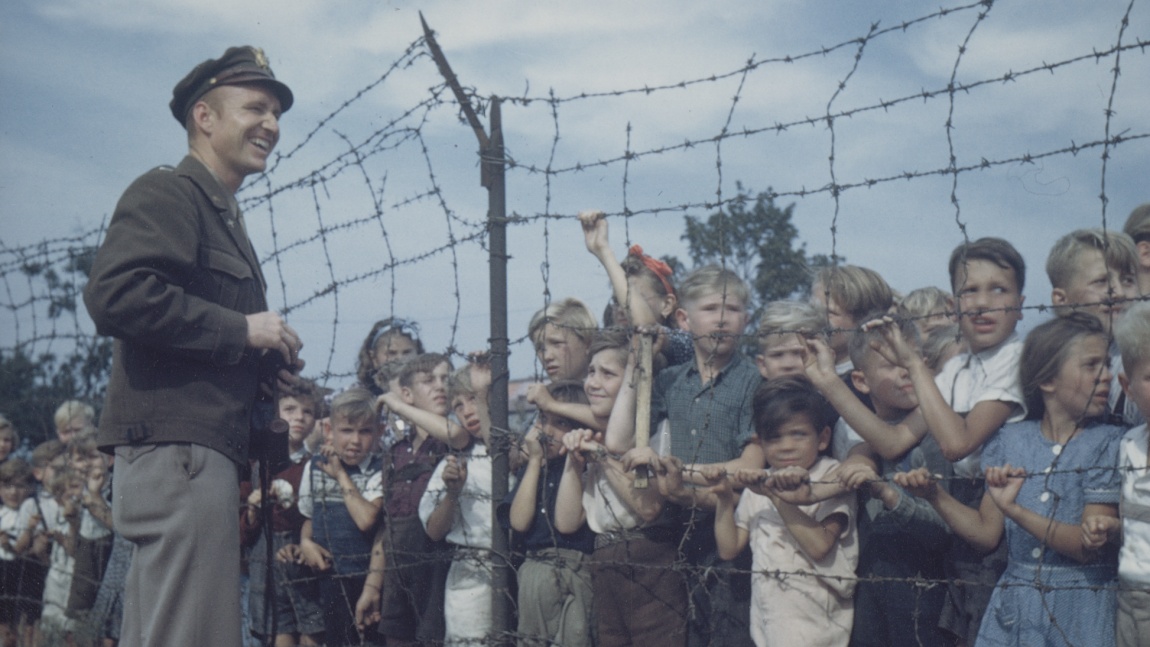
In the early years of the Cold War, the Berlin Blockade and Airlift became a major conflict between the United States and the Soviet Union. The blockade cut off supplies to West Berlin, while the airlift brought food, fuel, and other necessities to the city. At the same time, the airlift showed how the U.S. could display strength and power without going to war, and demonstrated its humanitarian values. Ultimately, this shaped how people in Europe and around the world viewed the United States.
This lesson was created in partnership with The Writing Revolution.



Subjects:
U.S. History, Civics/Government
Lesson Duration:
Up to three 45-minute class periods (depending on how many sources students analyze)
Essential Questions:
- How did the Berlin Airlift affect America’s popularity in Europe and across the world?
- How did the Berlin Airlift help the United States achieve its goals during the Cold War?
Objectives:
Students will:
- Develop a position and present a viewpoint based on historical evidence
- Examine the Berlin Airlift from multiple perspectives, including opposing viewpoints
Materials / Additional Resources:
The complete The Writing Revolution & Retro Report resource is available here and includes:
-
Retro Report video “How a Cold War Airlift Saved Berlin With Food, Medicine and Chocolate” (Transcript)
-
Accompanying background article
-
Primary sources with The Writing Revolution writing activities
-
Analytical composition with The Writing Revolution outlines
Key Vocabulary:
Blockade
Occupation
Airlift
Improvisation
Alliance
Procedure:
-
Build Background Knowledge
Students engage with Retro Report’s video and the provided background article to develop an understanding of the Berlin Airlift and its historical context.
-
Analyze Primary Sources Through TWR Writing Strategies
Students use structured sentence-level activities from the Hochman Method to build knowledge, interpret evidence, and express clear, precise ideas in writing.
-
Plan Analytical Composition
Students use a TWR composition outline to plan and structure their ideas and supporting evidence. The teacher selects from three outline options based on students’ needs.
-
Write Analytical Composition
Students use their completed TWR outline to draft a well-organized response explaining how the Berlin Airlift influenced perceptions of the United States.
About the Writing Revolution:
The Writing Revolution (TWR) is an educational non-profit organization that teaches the Hochman Method. The Hochman Method is a comprehensive, evidence-based approach for teaching expository writing while building content knowledge and critical thinking across all subjects, K–12. The activities in this series highlight select strategies of the method, which are most effective when taught explicitly through modeling and guided practice as part of ongoing instruction. To learn more about professional learning and full implementation guidance, visit thewritingrevolution.org.
Standards
College, Career, and Civic Life (C3) Framework for Social Studies
- D1.5.6-8. Determine the kinds of sources that will be helpful in answering compelling and supporting questions, taking into consideration multiple points of views represented in the sources.
- D2.Civ.2.9-12. Analyze the role of citizens in the U.S. political system, with attention to various theories of democracy, changes in Americans’ participation over time, and alternative models from other countries, past and present.
- D2.Civ.5.9-12. Evaluate citizens’ and institutions’ effectiveness in addressing social and political problems at the local, state, tribal, national, and/or international level.
- D2.Civ.13.9-12. Evaluate public policies in terms of intended and unintended outcomes, and related consequences.
- D2.His.1.9-12. Evaluate how historical events and developments were shaped by unique circumstances of time and place as well as broader historical contexts.
- D2.His.4.9-12. Analyze complex and interacting factors that influenced the perspectives of people during different historical eras.
- D2.His.5.9-12. Analyze how historical contexts shaped and continue to shape people’s perspectives.
- D2.His.14.9-12. Analyze multiple and complex causes and effects of events in the past.
- D3.1.6-8. Gather relevant information from multiple sources while using the origin, authority, structure, context, and corroborative value of the sources to guide the selection.
- D3.3.6-8. Identify evidence that draws information from multiple sources to support claims, noting evidentiary limitations.
- D4.1.6-8. Construct arguments using claims and evidence from multiple sources, while acknowledging the strengths and limitations of the arguments.
Common Core Literacy Standards
- CCSS.ELA.LITERACY.RI.11-12.3: Analyze a complex set of ideas or sequences of events and explain how specific individuals, ideas, or events interact or develop over the course of a text.
- CCSS.ELA.LITERACY.RH.11-12.7: Integrate and evaluate multiple sources of information presented in diverse formats and media (e.g., visually, quantitatively, as well as in words) in order to address a question or solve a problem.
