Transcript
TEXT ON SCREEN: January 25, 1972
ARCHIVAL (WNYC-TV, 1-25-72)
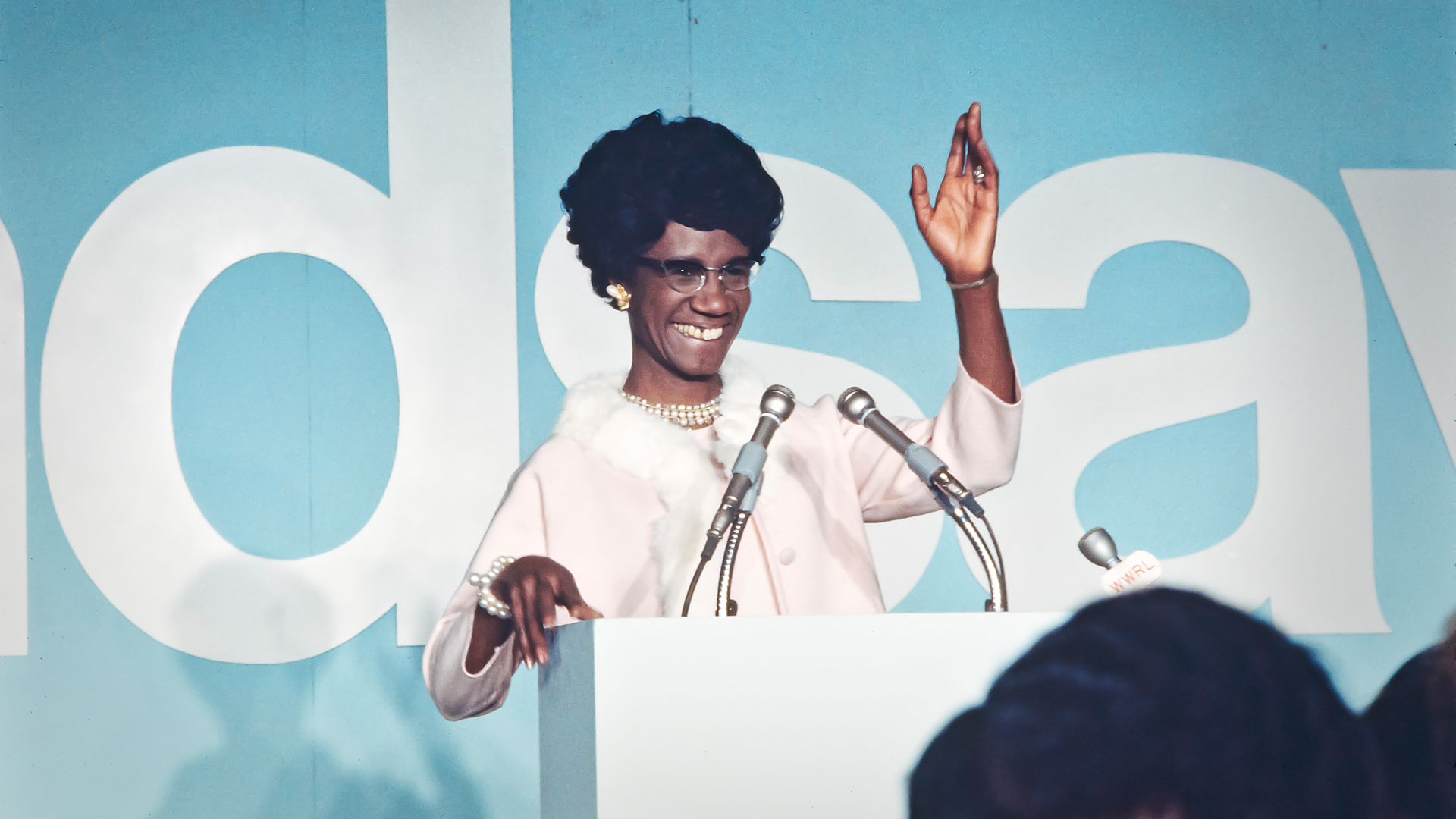
SHIRLEY CHISHOLM: I stand before you today as a candidate for the Democratic nomination for the presidency of the United States of America.
REP. BARBARA LEE (D-CA): Shirley Chisholm did that in 1972, and she was a catalyst for change, but she was also way out there ahead of her time.
ARCHIVAL (WNYC-TV, 1-25-72)
SHIRLEY CHISHOLM: I am not the candidate of Black America, although I am Black and proud.
ANASTASIA CURWOOD (CHISHOLM BIOGRAPHER): For Chisholm, there was no set trail in politics.
ARCHIVAL (WNYC-TV, 1-25-72)
SHIRLEY CHISHOLM: I am not the candidate of the women’s movement of this country, although I am a woman, and I’m equally proud of that.
ANASTASIA CURWOOD: To be Black, to be a woman, to be both meant that she had to just make her own path.
GLORIA STEINEM (FEMINIST LEADER): There had never been anybody but white males in the White House, and Shirley Chisholm made it possible to see and to imagine.
ARCHIVAL (THE GRIO, 2020):
KAMALA HARRIS (2024 DEMOCRATIC PRESIDENTIAL CANDIDATE): I stand as so many of us do on her shoulders because she understood that you just march to that podium and you claim that podium as yours and you don’t ask anybody permission.
REP. BARBARA LEE: This was her slogan, “Unbought and Unbossed,” throughout her entire elected life. She was the first African American woman elected to Congress and she knew that bringing her perspective and her experience to the table would strengthen the country.
TEXT ON SCREEN: BROOKLYN, NEW YORK 1968
NARRATION: In 1968, Shirley Chisolm, a former schoolteacher, daycare director and Democratic state legislator, ran for Congress, hoping to become the first Black politician to represent her predominantly poor and Black Brooklyn neighborhood, Bedford-Stuyvesant.
ARCHIVAL (NBC, 1968):
SHIRLEY CHISHOLM: My name is Shirley Chisholm. On November 5th, send me to the United States Congress.
ANASTASIA CURWOOD, Chisholm Biographer: She watched what people went through in their daily lives, what it was actually like to be doing domestic work, doing factory work. She wanted to have government respond to the day-to-day concerns of the people she saw on the streets of Brooklyn.
ARCHIVAL (NBC, 1968):
JAMES FARMER: Hello there. Please vote for me now.
ANASTASIA CURWOOD: Her opponent, James Farmer, was famous as the leader of the Congress of Racial Equality.
ARCHIVAL (NBC, 1968):
JAMES FARMER: Hope you’re gonna vote for me. November 5th.
ANASTASIA CURWOOD: He ran saying that we need to have a strong male voice in Washington.
ARCHIVAL (2002):
SHIRLEY CHISHOLM: James Farmer said to me, Shirley, the Congress is not for you. We need strong people. You’re a little schoolteacher. And I said, ah-ha, wait a minute. There are more women voters in my district. And boy, the women – white, Black, Puerto Rican – all the women moved behind me.
ANASTASIA CURWOOD: She went out and courted those women to get them out to the ballot box, and she won.
ARCHIVAL (NBC, 1-29-69):
REPORTER: I gather then that you do not plan to be quiet in Congress?
SHIRLEY CHISHOLM: Absolutely not. For 44 years of my life I have been forced to remain silent because of my skin color. I am going to be a freshman that is seen and heard.
ARCHIVAL (WNBC, 1969):
STUDENT: How do you feel being the first Black woman in the House of Representatives?
SHIRLEY CHISHOLM: I have mixed feelings, and, as far as I’m concerned, actually it’s overdue.
NARRATION: Chisholm called her first months on Capitol Hill some of the most difficult of her life. She often felt unwelcome, even among members of her own party, which still included powerful segregationists from the South. Some even refused to sit with her at lunch.
ARCHIVAL (THE DICK CAVETT SHOW, 8-8-69):
SHIRLEY CHISHOLM: I was sat at the Georgian delegation table, and I did not know this. He said, well, here in this body we all have our special tables. I said, look, there are three empty tables right here, they belong to other delegations. I’m eating my lunch and I’m enjoying it. After today I will not sit at this table now that I know it belongs to Georgia. But if you cannot sit now and have your lunch with me at this table, I would suggest you take one of the empty tables, and if indeed anybody from another delegation asks you to rise from those tables I will be the first to support you and help you, you understand.
NARRATION: Chisholm was on the vanguard of major political realignment in American politics. As one of only 13 Black representatives, she co-founded the Congressional Black Caucus.
ARCHIVAL (CBS, 3-25-71):
SHIRLEY CHISHOLM: We are motivated out of a deeper concern about what’s happening to over 25 million Black people in this country.
ARCHIVAL (PROTEST):
WOMEN: Join us!
NARRATION: She was also part of the growing women’s movement. . .
ARCHIVAL (PROTEST):
WOMEN: Equal rights for women now!
NARRATION:. . . supporting the Equal Rights Amendment, reproductive freedom and larger roles for women in the workplace and in politics.
GLORIA STEINEM (DISPLAYING A PHOTO): These are leaders of the National Women’s Political Caucus. We had the radical idea that women were half the population, we could be half the political representation. This is me. This is Bella Abzug. This is Shirley.
ARCHIVAL (WOMEN’S CONFERENCE, 1969):
SHIRLEY CHISHOLM: I happen to believe that women need to assume a much more important role. Women are a little bit more sensitized to the problems that concern family, education, social welfare measures.
NARRATION: Chisholm wanted government to serve people’s essential needs. . .
ARCHIVAL (WNBC):
SHIRLEY CHISHOLM: You know, I do what my conscience tells me to do.
NARRATION:. . . and was effective at building support in Congress for programs that benefited her constituents.
GLORIA STEINEM: Shirley was always representing what she experienced in her own life. For instance, she clearly understood the importance of childcare, access of women to elective positions. Her vision of what could be was in advance of the people around her.
TEXT ON SCREEN: 1972
ARCHIVAL (WNYC-TV, 1-25-72):
SHIRLEY CHISHOLM: Those of you who have been neglected, left out, ignored, forgotten or shunned aside, join me as we go down the Chisholm trail for 1972.
ARCHIVAL (CBS NEWS, 1-25-72):
WALTER CRONKITE: A new hat – rather, a bonnet – was tossed into the Democratic presidential race today, that of Mrs. Shirley Chisholm, the first Black woman to serve in Congress.
ARCHIVAL (2002):
SHIRLEY CHISHOLM: I felt that the time had come when a Black person or a female person could and should be president of these United States of America, not only white males, and I decided somebody had to get it started.
ARCHIVAL (ABC, 1-14-72):
SHIRLEY CHISHOLM: I’m a shaker-upper of the system!
ARCHIVAL (THE ASSOCIATED PRESS, 6-24-72):
SHIRLEY CHISHOLM: The Democratic Party must place primary stress on quality of life, the community.
ARCHIVAL (THE ASSOCIATED PRESS, 2-18-72):
SHIRLEY CHISHOLM: I even just want Black boys and Black girls to just remember that anybody can run for president.
ANASTASIA CURWOOD: She really wanted everybody to understand that they could find a home in her campaign, and to bring new people to the table in politics.
ARCHIVAL (RADIO ADVERTISEMENT, 1972):
SHIRLEY CHISHOLM: There must be a new coalition of Americans: Black, brown, white, red and yellow, rich and poor.
REP. BARBARA LEE: I met Shirley Chisholm when I invited her to come to my college campus in Oakland, California, Mills College. It was amazing. She talked about poverty, spoke fluent Spanish. She was a pro-abortion rights candidate and woman. And she said, are you registered to vote? I said no. She said, you have got to register to vote and you need to help me in my campaign. I said okay.
GLORIA STEINEM: This is the group of us who ran as delegates, pledged to support Shirley Chisholm and here are all of our names.
NARRATION: Throughout the primaries, Chisholm struggled for media coverage.
ARCHIVAL (THE ASSOCIATED PRESS, 3-22-72):
GLORIA STEINEM: Unfortunately, Shirley Chisholm has not got the depth and breadth of the coverage she deserves.
NARRATION: She was not invited to participate in televised debates and ultimately brought and won a lawsuit challenging her exclusion.
ARCHIVAL (CBS, 6-4-72):
SHIRLEY CHISHOLM: Well, the only thing that I’ve always asked for is equitability, you know, of treatment.
GLORIA STEINEM: Her campaign manager had succeeded in getting her compensatory time on some New York television station, and so he asked me to write her speech. It’s still the proudest political moment in my life to hear her saying words that I had written. Amazing.
NARRATION: While Chisholm knew she would not get the nomination, she wanted to win enough delegates to have bargaining power at the convention, to push for issues she cared about to be included in the Democratic party platform.
BARBARA LEE: I went to Miami as a Shirley Chisholm delegate. It was my first convention. I get chills just thinking about it. Oh God.
ARCHIVAL (THE ASSOCIATED PRESS, 7-13-72):
PERCY SUTTON: I present to you in nomination the honorable Shirley Chisholm.
BARBARA LEE: To be on the floor and to see how people responded to her, it was just amazing.
ARCHIVAL (DEMOCRATIC NATIONAL CONVENTION ROLL CALL, 1972):
MISSISSIPPI REP: Madam Chairman, Mississippi proudly casts 12 votes for Shirley Chisholm.
NEW JERSEY REP: Four for Congresswoman Chisholm.
PENNSYLVANIA REP: Pennsylvania votes nine and one-half for Chisholm.
ANASTASIA CURWOOD: She was nominated and she got up to 151 votes on the floor of the convention hall. That was the most for any woman until 2008.
ARCHIVAL (DEMOCRATIC NATIONAL CONVENTION, 7-12-72):
SHIRLEY CHISHOLM: In unity there is strength. I also want to make it quite clear that it was the delegates here that made history tonight. The delegates that made history tonight.
NARRATION: Ultimately Chisholm returned to Congress, where she served until 1983. She was elected secretary of the House Democratic Caucus and helped expand food programs for the poor that still exist today.
GLORIA STEINEM: She was never taken as seriously as a candidate as she should have been. I don’t know what made it possible for her to survive and lead and speak. It’s a miracle. But she did.
TEXT ON SCREEN: 2024
ARCHIVAL (DEMOCRATIC NATIONAL CONVENTION, 2024):
KATHY HOCHUL (GOVERNOR OF NEW YORK): We are the birthplace of Shirley Chisholm, and we cast 298 votes to make Kamala Harris the first female president of the United States.
ANASTASIA CURWOOD: The Democratic coalition has changed, and now is strikingly similar to the coalition that was behind Shirley Chisholm.
ARCHIVAL (DEMOCRATIC NATIONAL CONVENTION, 2024):
VICE PRESIDENT KAMALA HARRIS: I accept your nomination to be president of the United States of America.
NARRATION: Although she did not win, 50 years after Shirley Chisholm’s run, Vice President Kamala Harris was the first woman of color to gain a major party presidential nomination.
ANASTASIA CURWOOD: Kamala Harris was a young girl who saw Shirley Chisholm run for president and said oh yeah, Black women run for president.
ARCHIVAL (DEMOCRATIC NATIONAL CONVENTION, 2024):
VICE PRESIDENT KAMALA HARRIS: Don’t ever give up, and don’t you ever listen when anyone tells you something is impossible because it has never been done before.
ARCHIVAL (2002):
SHIRLEY CHISHOLM: I want history to remember me, not that I was the first Black woman to be elected to the Congress, not as the first Black woman to have made a bid for the presidency of the United States, but as a Black woman who lived in the 20th century and who dared to be herself. I want to be remembered as a catalyst for change in America.
(END)
Shirley Chisholm Was a Trailblazer for Change
Explore the groundbreaking career of Shirley Chisholm, the first Black woman to seek the U.S. presidency.
In 1972, Shirley Chisholm made history as the first Black woman to run for U.S. president. This Retro Report documentary chronicles Chisholm’s journey from Brooklyn to Capitol Hill, where, as the first Black woman elected to Congress, she overcame sexism and racism as an outspoken advocate for racial equality, women’s rights and social justice.
Known for her slogan “Unbought and Unbossed,” Chisholm’s candidacy challenged institutions long dominated by white men, and inspired women and people of color to follow her lead.
“Shirley was always representing what she experienced in her own life,” said Gloria Steinem, the feminist leader who worked closely with her. “Her vision of what could be was in advance of all the people around her.”
Chisholm’s pioneering influence was clear in the 2020 Democratic primary when Vice President Kamala Harris launched her first presidential run, acknowledging, “I stand, as so many of us do, on her shoulders.”
Stay up to date. Subscribe to our newsletters.
- Producer: Jill Rosenbaum
- Editor: Brian Kamerzel
 Grades
6-12
Grades
6-12
 1 Lesson Plan