
Transcript
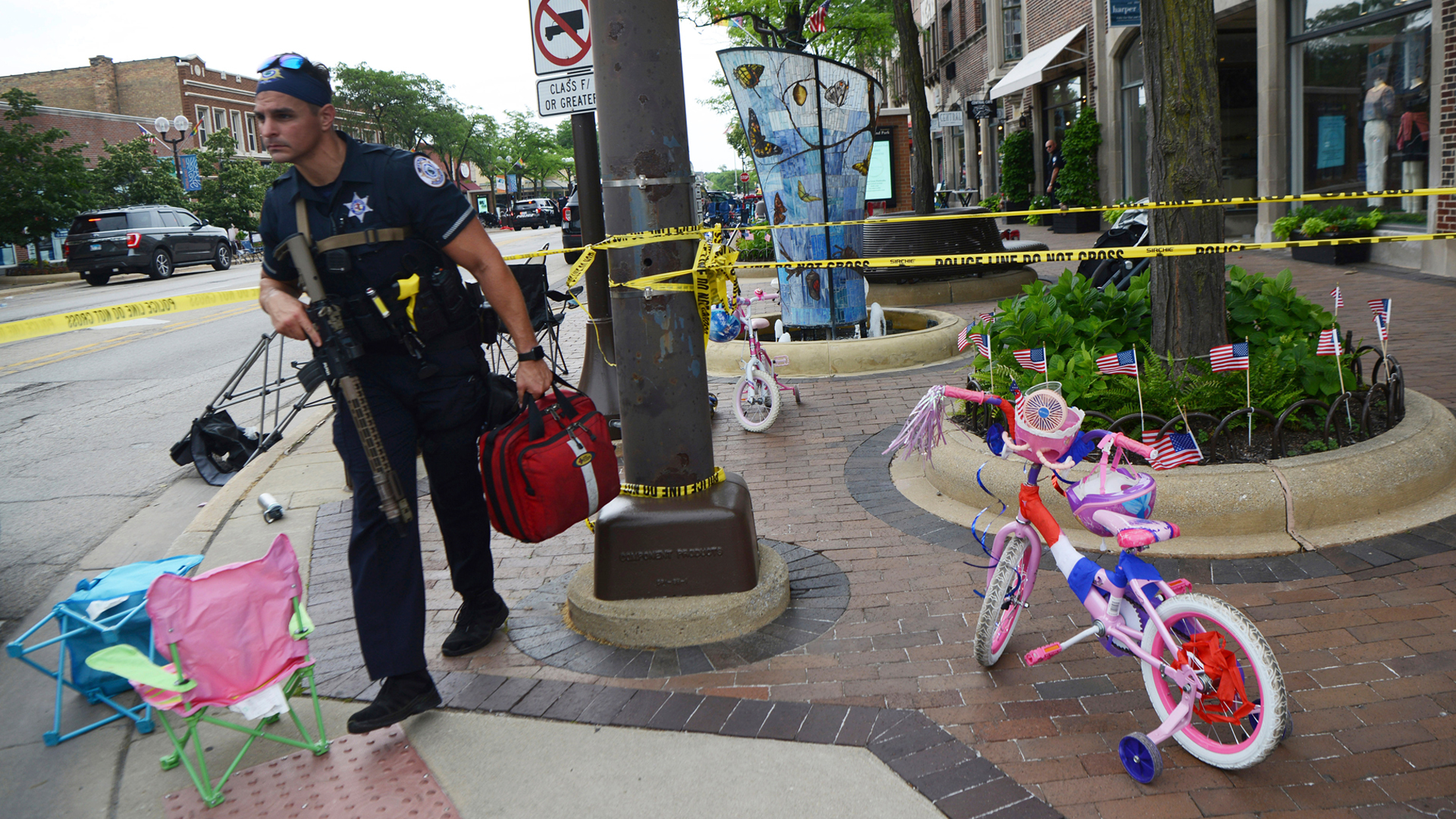
MARTIN ROSSEN: The morning was joyful, sun was shining. Our girls were just thrilled to be putting on their red, white and blue, and we got great spots on the parade route.
TEXT ON SCREEN:
Highland Park, Illinois
July 4, 2022
JASON ROTTER: My family, Martin’s family, we set up on a curbside and then, you know, 60 seconds later we hear gunshots. Within seconds, my wife, who’s facing towards where the gunfire is coming from, sees people falling. So I grabbed my 4-and-a-half-year-old and I run as fast as I can down the street, away from the direction of the gunfire.
MARTIN ROSSEN: Jason and I and our families are, quote unquote, the lucky ones from that day. Seven died, 48 were injured.
ARCHIVAL (CBS CHICAGO, 7-4-22):
NEWS REPORT: The suspect used a high-powered rifle.
ARCHIVAL (FOX32, 7-5-22):
NEWS REPORT: The Highland Park community in mourning tonight.
ARCHIVAL (SCRIPPS NEWS, 7-5-22):
NEWS REPORT: Surviving a mass shooting has become a rite of passage in our country.
MARTIN ROSSEN: How is it acceptable for a civilian to have access to such a weapon? How do we allow that as a society?
ARCHIVAL:
PROTESTERS: Enough is enough! Enough is enough!
MARTIN ROSSEN: There was a feeling that we should try and prevent the tragedy that happened in our community from happening to other communities in our state and our country.
ARCHIVAL:
PROTESTERS: Not one more!
DARREL MILLER (UNIVERSITY OF CHICAGO LAW SCHOOL): We have a significant amount of gun violence in the United States. But there’s two aspects to the possibility of gun regulation. There might be political will behind it, especially involving, like, a mass shooting for example, in Highland Park, but that doesn’t address the legal issue because the Supreme Court, with the Second Amendment, has been pushing more and more into this area, adjudicating things that a lot of people thought were settled law.
NARRATION: Darrel Miller, a Second Amendment scholar, has spent more than a decade studying America’s gun laws and their effect on cities and states across the country.
DARREL MILLER: There is a fairly long history going back to the Founding era of both gun rights and gun regulation co-existing side by side. For 200 years the court had used the militia clause of the Second Amendment to give it some context. If you wanted to have a gun, it had to be related in some way to the maintenance of a well regulated militia.
ARCHIVAL (EXCERPT FROM THE MOVIE “SCARFACE,” 1932):
ACTOR: Hey lookit, they got machines you can carry.
DARREL MILLER: For example, the first federal firearms regulation of 1934 put a tax on things like machine guns or short-barreled shotguns, essentially trying to drive them out of the market because they were used by bootleggers and mobsters to commit violence, and the court said that kind of weapon actually has no relationship to a well regulated militia and therefore the law is perfectly constitutional.
ARCHIVAL:
PROTESTER: Take our rights!
PROTESTERS: We say no. D.C. gun law has to go.
NARRATION: That changed 74 years later, in a 2008 case called District of Columbia versus Heller, when the Supreme Court struck down a longstanding D.C. law that made legal handgun ownership virtually impossible.
DARREL MILLER: It’s the first case to essentially hold that individuals have rights to keep and bear arms for purposes completely unrelated to a well regulated militia. And so after Heller, what happened was, people had a right to say I’m not a member of a militia, but I have a right to keep and bear arms in my home for personal purposes, like self-defense.
NARRATION: That Supreme Court decision was limited in scope, as it only applied to federal areas like Washington, D.C. However, many other cities also had extensive restrictions on handgun ownership. Chicago passed its ordinance in the 1980s, spurred by rising crime and the assassination attempt on then-President Ronald Reagan.
ARCHIVAL (NBC, 3-19-82):
NEWS REPORT: The Chicago City Council decided to try to control handguns by severely limiting their registration.
COLLEEN LAWSON: In 2007 I came face to face with three men having broken into my home at my back sliding glass door. I literally was eight inches away from their faces. I mean, to this day, I could tell you every pore or every scar on their faces.
NARRATION: Shaken by the experience, Colleen Lawson decided to apply for a handgun license, but was denied.
COLLEEN LAWSON: The city of Chicago told me no, you can’t have that, and I’m like, why? Because it’s illegal. And why is it illegal? Because you can’t have it. And this just went around like that. So I found it to be discriminatory.
ARCHIVAL (CBS, 6-28-10):
NEWS REPORT: Critics of Chicago’s gun ban say this dramatic shootout on the city’s South Side highlights the problem with gun bans. Bad guys will find a way to get weapons, often leaving law abiding citizens defenseless.
NARATION: In 2008, shortly after the Heller decision, Colleen Lawson and her husband decided to take the city of Chicago to court. Gun rights organizations gathered together other plaintiffs from diverse backgrounds.
ARCHIVAL (NBC, 3-2-10):
REPORTER: Otis McDonald has lived in this South Side Chicago neighborhood for 38 years, but says with gangs and drug dealers spreading in. . .
OTIS MCDONALD: It is a nerve wracking thing.
REPORTER: . . . He’d feel safer if he could have a handgun.
DARREL MILLER: Otis McDonald was significant for this case, in part because gun rights organizations and gun rights lawyers had been looking around for quite a while to have essentially an African American face to the issue of gun rights, and they found one in Otis McDonald.
ARCHIVAL (MSNBC, 3-2-10):
OTIS MCDONALD: This will give people like myself a little bit of of – a better feeling sitting in my own home.
COLLEEN LAWSON: What we had in common was our determination to end the constant bite of fear that we had felt.
NARRATION: Two years after filing suit to overturn Chicago’s gun ban, Colleen Lawson and the other plaintiffs finally got their answer.
ARCHIVAL (MSNBC, 6-29-10):
NEWS ANCHOR: On its final day of its session, the Supreme Court today coming down in favor of gun rights in a controversial 5 to 4 ruling, one that is likely to spur more gun control lawsuits nationwide.
ARCHIVAL (CBS, 6-28-10):
NEWS ANCHOR: The Second Amendment, Alito wrote, applies equally to the federal government and the states. Justice John Paul Stevens said in dissent that the ruling would prove destructive to our nation’s communities and to our constitutional structure. The ruling was a victory for the N.R.A., which has fought for decades to establish a constitutional right to own guns.
ARCHIVAL (ABC, 6-28-10):
OTIS MCDONALD: In my opinion, self-defense in America has been validated today.
COLLEEN LAWSON: Winning the case didn’t just mean that we could have the right to have a handgun in our home. It meant every home across the United States could. The Second Amendment right is a right, and you can’t just pick and choose what parts of that you want.
NARRATION: The struggle to overturn Chicago’s handgun ban turned Colleen Lawson into a gun rights advocate. . .
COLLEEN LAWSON (SHOWING HER GUN KIT): This is my traveling instruction kit that I keep at the training range.
NARRATION: . . . and a firearms safety instructor.
COLLEEN LAWSON: Revolvers . . .
DARREL MILLER: McDonald is really the culmination of a long arc by gun rights advocates to change the perception about the Second Amendment. And it was a successful campaign leading to where we are today.
NARRATION: Recent Supreme Court decisions have made it even harder for states and cities to regulate gun ownership, by changing the calculus of what justifies limiting a citizen’s Second Amendment rights.
DARREL MILLER: The future of firearm regulation and rights in America is really in flux, and that makes it really, really difficult to sort of figure out what is in fact, lawful or not.
JASON ROTTER: Before the Highland Park shooting, I understood generally that the gun laws in this country were being challenged.
MARTIN ROSSEN: But our entire community was grieving and experiencing trauma. And for me, the fundamental question that I found myself asking after the parade shooting was, in order to effect change, how do we get more organized to get the outcomes that we want, to make our society a safer place for our kids to grow up in?
ARCHIVAL:
PROTESTERS: Demand action now! Demand action now!
JASON ROTTER: We shouldn’t have more kids dying from gun violence than, than motor vehicle accidents.
ARCHIVAL:
PROTESTERS: Assault rifles have got to go!
JASON ROTTER: One of my proudest accomplishments is that we were able to ban assault rifles and weapons in Illinois within a year of the Highland Park mass shooting.
NARRATION: That law is now on appeal, with critics claiming that it infringes on their right to self-defense. But gun control advocates like Rotter and Rossen say they will keep pressing the case for what polls estimate nearly 60 percent of Americans want — gun laws that balance regulation with Second Amendment rights.
MARTIN ROSSEN: The majority of gun owners that I’ve talked to are willing to give up small amounts of personal freedom to lower the amount of gun violence in our communities. The majority of Americans want to see that change.
(END)
How Gun Violence and the Supreme Court Have Shaped Second Amendment Rights
Supreme Court rulings on gun laws highlight the struggle to balance individual rights and public safety.
Supreme Court rulings on gun laws reflect an ongoing national debate over how to balance individual rights and public safety. This video considers the perspectives of gun rights advocates, scholars, and those pressing for stricter firearms regulation as it explores how the court has reinterpreted the Second Amendment.
Experts underscore pivotal developments, including the Founding era’s focus on “a well regulated militia” and the 2008 ruling in District of Columbia v. Heller, where the Supreme Court affirmed an individual’s right to own firearms for personal use. Key moments – like the 1934 National Firearms Act targeting violent mobsters, and the Supreme Court’s decision in 2010 in McDonald v. Chicago, extending Second Amendment rights to state and local governments – illustrate how the balance between regulations and rights has shifted over centuries.
Through personal accounts from survivors of the 2022 mass shooting at a July 4 parade in Highland Park, Ill., that left seven people dead and 48 wounded, the narrative captures the emotional toll of gun violence.
Today, as efforts to limit access to high-powered weapons face legal challenges and courts reinterpret the Second Amendment, the future direction of gun regulation is uncertain. Meanwhile, new data from the C.D.C. show a clear link between weaker gun regulations, higher gun ownership rates and elevated gun death rates, as highlighted in a recent Violence Policy Center analysis.
Gun law advocates say they will keep pressing the case for what polls estimate nearly 60 percent of Americans want: gun laws that balance regulation with Second Amendment rights.
- Producer: Kit R. Roane
- Editor: Brian Kamerzel
- Associate Producer / Reporter: Cole Cahill
 Grades
9-12
Grades
9-12


 1 Lesson Plan

