

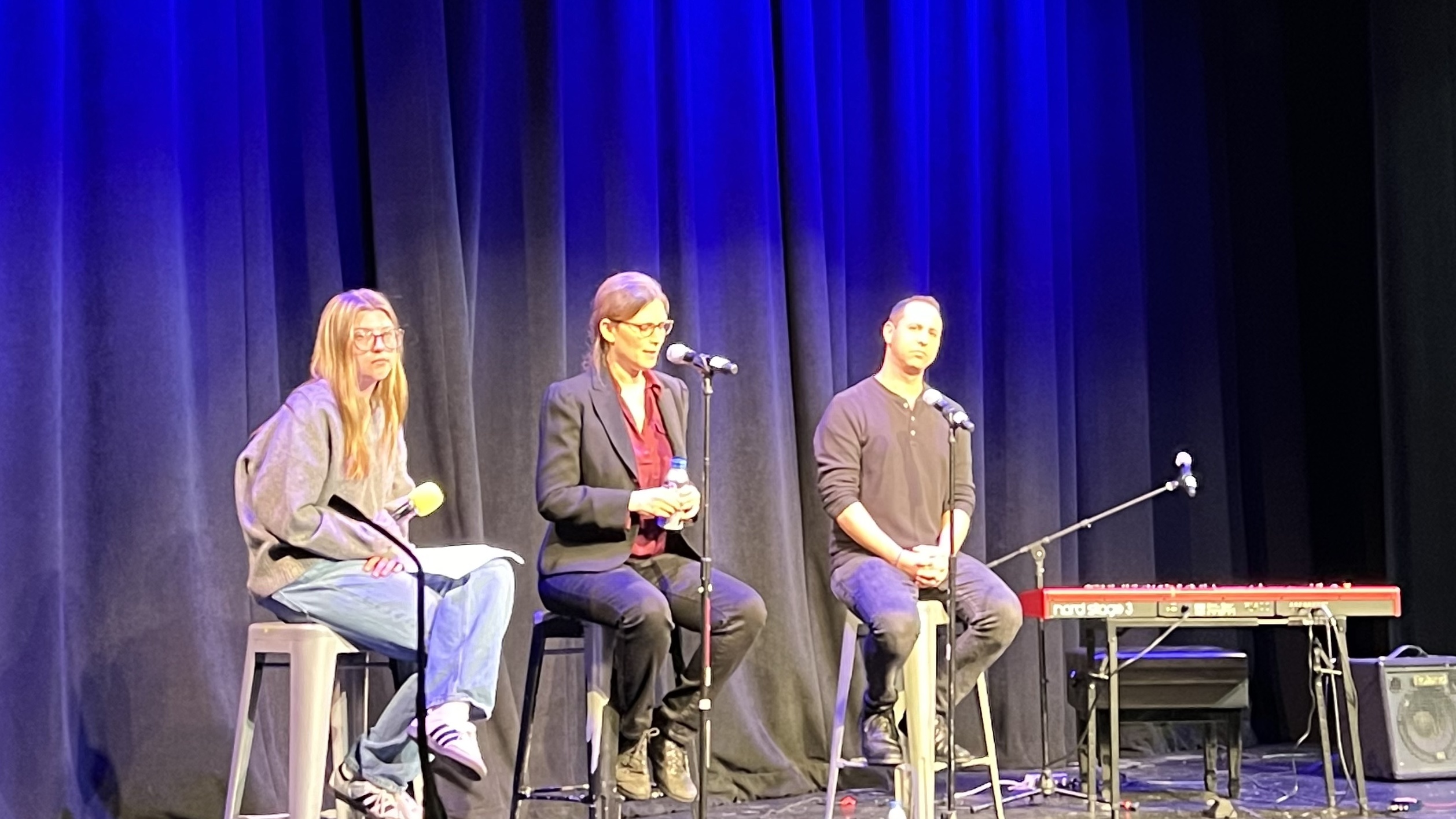
In observance of Holocaust Remembrance Day, Sara Taksler, the director of “How Saba Kept Singing,” a film about a Holocaust survivor and Avi Wisnia, the grandson of the film’s main character, visited the Masters School in Dobbs Ferry, N.Y., to screen the film for students and teachers.
Lily Zuckerman, a student at the school and a former Retro Report intern, requested the screening on behalf of the school’s Jewish Culture Club.
One of Zuckerman’s first assignments as an intern was to watch Retro Report films and review educational resources, choosing the five stories she wished she had seen in class. “I knew that my school community would benefit from learning about Saba’s story,” she said.
In the past, the Jewish Culture Club has invited Holocaust survivors to share their stories, but over time, their number has dwindled. “I’m happy that we had survivors come when that was possible,” said Miriam Emery, a faculty advisor to the club, “but as survivors have gotten older and there’s fewer of them, it’s been challenging to find the right people to speak.” Soon, Emery said, “we’re going to enter a new stage of Holocaust studies and Holocaust remembrance, which is not going to involve the survivors themselves.”
Matthew Ives, a history teacher at the school, said the film supported the way he addresses the Holocaust in class. “I was moved by the personal emotions in Saba’s story from the film, often overlooked in history,” he said. “Understanding the Holocaust involves more than analyzing the past. It requires empathy and imagination to immerse oneself in that period.” Retro Report’s film accomplished that, Ives said, by emphasizing the importance of personalizing history rather than simply explaining it.
Ives, who is an advisor for Tower, the student newspaper, invited Taksler and Wisnia to speak to the paper’s staff about their creative process.
By hearing from the storytellers, students “got a sense of the decision-making process regarding deciding what goes in,” Ives said. “They learned how the material was gathered, and ideas came into play.”
Lydia Ettinger, a Masters senior whose grandfather survived the Holocaust, said that the film “was super impactful and touching.”
“Being able to actually talk to Sara, the director of the film, was very special, and being able to speak to Avi was incredibly important, as it is their responsibility to pass on the stories of their grandparents,” she said.
“It can’t just be the responsibility of Jews to understand the Holocaust,” she said, but rather, it “is the entire community that bears that responsibility.”
Aron Tucker, a senior whose great-grandparents survived the Holocaust and whose grandparents fled to Israel, said he was inspired by the film.
“The movie portrayed the resilience and unique Jewish community, which is often misunderstood in modern society,” Tucker said. “I attended the Q&A session at lunch and found the family to be carrying the message of strength” – that the prosperity and flourishing of modern Jewish families “is in itself revenge and resistance against our families suffering in the Holocaust.”
In a conversation with Wisnia, Tucker said, “I felt a strong sense of understanding and community.” He continued, “We discussed contemporary Jewish emotions and even spoke some Hebrew together. I feel he brought a message of connection, understanding and love of modern Jews to the Masters School.”
LILY ZUCKERMAN, a former Retro Report intern, is a senior at The Masters School in Dobbs Ferry, NY.
Stay up to date. Subscribe to our newsletters.
