
Lesson Plan: How the Supreme Court Ruling in Obergefell v. Hodges Legalized Same-Sex Marriage
 Grades 9-12
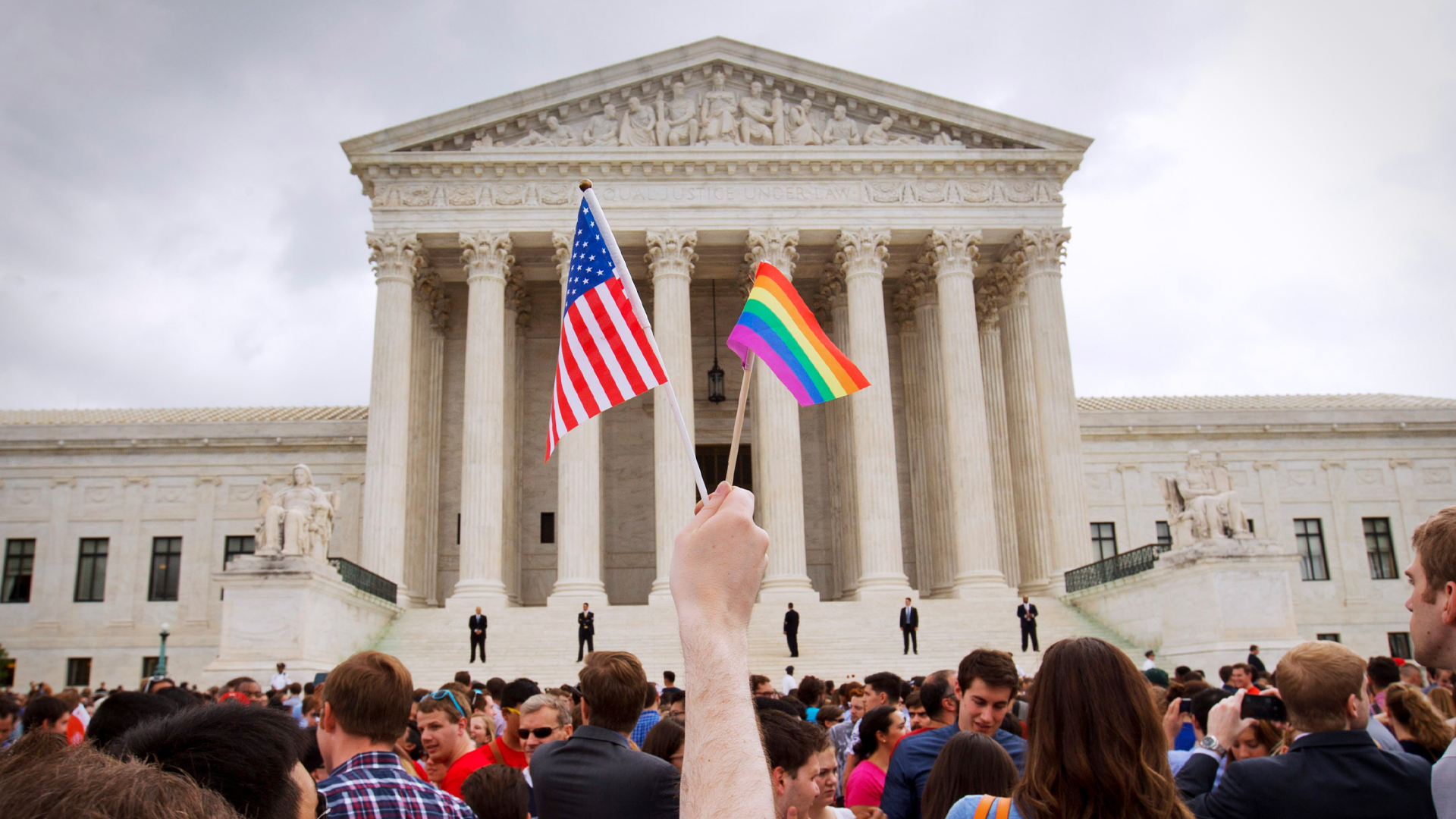
When Jim Obergefell and his partner John Arthur decided to marry after more than 20 years together, they faced a formidable obstacle: their home state of Ohio refused to recognize same-sex marriages. With John terminally ill, the couple chartered a medical jet to Maryland, where their marriage would be legal. Their decision set in motion a legal challenge that reached the Supreme Court in 2015, as Obergefell v. Hodges. The court ruled 5 to 4 that the 14th Amendment’s equal protection clause requires all states to recognize the marriages of same-sex couples.



Subjects:
Civics/Government
- This lesson covers Supreme Court rulings over several decades in U.S. history, specifically focusing on the 14th Amendment’s equal protection clause and marriage equality.
Essential Questions:
- How has the legal definition of marriage changed over time?
- How have states and the national government defined marriage differently?
- How have constitutional definitions of marriage (both state constitutions and the U.S. Constitution) been addressed over time?
- How did the 14th Amendment’s guarantee of equal protection evolve through landmark U.S. Supreme Court cases to affirm the right to marry for all individuals, regardless of sex?
- To what extent did the Defense of Marriage Act (DOMA) reflect and clash with the evolving understanding of equality and fundamental rights under the U.S. Constitution?
Lesson Objectives:
Students will:
- Identify the key legal questions addressed in Obergefell v. Hodges.
- Explain the significance of the 14th Amendment’s equal protection clause in the context of marriage equality.
- Summarize the key holdings and reasoning of precedent cases.
- Synthesize their understanding of the legal arguments and historical context, with a particular emphasis on the equal protection clause, to create a visual representation (infographic or flowchart).
Materials:
- Retro Report video “How the Supreme Court Ruling in Obergefell v. Hodges Legalized Same-Sex Marriage” (Transcript)
- Student Activity handout
- Article IV, Section 1 Constitution Annotated | Congress.gov
- Excerpts from H.R.3396 – Defense of Marriage Act (1996) | Congress.gov
- Case Summaries: Obergefell precedents: Summaries of Loving v. Virginia, Romer v. Evans, United States v. Windsor, and Baker v. Nelson are based upon information drawn from oyez.com and justia.com.
- Art supplies or digital tools for creating infographics/flowcharts
- 14th Amendment, Section 1 | Constitution Annotated
Procedure:
- Introduce the following scenario for students: “Imagine that you and your family are moving from your home state across the country to another state. What are some things that your family might have done, or documents that they might possess, in your home state that they would need or expect to still be valid or recognized in the new state?”
- Have students brainstorm examples on the Student Activity handout, categorizing them as “Public Acts,” “Records,” or “Judicial Proceedings.”
- Ask students to volunteer to share their examples and categorization.
- Then, display Article IV, Section 1, the full faith and credit clause of the Constitution: “Full Faith and Credit shall be given in each State to the public Acts, Records, and judicial Proceedings of every other State. And the Congress may by general Laws prescribe the Manner in which such Acts, Records and Proceedings shall be proved, and the Effect thereof.”
- Explain to students that this clause says that states have to recognize and respect the public acts, records, and court decisions of other states. Make the connection to how marriages were recognized both pre- and post-DOMA and Obergefell.
- Briefly introduce Obergefell v. Hodges as a landmark Supreme Court case that addressed the issue of same-sex marriage.
- Write the main questions the case addressed on the whiteboard/blackboard:
- Does the 14th Amendment require a state to license a marriage between two people of the same sex?
- Does the 14th Amendment require a state to recognize a marriage between two people of the same sex that was legally licensed and performed in another state?
- Preview the questions with students to prepare them to answer during the video. Watch the Retro Report video and answer the following:
- When did Jim and John first meet? What was the legal situation for same-sex couples in the United States at that time?
- What was the purpose of the Defense of Marriage Act (DOMA) when it was passed in 1996?
- What significant event occurred on June 26th, 2013, regarding DOMA, and what immediate impact did it have on same-sex couples like Jim and John?
- What hurdle did Jim and John need to overcome to get married after the 2013 Supreme Court ruling?
- How did the Health Department Director in Ohio, a Republican, explain his position as the defendant in the Obergefell case, despite his personal views?
- Beyond legal arguments, what did Jim Obergefell find to be a powerful factor in changing hearts and minds regarding marriage equality?
- What was the Supreme Court’s final decision in Obergefell v. Hodges on June 26th, 2015, and what key phrase did Justice Anthony Kennedy use in the majority opinion?
- According to the video, what threats or challenges to marriage equality have emerged since the Obergefell decision in 2015?
- Analysis: Students will read excerpts from the Defense of Marriage Act (DOMA) and answer the related questions on the Activity handout. Review answers as a class, as needed.
- Based on the first excerpt, if a same-sex couple was legally married in Massachusetts (a state that recognized same-sex marriage), would another state like Ohio be required to recognize their marriage under this part of DOMA? Explain your answer.
- What specific type of legal concept is the first excerpt of DOMA attempting to override or limit regarding how states interact with each other’s laws? (Hint: Think about full faith and credit).
- According to the second excerpt, how did DOMA define “marriage” and “spouse” for all federal purposes?
- Why would the second excerpt of DOMA be particularly significant for same-sex couples, even if their state recognized their marriage?
- How do these two sections of DOMA address both state-to-state recognition and federal recognition of same-sex relationships?
- If a state had a law allowing same-sex marriage, could the federal government still deny them benefits under DOMA? Explain using the provided text.
- Case Summaries for Obergefell precedents:
- In small groups, students will jigsaw summaries of four marriage equality precedent cases (Loving v. Virginia, Romer v. Evans, United States v. Windsor, Baker v. Nelson).
- Assign students to “home” groups of four or five students per group. Assign each member of the group a different precedent case to analyze.
- Students individually read their assigned case summary, jotting down the main points, big ideas, or key terms and identifying ideas that seem important, puzzling, surprising, etc.
- Students should stay focused on how the equal protection clause was referenced in the precedent case as well as how the precedent case relates back to the main questions in Obergefell.
- Students then move to “expert” groups consisting of people who read the same precedent case they did. As a group, students discuss the text.
- Tell students: “Each member of the ‘expert group’ will be explaining their precedent case to classmates who have not read it. To prepare, you will meet with other ‘experts’ on the precedent case to confirm your understanding. Review the key points and address any questions about the case. With the last few minutes of discussion time, collectively agree upon three to five talking points that summarize the big ideas of your case to be shared by each expert with their respective home groups.”
- Finally, students join “home groups” of four to five for each person to share what they read. First, each person should take no more than a couple of minutes to give the group the main ideas from their section of the reading.
- Next, everyone should join in a general discussion about all of the cases. Students try to find connections, similarities and differences, or themes, jotting down notes as they discuss.
Extension Activity:
- Explain to students that they will be working together to create a visual representation of marriage equality through either a flowchart or infographic.
- Give students specific guidelines for their visual products, including the key information they need to include and any formatting requirements.
- Provide students with access to reliable sources for their research, such as summaries of Supreme Court cases and reputable news articles.
- Allow students some flexibility in their design and presentation to foster engagement.
- The visual should accurately and creatively represent the key legal concepts, precedent cases and the Obergefell decision, as well as explicitly addressing the role of the equal protection clause.
- Infographic Ideas:
- The Journey to Marriage Equality: timeline-based infographic visually representing the key legal milestones, including DOMA and the precedent cases, leading to Obergefell.
- The 14th Amendment and Marriage: infographic that visually breaks down the equal protection clause of the 14th Amendment and explains how it was applied in the Obergefell decision.
- The Impact of Obergefell: infographic illustrating the rights and recognition afforded to same-sex couples nationwide after the Obergefell ruling.
- Arguments For and Against Marriage Equality: balanced infographic presenting the key legal and social arguments on both sides of the marriage equality debate, referencing the precedent cases and the 14th Amendment.
- Flowchart Ideas:
- The Legal Pathway of Obergefell: flowchart showing the progression of the case through the legal system, highlighting key arguments and the Supreme Court’s decision-making process.
- Applying the 14th Amendment to Marriage: a flowchart that starts with the text of the 14th Amendment and branches out to show how the equal protection clause was used to support the right to same-sex marriage.
- The Interconnectedness of rights: a flowchart demonstrating how the right to marry connects to other fundamental rights, like privacy and equal protection.
- Have students share their visual representations with the class. Encourage them to explain their design choices and how their visuals illustrate the legal concepts and history of marriage equality.
- Connect to current events by briefly discussing how the legal landscape surrounding marriage equality continues to evolve and the relevance of understanding the foundational arguments in Obergefell.
- Conduct a class discussion on this question: How does the ability to be recognized as a legally married couple change people’s status in society?
Alternate Introductory Activity:
- Display the text of the equal protection clause: “All persons born or naturalized in the United States, and subject to the jurisdiction thereof, are citizens of the United States and of the State wherein they reside. No State shall make or enforce any law which shall abridge the privileges or immunities of citizens of the United States; nor shall any State deprive any person of life, liberty, or property, without due process of law; nor deny to any person within its jurisdiction the equal protection of the laws.”
- Explain to students that many laws make distinctions that treat categories of people (classifications) differently. When might such distinctions be unfair? Do laws that treat people differently go against the part of the Constitution that says people must have equal protection? As a class, examine the different rationales created by the Supreme Court for laws that create distinctions on how people are treated by working through Retro Report’s Activity: Levels of Scrutiny Definitions.
- Optional reading: Lesson 19 of the We The People: The Citizen and the Constitution, Level 3 | The Center for Civic Education
- Next, tell students to consider the criteria for each level of scrutiny and determine which level of scrutiny they think should apply to the following made-up government actions and why. Students may indicate the level of scrutiny with a show of fingers (1 = Strict Scrutiny, 2 = Intermediate Scrutiny, 3 = Rational Basis) or by physically positioning themselves under labeled signs in the classroom. Possible scenarios and likely answers could include:
- A multi-level public courthouse is not wheelchair accessible.
- Strict scrutiny
- A law prohibits a person from voting because of their race.
- Strict scrutiny
- A public school has a policy that does not allow boys to wear eye makeup (does not apply to girls).
- Intermediate Scrutiny
- A requirement that all airline pilots retire by age 65, even if they pass regular physical and mental fitness tests.
- Rational Basis
- Not allowing a child to attend school due to the child’s citizenship status.
- Strict scrutiny
About the Author:
Kymberli Wregglesworth is a high school social studies teacher at Onaway Secondary School in Michigan. She serves on the Michigan Council for the Social Studies board and the Board of Directors for the National Network of State Teachers of the Year. She was named a national finalist for the Bill of Rights Institute Civics Teacher of the Year in 2023, and was chosen as a James Madison Fellow in 2011.
Standards
College, Career, and Civic Life (C3) Framework for Social Studies
- D2.Civ.5.9-12. Evaluate citizens’ and institutions’ effectiveness in addressing social and political problems at the local, state, tribal, national, and/or international level.
- D2.Civ.8.9-12. Evaluate social and political systems in different contexts, times, and places, that promote civic virtues and enact democratic principles.
- D2.Civ.10.9-12. Analyze the impact and the appropriate roles of personal interests and perspectives on the application of civic virtues, democratic principles, constitutional rights, and human rights.
- D2.Civ.12.9-12. Analyze how people use and challenge local, state, national, and international laws to address a variety of public issues.
- D2.Civ.14.9-12. Analyze historical, contemporary, and emerging means of changing societies, promoting the common good, and protecting rights.
- D3.3.9-12. Identify evidence that draws information directly and substantively from multiple sources to detect inconsistencies in evidence in order to revise or strengthen claims.
