
Lesson Plan: Future of College
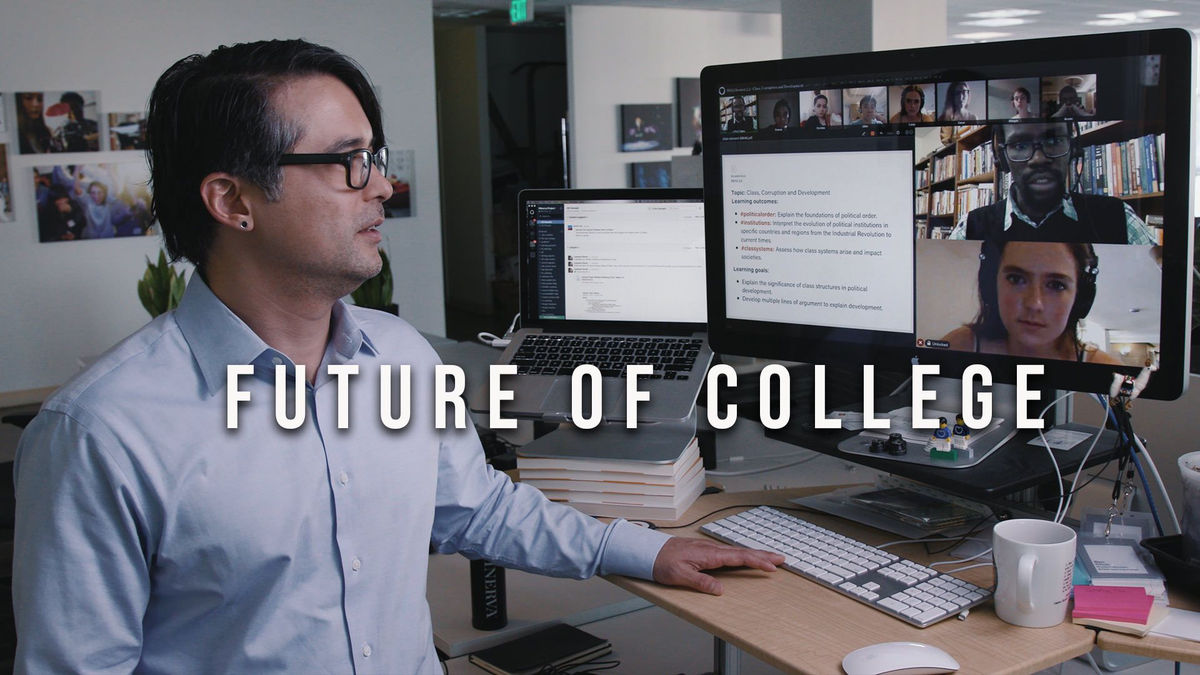
Online learning has changed the educational experience for many students. Several challenges on the horizon could disrupt college further. But as automation changes the workplace, the future may hold a need for lifelong learning, meaning more college, not less.
Subjects:
English Language Arts (E.L.A.), particularly units focused on writing or speech/debate
- Could also work with Current Events; Career and Technical Education (C.T.E.)
Lesson Duration:
- One to two class periods
Essential Questions:
- How has a growing society shaped how people view college?
- What is the purpose of college?
Lesson Objectives:
Students will:
- Identify and analyze claims, evidence and reasoning present in the film.
- Synthesize ideas presented in the film with their own previous knowledge.
- Compare and contrast their own claim with a peer’s claim.
- Collaborate to compose a paragraph that reflects elaboration of main ideas in their arguments.
Materials:
- Retro Report video “Future of College” (Transcript)
- Student Activity handout
Procedure:
- Distribute the student activity handout and have students sketch what they think college was like in the past, what they think college is like now, and what they imagine it will be like in the future. They may also use words.
- Have students share with a partner, then with the class, as appropriate.
- Inform students that they will be watching the 9-minute Retro Report film “Future of College” (Transcript). Have students preview the tables on the student activity handout and inform them that they will have time after viewing the film to complete them. They will also have access to the transcript and film (to rewatch), as needed.
- As a class, watch the film.
- Optional transition: Ask the class, “What are some misconceptions of online classes discussed in the video? What are some benefits and drawbacks of online versus in-person college learning?”
- Direct students to begin working on the first Claim–Evidence–Reason (CER) table which provides students with a claim made in the film. The students’ task is to identify evidence and reasoning from the film that supports the claim.
- The second table asks students to identify a claim made in the film based on the provided question: Why is the model for college ever-changing? An answer to this question can serve as a claim. Then have students complete the same process as they did in the previous table to identify evidence and reasoning found in the film.
- This table has sentence stems that are provided if deemed necessary.
- The third table asks students to move beyond the scope of the film and construct their own claim in response to the question: What is the purpose of college? The goal is for students to synthesize their prior knowledge with ideas presented in the film as they identify a claim alongside evidence and reasoning.
- Optional: If students need additional support while working on this skill, an “I Do-We Do-You Do” model could be employed for the first three tables. (Teacher provides responses to table 1 as an example, students complete table 2 together as the teacher guides the class, and students independently complete table 3).
- After the three CER tables are complete, have students work in pairs to compare and contrast their CER response from table three. Students can record similarities and differences in table 4.
- Optional: At this time, have pairs share with the class what their claims are and any similarities/differences with their partners.
- Inform students that the goal of the partner paragraph is for a pair of students to collaborate as they write a singular paragraph that conveys the main ideas of their discussion. Table 5 provides two options for students to approach their partner paragraph.
- Option 1 would be for pairs who have the same or similar ideas and addresses how they can combine their similar claims into one claim (which ultimately serves as the main idea of the paragraph).
- Option 2, however, provides pairs who may have differing or conflicting claims with an avenue to compose one single paragraph with a “dual-claim statement.” A dual-claim statement would be similar to the following example: While some believe the purpose of college is to provide financial stability, others also believe the purpose of college is to explore one’s passion in any given field of study.
- A sentence stem is also provided (While some believe___, others also believe___.) in this section of the table if necessary.
- Emphasize elaborating beyond the scope of what’s already typed in table 3. This is important for the development of the partner paragraph. Students will need to expand upon their ideas in order to avoid solely copying what they have already typed.
Extension Activity:
- Ideas for other E.L.A. connections or additional steps beyond the lesson: peer reviews and providing writing feedback, writing with clear transitions, and/or any other writing skills you may be targeting in your class.
About the Author:
Kaylen Rodrigues is an ELA and Speech teacher in York, Neb. She has taught grades 7-12 and covered a variety of argumentative and persuasive writing skills, in addition to constructing debates, rhetorical analysis in communication, and text-based evidence to support arguments.
Standards
Common Core Literacy Standards
- CCSS.ELA-LITERACY.RI.11-12.1 Cite strong and thorough textual evidence to support analysis of what the text says explicitly as well as inferences drawn from the text, including determining where the text leaves matters uncertain.
- CCSS.ELA-LITERACY.RI.11-12.2 Determine two or more central ideas of a text and analyze their development over the course of the text, including how they interact and build on one another to provide a complex analysis; provide an objective summary of the text.
- CCSS.ELA-LITERACY.SL.11-12.1 Initiate and participate effectively in a range of collaborative discussions (one-on-one, in groups, and teacher-led) with diverse partners on grades 11-12 topics, texts, and issues, building on others’ ideas and expressing their own clearly and persuasively.
- CCSS.ELA.LITERACY.W.11-12.1 Write arguments to support claims in an analysis of substantive topics or texts, using valid reasoning and relevant and sufficient evidence.
- CCSS.ELA-LITERACY.W.11-12.4 Produce clear and coherent writing in which the development, organization, and style are appropriate to task, purpose, and audience.
College, Career, and Civic Life (C3) Framework for Social Studies
- D4.1.9-12. Construct arguments using precise and knowledgeable claims, with evidence from multiple sources, while acknowledging counterclaims and evidentiary weaknesses.
- D4.2.9-12. Construct explanations using sound reasoning, correct sequence (linear or non-linear), examples, and details with significant and pertinent information and data, while acknowledging the strengths and weaknesses of the explanation given its purpose (e.g., cause and effect, chronological, procedural, technical).
- D4.4.9-12. Critique the use of claims and evidence in arguments for credibility.
- D4.5.9-12. Critique the use of the reasoning, sequencing, and supporting details of explanations.
- D4.8.9-12. Apply a range of deliberative and democratic strategies and procedures to make decisions and take action in their classrooms, schools, and out-of-school civic contexts.
