
Transcript
ARCHIVAL (4-3-68):
Rev. Dr. Martin Luther King, Jr.: I may not get there with you, but I want you to know tonight that we as a people will get to the promised land!
BILLIE BREAUX (FORMER STATE SENATOR, ATTENDED THE SPEECH): Martin Luther King was our hope and our future. We believed in him.
ARCHIVAL (CBS, EVENING NEWS, 4-4-68):
NEWS REPORT: Dr. Martin Luther King, the apostle of nonviolence in the civil rights movement, has been shot to death in Memphis, Tennessee.
ARCHIVAL (ABC, 4-4-68):
NEWS REPORT: There’s a great deal of confusion and chaos, uh, resulting from the announcement here that Dr. King had died.
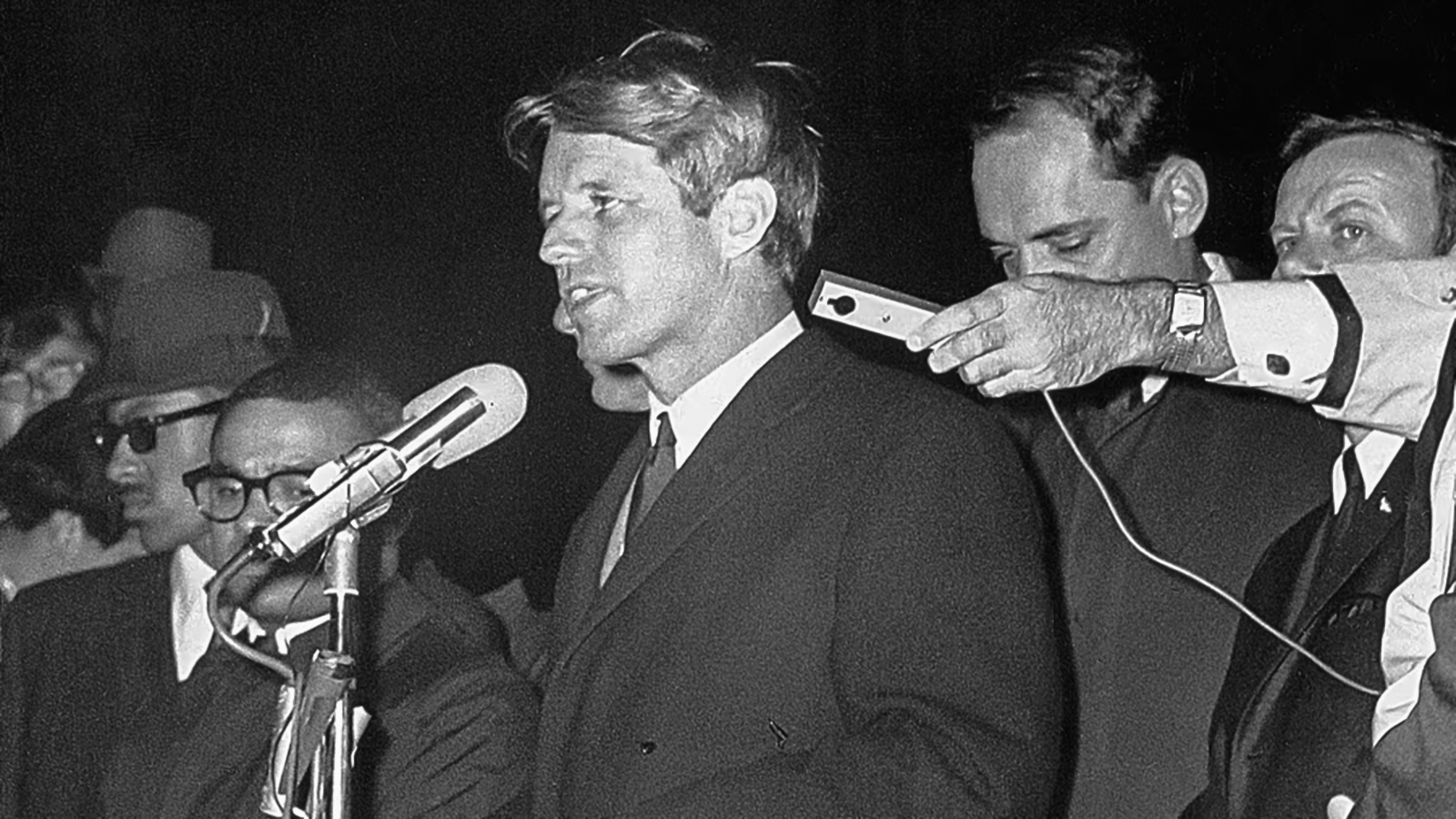
NARRATION: Just as troubling news had begun to spread about Martin Luther King, a crowd gathered in Indianapolis to hear a speech by Democratic presidential candidate Robert F. Kennedy.
SEAN WILENTZ (PROFESSOR OF HISTORY, PRINCETON UNIVERSITY): They didn’t know what had happened, that the greatest figure in Black America – in many ways the greatest figure in America – had just been killed.
BILLIE BREAUX: It was a very gloomy and rainy evening. The crowd there was very subdued, not like a political rally.
ARCHIVAL (4-3-68):
ROBERT F. KENNEDY: Could you lower those signs please? I have some very sad news for all of you and that is that Martin Luther King was shot and was killed tonight in Memphis, Tennessee.
NARRATION: It was shocking news. King, the civil rights leader, had broken through barriers of racial segregation with peaceful protest and compassion.
ARCHIVAL:
STOKELY CARMICHAEL: He was the one man in our race who was trying to teach our people to have love, compassion and mercy for what white people have done.
NARRATION: His murder sparked riots across the country . . .
ARCHIVAL (CBS, 4-5-68):
NEWS REPORT: There is a countrywide reaction, turmoil in at least a dozen more cities today, for a total of 40 or so, and serious in some places, including the capital city.
NARRATION: . . . but on the night of King’s death, Kennedy, whose own brother, President John F. Kennedy, had fallen to an assassin’s bullet, spoke to a crowd he’d been warned might riot.
DAVID MARGOLICK (AUTHOR, “THE PROMISE AND THE DREAM”): Bobby Kennedy was fearless about that. Kennedy, with an instinct very rare in politicians in any era, resolved that he was just going to say what was in his heart.
ARCHIVAL (4-3-68):
ROBERT F. KENNEDY: Martin Luther King dedicated his life to love and to justice between fellow human beings. He died in the cause of that effort.
BILLIE BREAUX: Here was a man who wasn’t thinking about himself, but who is thinking about the impact that Martin Luther King Jr. had made on the world.
ARCHIVAL(4-3-68):
ROBERT F. KENNEDY: For those of you who are Black, considering the evidence there evidently is that there were white people who were responsible, you can be filled with bitterness and with hatred and a desire for revenge.
SEAN WILENTZ: It was a plea for people not to get angry in response because after all, he had lost a brother who had been killed by a white man as well.
ARCHIVAL(4-3-68):
ROBERT F. KENNEDY: We can move in that direction as a country, in greater polarization – Black people amongst Blacks and white amongst whites – filled with hatred toward one another, or we can make an effort, as Martin Luther King did: to understand and to comprehend and replace that violence, that stain of bloodshed that has spread across our land with an effort to understand with compassion and love.
SEAN WILENTZ: He wasn’t condescending to them. He gave them everything that was in his heart, and it was an extraordinary speech.
ARCHIVAL(4-3-68):
ROBERT F. KENNEDY: Thank you very much.
NARRATION: Then, just two months later . . .
ARCHIVAL (6-5-68):
ROBERT F. KENNEDY: My thanks to all of you and now it’s on to Chicago and let’s win there.
PATRICIA SULLIVAN (PROFESSOR OF HISTORY, UNIVERSITY OF SOUTH CAROLINA): Robert Kennedy, after winning the California primary is gunned down in Los Angeles.
ARCHIVAL (6-6-68):
MAN (HOLDING A SHOT ROBERT F. KENNEDY IN HIS ARMS): I’m right here!
PATRICIA SULLIVAN: It’s haunting because both of these individuals by this point in their young lives had come to represent a kind of leadership that was helping the country to lean forward, to try to find a way to bridge these divides and to connect around a common humanity.
NARRATION: But Kennedy’s speech is remembered for helping to keep some peace in a country that seemed to be unravelling.
SEAN WILENTZ: There were great riots after the assassination of Dr. King. All around the country, Black neighborhoods went up in flames. Didn’t happen in Indianapolis. Robert Kennedy had something to do with that.
DAVID MARGOLICK: One would like to think that politicians could still have that kind of effect. When a politician speaks from the heart, it can move the hearts of men and women.
(END)
A Powerful Speech Urged Unity After Martin Luther King Jr.’s Assassination
After the Rev. Martin Luther King Jr. was assassinated, Robert F. Kennedy called on a grieving crowd to reject hatred.
On April 4, 1968, Robert F. Kennedy arrived at a campaign rally in Indianapolis with news that many in the crowd had not heard: The Rev. Martin Luther King Jr. had been killed. Despite a warning that violence might erupt, Kennedy, a Democratic presidential candidate, went ahead with his appearance and delivered an unscripted appeal for compassion and restraint. Kennedy spoke of his brother’s assassination and urged listeners to resist hatred and racial division.
Two months later, Kennedy was fatally shot in Los Angeles after winning the California primary.
Through archival footage and interviews with historians and an eyewitness, this video examines Kennedy’s response to King’s death, and the enduring significance of a speech that asked Americans to confront grief and injustice with a sense of their shared humanity.
- Producer / Narrator: Joseph Hogan
- Editor: Heru Muharrar
 Grades
8-12

 Grades
7-12


 2 Lesson Plans

