
Lesson plan

Lesson Plan: Fights Over American Democracy – Teaching With Primary Sources (Scaffolded Writing Resources)

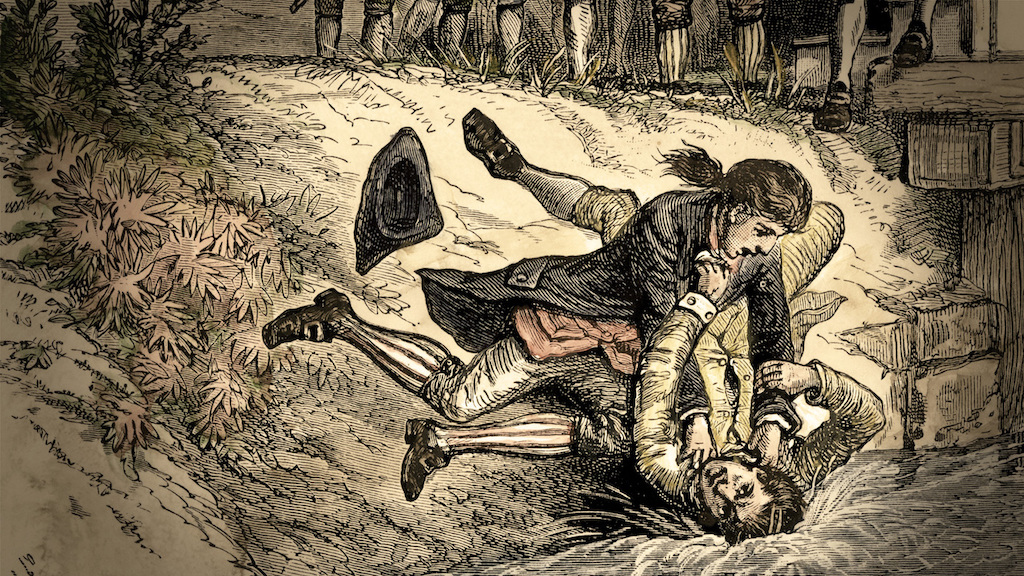
This video explores how American democracy developed during the Revolutionary War and the challenges it faced along the way. It shows how the Founders supported democratic ideals but also feared giving the people too much power. The video highlights key conflicts, especially over slavery, that shaped the nation and eventually led to the Civil War.
See more

Subjects:

U.S. History, Civics/Government

Grade Level:

7-12

Lesson Duration:

  • Two 40-55 minute class periods

Essential Questions:

  • How did the early leaders of the United States view the power of the people in relation to the need for a stable government?

Lesson Objectives:

Students will:

  • Develop a position and present a viewpoint based on historical evidence.

  • Analyze the tensions between democracy and stability by watching a video, answering questions, completing an outline and drafting a paragraph.

Materials:

Key Vocabulary:

  • popular sovereignty: the idea that people are the source of governmental power and give government its authority

  • republic: A form of government in which people elect representatives to make laws and govern on their behalf

  • rebellion: An organized resistance against a government or its laws, often involving violence or refusal to obey authority

  • stability: The ability of a government to maintain order, enforce laws, and prevent chaos over time

  • checks and balances: A system in which different branches of government limit each other’s power to prevent abuse or tyranny

  • tyranny: A form of rule in which power is held or used unfairly, often when one person or group has too much power, and people’s rights are ignored or taken away

Procedure:

  1. Review: This lesson is best used in a U.S. history class to examine how early conflicts shaped the development of American democracy and influenced the structure of the U.S. government, or in a Civics/Government class to analyze the balance between popular power and the need for a stable, effective government.

    1. Potential discussion and review topics for U.S. History:

      1. Early American leaders supported democratic ideals but feared that unchecked popular action could lead to disorder, violence, or instability, as seen in events like Shays’ Rebellion and the Whiskey Rebellion.

      2. Founding-era debates reveal that democracy in the United States developed through conflict, compromise, and experimentation rather than consensus.

      3. The expansion of political participation over time, contrasted with moments of instability such as secession, highlights ongoing tensions between democratic ideals and national unity.

      4. Primary sources from the founding era show how concerns about rebellion, slavery, and factionalism shaped the Constitution and the structure of government.

    2. Potential discussion and review topics for Civics/Government:

      1. How governments can allow citizen participation and protest while still enforcing laws and maintaining order.

      2. The purpose of the separation of powers and checks and balances was a response to fears of both tyranny and chaos.

      3. The idea that democracy alone is not always sufficient to protect rights without structural safeguards.

      4. How debates about majority rule, minority rights, and government authority continue to influence American politics today.

  2. Guided Instruction: Have students watch the Fights Over American Democracy Reach Back to the Founding Era” (Transcript) video.

    1. This can be done as a whole class, or individually on computers or using the EdPuzzle platform.

    2. The video guide and question sheet pose two guiding questions for the whole video, along with several sentence stems that students can complete as they watch.

    3. After reviewing responses and highlighting exemplary answers, the teacher will distribute the scaffolded outlines to students.

  3. Outline and Writing Prompt: Each outline version uses the same writing prompt. For this activity, students will respond to the following prompt:

    1. How did the early leaders of the United States view the power of the people in relation to the need for a stable government?

    2. Demonstrate how responses on the video guide and question sheet could be used to craft topic and concluding sentences.

    3. Guide students through creating categories and details on their version of the Outline form.

      1. Depending on time and classroom set-up, students can work together or independently to turn their categories and details into full sentences.

      2. Be sure to emphasize that each detail can be more than one sentence.

  4. Primary Source Analysis: Have students complete one or more of the Primary Source Analysis activities provided for this lesson.

    1. Students are encouraged to draw on one or more primary sources to support their answers and evidence as they construct their outline.

  5. Outline Construction: Have students complete whichever scaffolded outline they were given.

  6. Paragraph Construction: Using the outline that students completed, have them construct their full paragraph.

To learn more about the evidence-based instructional methodology used here for teaching writing, see: The Hochman Method | The Writing Revolution

About the Author:

Jaclyn Jecha is an educator with over 15 years of experience in formal and informal education. She teaches social studies at New Berlin West Middle and High School, where she develops curriculum emphasizing critical thinking, research, and communication. As a Media Literacy Consultant for the Center for Civic Education, Jaclyn focused on combating disinformation and fostering informed citizenship. She has collaborated with organizations such as the National Park Service and PBS Wisconsin to create innovative educational materials. Dedicated to lifelong learning, Jaclyn integrates diverse primary sources into her teaching to inspire engagement and build essential skills.

Standards

College, Career, and Civic Life (C3) Framework for Social Studies

  • D1.5.6-8. Determine the kinds of sources that will be helpful in answering compelling and supporting questions, taking into consideration multiple points of views represented in the sources.

  • D2.Civ.2.9-12. Analyze the role of citizens in the U.S. political system, with attention to various theories of democracy, changes in Americans’ participation over time, and alternative models from other countries, past and present.

  • D2.Civ.5.9-12. Evaluate citizens’ and institutions’ effectiveness in addressing social and political problems at the local, state, tribal, national, and/or international level.

  • D2.Civ.13.9-12. Evaluate public policies in terms of intended and unintended outcomes, and related consequences.

  • D2.His.1.9-12. Evaluate how historical events and developments were shaped by unique circumstances of time and place as well as broader historical contexts.

  • D2.His.4.9-12. Analyze complex and interacting factors that influenced the perspectives of people during different historical eras.

  • D2.His.5.9-12. Analyze how historical contexts shaped and continue to shape people’s perspectives.

  • D2.His.14.9-12. Analyze multiple and complex causes and effects of events in the past.

  • D3.1.6-8. Gather relevant information from multiple sources while using the origin, authority, structure, context, and corroborative value of the sources to guide the selection.

  • D3.3.6-8. Identify evidence that draws information from multiple sources to support claims, noting evidentiary limitations.

  • D4.1.6-8. Construct arguments using claims and evidence from multiple sources, while acknowledging the strengths and limitations of the arguments.

Common Core Literacy Standards

  • CCSS.ELA.LITERACY.RI.11-12.3: Analyze a complex set of ideas or sequences of events and explain how specific individuals, ideas, or events interact or develop over the course of a text.

  • CCSS.ELA.LITERACY.RH.11-12.7: Integrate and evaluate multiple sources of information presented in diverse formats and media (e.g., visually, quantitatively, as well as in words) in order to address a question or solve a problem.

Verify your email

We'll send a verification code to .

Gift this article