
Transcript
HOPE M. HARRISON (PROFESSOR OF HISTORY AND INTERNATIONAL AFFAIRS, GEORGE WASHINGTON UNIVERSITY): The wall was the iconic symbol of the Cold War. There it was, in concrete. You could touch it. There’s something about it. It represented division. I have long been fascinated by the fact that a major world city, a metropolis, was divided by a wall dividing families, dividing friends, lovers. What led to that decision?
ARCHIVAL (HISTORIC FILMS, 1945):
ANNOUNCER: 1945, and this was Berlin. Amid the rubble and destruction, the flags of the victors, a defeated nation.
HOPE M.HARRISON: With the end of World War II, the victorious powers – the Soviet Union, U.S., Great Britain and France – wanted to be really sure that Germany could not rise up again, so they occupied Germany, boots on the ground. When they couldn’t agree on how to govern Germany, they divided the country and the capital city, Berlin, which was deep inside the Soviet communist occupation zone. Then in 1952 Stalin decided to seal the border between East Germany and West Germany. That meant that the only place in all of Germany where there was freedom of movement between the East and West was in Berlin, and that border became harder and harder to cross.
ARCHIVAL (HISTORIC FILMS, 1945):
ANNOUNCER: At the Eastern sector border, the trams were forced to change both drivers and conductors, while anyone passing at first to change his money, for the East did not accept Western marks, and vice versa.
HOPE M. HARRISON: So Germany was at the center of this global Cold War between the Soviet Union and communism in the East and the U.S. democracy and capitalism in the West.
ARCHIVAL (HISTORIC FILMS, 1945):
ANNOUNCER: These were the years in which the expression Iron Curtain became a reality.
HOPE M. HARRISON: And Berlin was ground zero. If anything is going to lead to a nuclear war, it’s going to be conflicts in Berlin.
Then in the summer of 1961, Soviet leader Khrushchev met with U.S. President Kennedy, and Khrushchev kept saying you have to remove your troops from West Berlin, and Kennedy said if you interfere with our rights to get to West Berlin, that will be a cause for war. Khrushchev said, well, then there will be war.
ARCHIVAL (1961):
ANNOUNCER: At the presidential news conference, the president is asked if people are unduly worried about war.
PRESIDENT JOHN F. KENNEDY: We happen to live in the most dangerous time in the history of the human race.
HOPE M. HARRISON: So, in the summer of 1961, over 1,000 East Germans fled every day to West Berlin – highly educated people, doctors, teachers. It grew into a crisis, and so finally they seal the border in Berlin. People were shocked.
ARCHIVAL (1961):
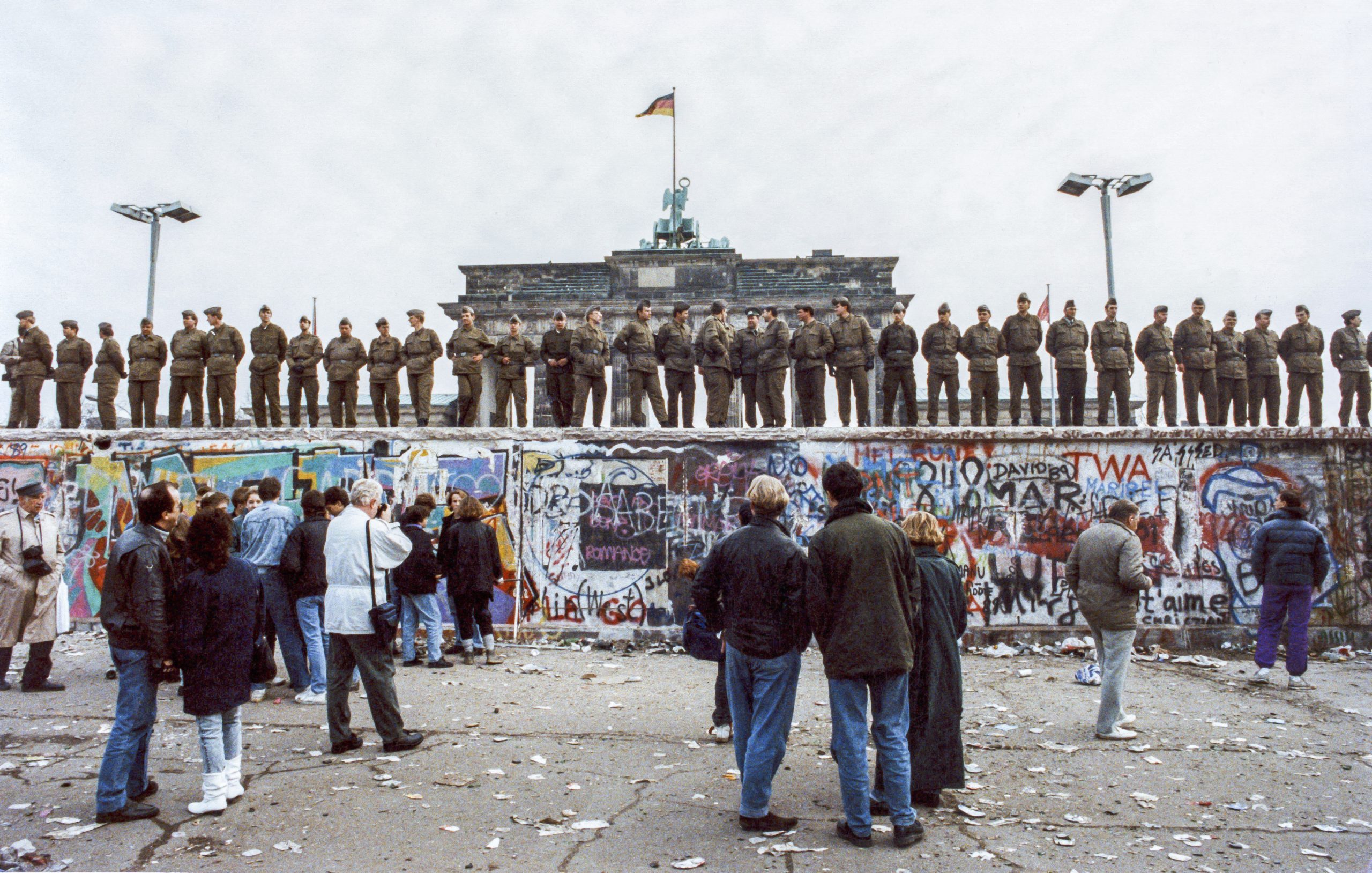
ANNOUNCER: On the 13th of August, 1961, a wall of East German police stands at the Brandenburg Gates. All communication between the Eastern sector and those of the West has been cut as though by a knife. West Berliners stand stunned.
ARCHIVAL ( 8-13-61):
ANNOUNCER: Groups of them gather near the border of the Eastern sector and watch the East German soldiers fixing the barbed wire. They watch them cutting the city in half.
PETER KEUP (FORMER EAST GERMAN CITIZEN): The moment they closed up West Berlin, everything changed. My mother, she was not a communist. She moved to the East because my father was communist, and she wanted to live with him, and the wall cut her off from her family. She felt imprisoned. To me it was like – the wall will stand there forever. Nobody can bring that to fall.
PATRICK DAUBITZ (FORMER WEST BERLIN CITIZEN): I was born in West Berlin, in the American sector. I was going to bike around the city, and then there was a wall, and each day I traveled in another direction, and always, the wall stopped me then. When you are young, it’s like a tiger in his cage, and the wish was growing more and more to, to know what behind the wall.
HOPE M. HARRISON: From the East German leadership’s perspective, they said, hey, now we can control our economy because we don’t have East Germans fleeing. We don’t have brain drain anymore. Now we can really go forward developing communism.
PETER KEUP: The daily propaganda started at school, like – America is the main enemy, and all the West European countries who are kind of slaves for America. But I had a rough idea what the Western world means. Just by their stories, I mean, maybe sounds naive, but it was like everything is possible in the West. You can talk openly. The free press, the free media. So I decided to escape, and I ended up in the prison Cottbus.
HOPE M. HARRISON: East Germans found ways to smuggle their friends out. Some of them built tunnels under the wall. But the Berlin Wall was manned by armed guards who were told to stop people fleeing at any cost, even if it was women and children.
ARCHIVAL (1970):
ANNOUNCER: Communists call the wall a modern border. At least 64 people have met death at this modern border from 1961 to 1969. Dogs trained to kill among the guards at the modern border, in the water guard boats patrol incessantly.
HOPE M. HARRISON: Then, in 1985, Soviet leader Mikhail Gorbachev came to power. . .
ARCHIVAL (NATIONAL ARCHIVES AND RECORDS ADMINISTRATION, 12-31-87):
MIKHAIL GORBACHEV (LEADER OF THE SOVIET UNION): There will be profound changes in our country.
HOPE M. HARRISON: . . . and he instituted two really important reforms. One reform was called perestroika, which means restructuring, giving people more freedom economically. The other reform was glasnost, which means openness. Once you open up freedom of speech, it’s pretty hard to stop it. It spread like wildfire. Poland had the first partially free election. Hungary opened its barbed wire border with free Austria. By the fall of 1989, the East German regime faced citizens who were taking to the streets. And then you come to the role of chance in history. The East German regime realized, O.K., we’ve got to make some changes. You still have to apply to be able to go visit the West, but basically, trust us, we’re going to say yes.
ARCHIVAL (FERNSEHENDER DDR, 11-9-89):
GÜNTER SCHABOWSKI (TRANSLATED FROM GERMAN): We have decided to make a regulation.
HOPE M. HARRISON: But Günter Schabowski, the spokesman, showed up unprepared at a live international press conference. Suddenly someone asks –
ARCHIVAL (FERNSEHENDER DDR, 11-9-89):
REPORTER (TRANSLATED FROM GERMAN): Mr. Schabowski, what will happen to the Berlin Wall now?
HOPE M. HARRISON: You see him, like, looking down, confused, at his papers, and then you see him, like, looking over at his aides, you know, sort of like – help. And he says, yeah, entries will be open. The Berlin Wall will be open. And someone says — when? And again, he looks down, confused. He says —
ARCHIVAL (FERNSEHENDER DDR, 11-9-89):
GÜNTER SCHABOWSKI (TRANSLATED FROM GERMAN): As far as I am aware, immediately. Straight away.
HOPE M. HARRISON: Immediately. So the press conference ends at 7 p.m. on November 9th. Over the next few hours, more and more East Germans head to the Berlin Wall to the crossing points. They just heard it was open so they’re showing up. With this one crossing point, Bornholmor Strasse, Harald Jager, he keeps trying to reach his superiors. He finally reaches someone and he said, you know, things are pretty bad here. I’ve got, like, thousands of people. They’re kind of angry. And his boss on the phone, he doesn’t believe him. Well, that does it. So he tells one of the guys working for him, open the border, and East Germans flood through to West Berlin. It was absolutely extraordinary to witness East Germans and West Germans living this moment, and this all was a mistake.
ARCHIVAL (ABC NEWS, 11-10-89):
NEWS REPORT: Occasionally they shout “Die Mauer muss weg” — the wall must go. Thousands and thousands of West Germans come to make the point that the wall has suddenly become irrelevant. And at every border crossing, thousands of West Germans there to say welcome.
PATRICK DAUBITZ: This line of bricks in the ground stands for the place where the wall has been. I can see exactly the point where I have been in these nights, where I was going to the top of the wall. It was unbelievable.
PETER KEUP: Although the propaganda was so intense, it couldn’t bring the people apart. I mean, after the fall of the Berlin Wall, people hugged each other. They didn’t know each other. They were, according to the propaganda, enemies. Relationships are stronger than any kind of propaganda. As soon as the system changes, when people have the chance to, to come together, then they will, and they will find each other as simply human beings.
(END)
Berlin Wall: The Rise and Collapse of a Cold War Symbol
The Berlin Wall divided a city, and fell in a moment of change.
The Berlin Wall stood for almost 30 years as one of the most powerful symbols of the Cold War. But how did it get there, and what caused it to fall?
In 1961, Berlin was a divided city: a wall separated the Communist-controlled East and the democratic West. Through the voices of people on both sides of the wall, this short documentary shows how the East German government enforced the border, and how ordinary Berliners pushed back or found ways to escape or adapt.
In the 1980s, reforms in the Soviet Union led to protests in the streets and a growing sense that change was building. Then in November 1989, a confusing announcement about travel rules sent crowds rushing to the checkpoints. Guards, with no clear orders, eventually opened the gates. Almost by accident, the Berlin Wall came down.
- Producer: Kit R. Roane
- Co-Producer / Editor: Jeff Bernier
- Assistant Editor: Jordan Bernier
 Grades
6-12
Grades
6-12


 4 Lesson Plans

