
Transcript
ARCHIVAL (PBS, 1979):
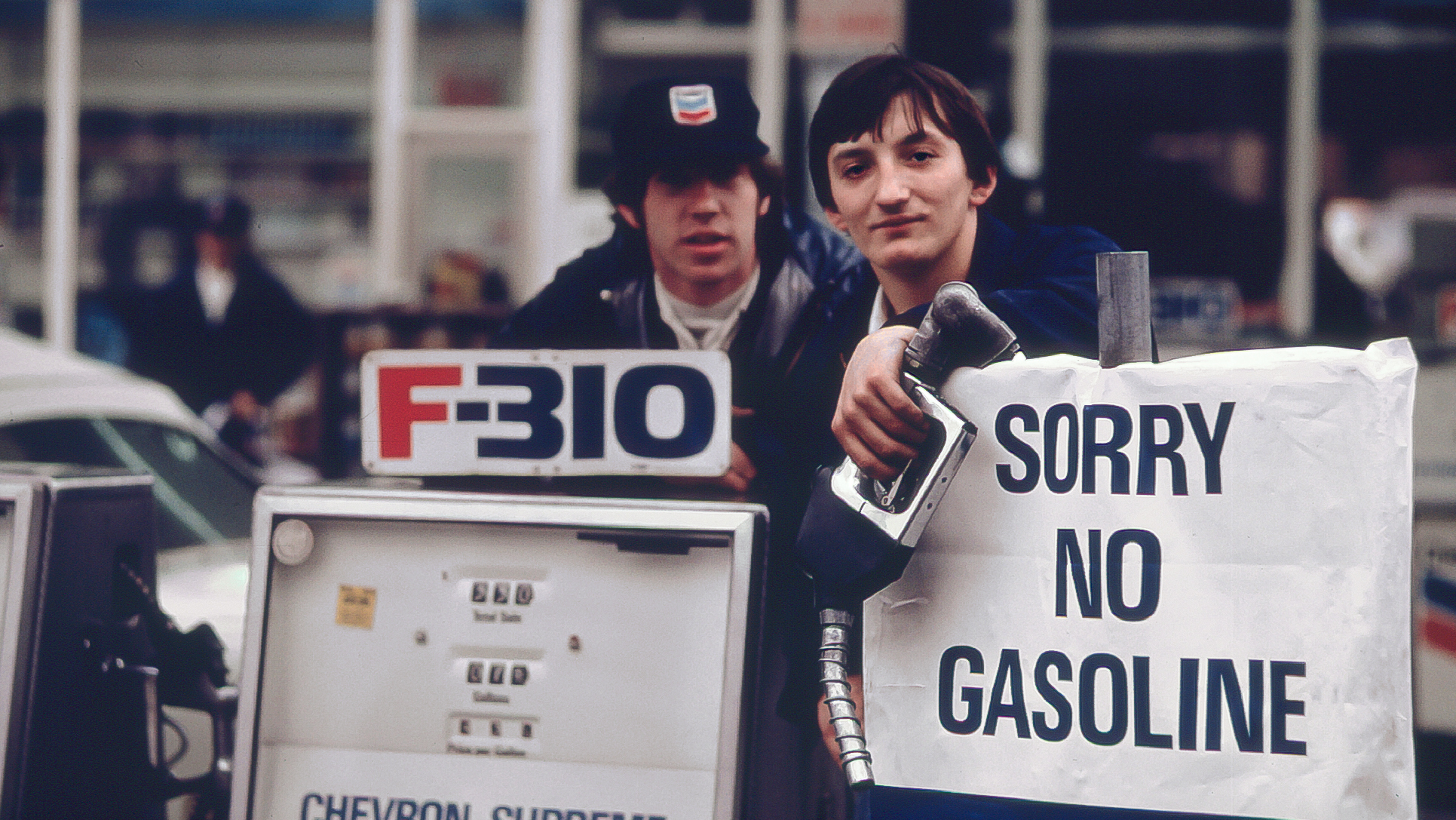
NEWS REPORT: Gasoline shortages are spreading across the country. Gasoline lines and closed gas stations are becoming increasingly common.
GAS STATION ATTENDANT: We’re all out of high test and regular gas. That’s it. The lines are completely around the corner.
MAN: What is this? I’m in line for two hours here, and I can’t get gas. This is baloney!
JAY HAKES (SENIOR ENERGY POLICY ADVISOR, CARTER ADMINISTRATION): In the 1970s, Americans experienced an energy crisis. It had a big impact on people’s lives.
ARCHIVAL (WPIX, 1979):
MAN: Been in both lines for over an hour and I’m outa gas.
JAY HAKES: People felt like things were slipping away. There was this sense at that time of, of total failure.
ARCHIVAL (CBS NEWS, 1973):
NEWS REPORT: The cost of living went up 8 percent. Food prices alone 19percent.
ARCHIVAL (6-12-73):
WOMAN: I just couldn’t imagine something like this would happen in America.
JAY HAKES: The crisis of the 1970s was a wake-up call and people really started paying attention to energy.
ARCHIVAL (CBS, 7-15-9):
PRESIDENT JIMMY CARTER: The energy crisis is real. It is a clear and present danger to our nation.
JAY HAKES: But there’s one big misconception, and that was we didn’t do anything about it.
ARCHIVAL (PERISCOPE FILM):
MAN (DEMONSTRATING HOW TO USE A WASHING MACHINE): Let’s set the controls to spin.
NARRATION: Before the 1970s, Americans had a different attitude towards energy.
ARCHIVAL (PERISCOPE FILM):
MAN (DEMONSTRATING HOW TO USE AN APPLIANCE): You can have a central air conditioning system for all your rooms. It’s controlled summer and winter by a thermostat.
JAY HAKES: They saw energy as an unlimited good. We felt like there was plenty of oil being produced here, we had plenty of coal, and people were getting new ways to use energy.
ARCHIVAL:
ANNOUNCER: The whole nation has become swift and mobile, flowing along over a great network of highways more than 3 million miles long and constantly growing.
NARRATION: But in 1973, several Middle Eastern countries stopped selling oil to the U.S. to punish them for supporting Israel during the Yom Kippur War.
ARCHIVAL (1974):
SOLDIER (FIRING WEAPON): Fire!
JAY HAKES: Saudi Arabia led the other Arab oil producers to use what was called the oil weapon to punish the United States.
ARCHIVAL (NBC NEWS, 11-22-73):
NEWS REPORT: The Saudi Arabian oil minister threatened tonight to cut oil production in his country by 80 percent.
ARCHIVAL (ABC NEWS, 11-19-73):
SHEIKH AHMED ZAKI YAMANI (OIL MINISTER): I think this is not blackmailing at all.
NARRATION: At the time, the United States imported roughly 35 percent of its oil, much of it from Arab members of the Organization of Petroleum Exporting Countries — OPEC. The ensuing embargo caused oil prices to nearly quadruple and triggered fuel shortages nationwide.
ARCHIVAL (NBC NEWS, 11-22-73):
NEWS REPORT: In many places in the United States, measures are being taken now to deal with the crisis. One of these places is Wayne, Nebraska. For more than a week, most of the streetlights have been kept off. It’s an effort to save electricity because the town is running out of fuel to produce electricity.
JAY HAKES: People were very upset. There was a feeling that things are kind of falling apart.
ARCHIVAL (6-12-73):
REPORTER (BANGS ON AN OIL TANK): How much have you got left in there?
HOME OWNER: None. It’s empty. There is no oil.
NARRATION: President Richard Nixon, already under public pressure to resign because of the Watergate scandal, struggled to contain the crisis.
ARCHIVAL (11-17-73):
PRESIDENT RICHARD NIXON: My point is, the United States of America shouldn’t have to depend on any other country for energy.
JAY HAKES: Nixon talked about energy independence, which led to a 55-mile-an-hour speed limit. And, one of the great incidents of the Nixon administration was when they lit the White House Christmas tree. . .
ARCHIVAL (CBS NEWS, 12-14-73):
PRESIDENT RICHARD NIXON: There we got it.
JAY HAKES:. . . and it just had a few little lights on it.
ARCHIVAL (CBS NEWS, 12-14-73):
NEWS REPORT: The lights this energy-short year, only about 20 percent of normal.
JAY HAKES: And Nixon said, this is symbolic of how all of us have to conserve energy.
ARCHIVAL (RICHARD NIXON PRESIDENTIAL LIBRARY AND MUSEUM, 12-14-73):
PRESIDENT RICHARD NIXON: This year we will drive a little slower. This year the thermostats will be a little lower. This year every American perhaps will sacrifice a little, but no one will suffer.
JAY HAKES: The oil embargo lasted until March of 1974, and the United States anticipated that production would go back to previous levels, but it didn’t happen.
NARRATION: When Nixon resigned later that year. . .
ARCHIVAL (12-30-73):
PRESIDENT GERALD FORD: The duties of the office …
NARRATION:. . . his successor, Gerald Ford, instituted new fuel efficiency standards for cars and attempted to mobilize the public through a federal ad campaign.
ARCHIVAL (ADVERTISEMENT):
ANNOUNCER: If we don’t pace ourselves now, we won’t have enough energy for the long run. Please don’t be fuelish.
NARRATION: As President Jimmy Carter entered office, U.S. power consumption was still rising, even as American dependence on foreign oil reached a historic high.
JAY HAKES: When Carter came into office in 1977, he was following two presidents who had talked about energy independence. But Carter called energy the moral equivalent of war.
ARCHIVAL (CBS, 7-15-79):
PRESIDENT JIMMY CARTER: The energy crisis is real. It is worldwide. It is a clear and present danger to our nation. These are facts, and we simply must face them.
JAY HAKES: When Carter grew up in Plains, Georgia, they didn’t have electricity. So he preached conservation, conservation, conservation, and that was the message that was there from beginning to end.
ARCHIVAL (CBS, 7-15-79):
PRESIDENT JIMMY CARTER: I’m proposing a bold conservation program to involve every state, county and city and every average American in our energy battle.
NARRATION: But Carter pushed beyond conservation. He formed the Department of Energy, and he envisioned renewable resources leading America into a new energy age: environmentally friendly technologies that would harness geothermal heat, sweeping winds and rays from the sun.
DENIS HAYES (FORMER DIRECTOR, SOLAR ENERGY RESEARCH INSTITUTE): President Carter had a real fondness for renewable energy, for solar in particular. When I organized the first Sun Day in 1978, Carter went out to Colorado and he commissioned a new solar energy research institute.
ARCHIVAL (CBS NEWS, 5-3-78):
NEWS REPORT: Today is Sun Day. Americans and citizens of 30 other nations celebrated with fairs, festivals, parades, speeches and demonstrations. Behind the hoopla in this country, there was a serious purpose, a demand that the government give priority to solar power.
DENIS HAYES: We’re trying to get an even break for solar energy in the national priorities of the United States.
DENIS HAYES: Jimmy Carter understood that if you can get economies of mass production and economies of scale for the installation of it, that solar can become very cheap. He wanted to move just as fast as he could.
ARCHIVAL (CBS, 7-15-79):
PRESIDENT JIMMY CARTER: I will soon submit legislation to Congress calling for the creation of this nation’s first solar bank, which will help us achieve the crucial goal of 20 percent of our energy coming from solar power by the year 2000.
DENIS HAYES: It was a moonshot program, and I was responsible for the institution that had to design the plan to get there.
NARRATION: To encourage adoption, the Carter administration offered federal subsidies and even installed solar panels on the White House.
ARCHIVAL (ABC NEWS, 6-20-79):
NEWS REPORT: The president showed off his new solar hot water heating system. The 32 panels over the Cabinet room in his Oval Office, and talked about substituting the sun for oil.
ARCHIVAL (JIMMY CARTER PRESIDENTIAL LIBRARY AND MUSEUM, 6-20-79):
PRESIDENT JIMMY CARTER: No one can ever embargo the sun.
DENIS HAYES: It was bold and there was nothing like that anywhere else in the world. Unfortunately, it lasted about three months into the Reagan administration, at which point they pulled the plug.
NARRATION: Reagan pushed a different approach to the energy problem: deregulation. He encouraged drilling and relaxed fuel efficiency standards. Those solar panels on the White House? They were removed.
ARCHIVAL (RONALD REAGAN PRESIDENTIAL LIBRARY AND MUSEUM, 1-11-88):
PRESIDENT RONALD REAGAN: We’re not merely accelerating the processes of the Industrial Revolution, we’re fundamentally transforming them.
NARRATION: But in a twist, it was Carter’s early investment in research for new energy sources that helped spur the development of fracking, which allowed companies to extract oil and gas from previously inaccessible shale rock formations and caused U.S. production to surge.
JAY HAKES: Ironically, Carter invested in oil and gas technology, which led to the fracking technology that we have today. The reason the United States has gone from being 60 percent dependent on foreign oil in 2005 to being an exporter of oil is because of that shale revolution.
ARCHIVAL (FOX):
NEWS REPORT: I mean, we’re sitting on a mega-load of energy.
DENIS HAYES: Fracking simply was a pressure release valve. It caused people not to worry about conservation, not to worry about efficiency, and to have affordable access to abundant fuel.
NARRATION: As fracking made natural gas cheaper to extract, investment in alternative energy slowed. Today, renewables account for around 10 percent of total energy production in the U.S. , half the level Carter had hoped to reach by 2000. Other countries, like India and China, have become the epicenter of renewable technology and production, just as the worldwide need for multiple sources of energy has skyrocketed.
JAY HAKES: The problem is, as we got further away from the oil embargoes, we got complacent.
DENIS HAYES: I’m afraid that what we’re going to be doing is creating an America that has to buy the technology that it needs from others, despite the fact that we were the pioneers.
(END)
The Price of Oil: Lessons From a 1970s Energy Crisis
When oil shortages disrupted daily life in the 1970s, Americans were forced to rethink consumption, and the crisis set in motion decisions that continue to shape energy policy today.
In the 1970s, when oil-producing nations cut supplies to the United States during the Yom Kippur War, gas stations ran dry, prices soared, and long lines became a fact of daily life. The crisis exposed how dependent the country had become on foreign oil, much of it controlled by Arab members of OPEC.
Leaders searched for answers. President Richard Nixon urged conservation and energy independence. Gerald Ford pushed efficiency. President Jimmy Carter compared the energy crisis to a war and spearheaded investments in renewable power, and even installed solar panels on the White House roof.
While policy shifted in the 1980s under Ronald Reagan, the drive to develop renewables slowed. Some of Carter’s initiatives had unexpected results, leading decades later to the widespread use of fracking, and fossil fuel production surged.
- Producer: Kit R. Roane
- Editor: Brian Kamerzel
- Associate Producer: Matteo Cervone
 Grades
7-12
Grades
7-12

 Grades
7-12
Grades
7-12
 1 Lesson Plan


