
Transcript
ARCHIVAL (NBC NEWS, 9-15-08):
NEWS REPORT: We begin our coverage tonight of what’s been called the worst financial crisis in modern times.
ARCHIVAL (NBC NEWS, 9-15-08):
NEWS REPORT: Three of the five biggest investment banks are gone.
ARCHIVAL (C-SPAN, 9-24-08):
PRESIDENT GEORGE W. BUSH: Major sectors of America’s financial system are at risk of shutting down.
SHEILA BAIR (FORMER CHAIR, F.D.I.C.): The crisis created the biggest economic downturn since the Great Depression. We call it the Great Recession.
ARCHIVAL (ABC NEWS, 2-23-09):
NEWS REPORT: Its genesis can be traced to the U.S. housing market. A combination of greed and lack of regulation built the foundation for a house of cards.
NARRATION: The financial crisis grew out of a housing bubble that swept the nation in the early 2000s.
ARCHIVAL (NBC NEWS, 5-31-05):
NEWS REPORT: Real estate is a national obsession.
NARRATION: That’s when Lissie Dickerson and her partner bought a townhome in suburban Maryland.
LISSIE DICKERSON (HOMEOWNER): It was supposed to be a great time to buy a house. I was thinking that, you know, I could move here and get a house, get some equity going.
NARRATION: They say even though they had steady jobs and a down payment, their broker gave them an expensive subprime loan instead of a standard mortgage.
ARCHIVAL (MORTGAGE LENDER COMMERCIAL, 2007):
COMMERCIAL: So if you need a lender who actually finds ways to make loans, call Countrywide.
LISSIE DICKERSON: We just didn’t do our homework. We didn’t know it was a 10 percent mortgage, and so found that out at the closing, actually. The realtor was like, don’t worry, in six months you can refinance that to like, 3 to 5 percent, and you’ll be fine.
ARCHIVAL (MORTGAGE LENDER COMMERCIAL, 2007):
COMMERCIAL: 100% financing, even with a 575 credit score.
NARRATION: Designed for borrowers with poor credit, subprime loans had higher interest rates because of the greater risk of nonpayment.
Beth Jacobson was a top subprime loan officer for Wells Fargo.
BETH JACOBSON (FORMER MORTGAGE LOAN OFFICER, WELLS FARGO): Did I ever put people into loans that I didn’t think they should be in? Yes. There was greed everywhere. The subprime loans made three to four times more than the prime loan, so our big bosses would come to us and say, what can we do to get more subprime loans?
SHEILA BAIR: When I got to the F.D.I.C., it was in the summer of 2006. This was the meeting where we briefed the president.
NARRATION: Sheila Bair was chairman of the F.D.I.C., a government agency that regulates depository banks. She quickly realized that many people with these mortgages couldn’t actually afford them.
SHEILA BAIR: We looked at all these mortgages, I mean, it was lunacy, and nobody was paying attention to what the heck is going on. The party stopped when the housing bubble burst. Home prices started to fall. The people with these mortgages could not refinance them anymore. They started to default on their mortgages.
ARCHIVAL (NBC NEWS, 8-31-07):
PATRICIA HERNANDEZ (HOMEOWNER): I don’t have any options. Um, I don’t have the option to sell or to refinance.
ARCHIVAL (CBS NEWS, 8-16-07):
CARL DONOVAN (HOMEOWNER): I don’t want to lose my house. I worked hard for this. It took me 10 years to get this house.
ARCHIVAL (CBS NEWS, 11-30-07):
NEWS REPORT: More than 1,600,000 subprime loans are in foreclosure or in distress. . .
NARRATION: These mortgages had been very profitable for banks. They were selling bundles of them as investments called mortgage-backed securities.
SHEILA BAIR: The whole thing cascaded because some very, very large financial institutions – not only had they been securitizing all of these unaffordable mortgages, but they had been investing in them themselves.
ARCHIVAL (NBC NEWS, 3-17-08):
NEWS REPORT: A big New York City bank has effectively gone under, and other banks are under close watch.
ON SCREEN TEXT: 2008
ARCHIVAL (CBS NEWS, 9-15-08):
NEWS REPORT: Lehman Brothers, a 158-year-old firm, filed for bankruptcy. Brought down by bad mortgage investments, Lehman, which has 25,000 employees, will be liquidated.
BETHANY MCLEAN (AUTHOR, “ALL THE DEVILS ARE HERE: THE HIDDEN HISTORY OF THE FINANCIAL CRISIS”): America’s big capitalistic enterprises weren’t supposed to be able to collapse in the blink of an eye.
ARCHIVAL (CBS NEWS, 9-15-08):
NEW REPORT: It’s got to be one of the worst-hit days in financial markets history.
BETHANY MCLEAN: And then the crisis began to spread to all the other banks and investment banks.
ARCHIVAL (NBC NEWS, 9-15-08):
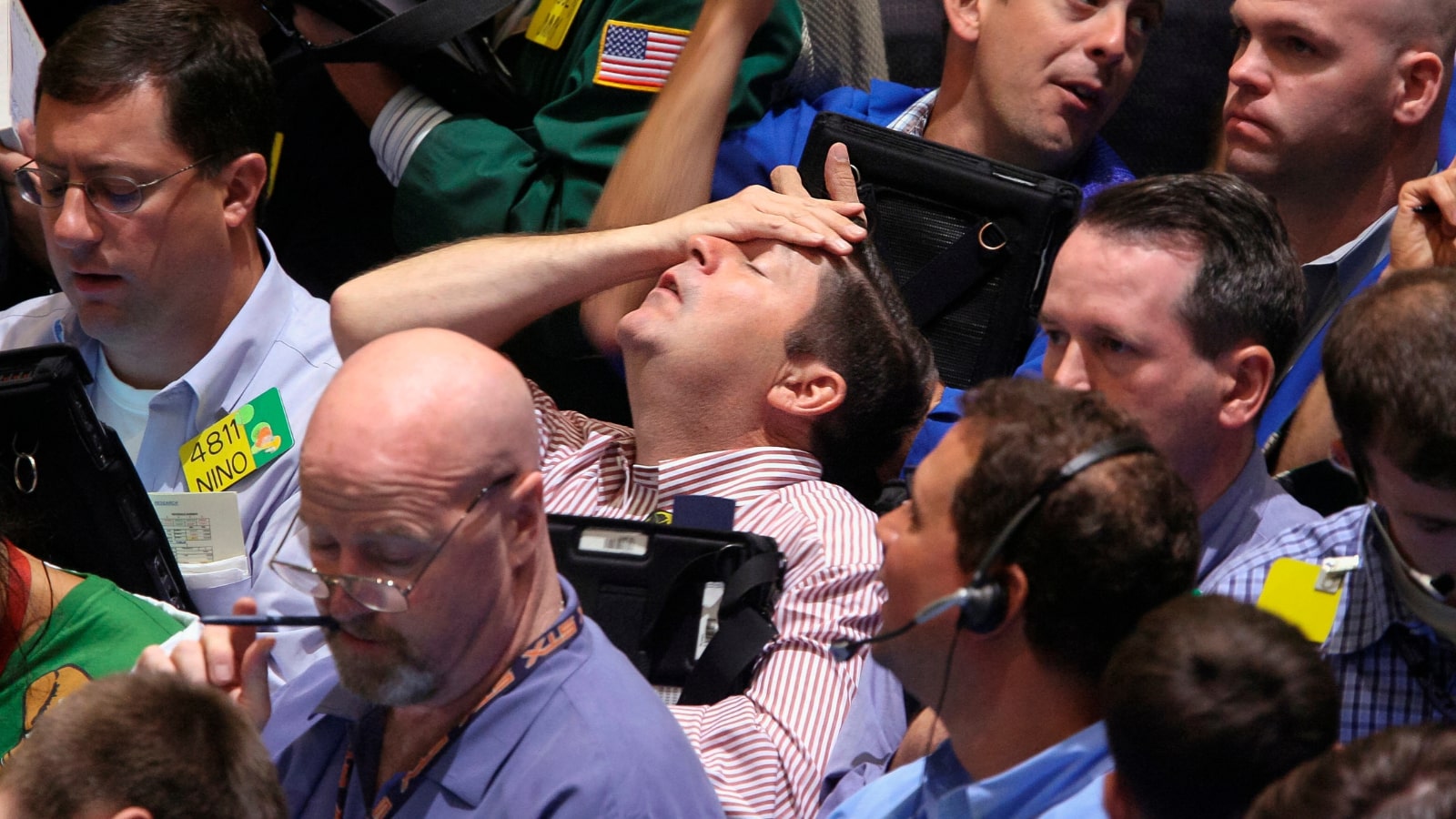
NEWS REPORT: Not in generations has Wall Street absorbed the number of body blows it took today. Some call it payback for years of risky lending practices and weak regulation.
MIKE CALHOUN (PRESIDENT, CENTER FOR RESPONSIBLE LENDING): The stock market drops precipitously. You’ve got spending going down, house prices going down, all of these things are converging to bring the whole economy to its knees, which it did in a remarkably short time.
NARRATION: Within weeks, the economy began to crumble. Banks were suddenly unable to lend money to businesses around the country.
SHEILA BAIR: There was a withdrawal of credit availability in the whole economy. That really triggered an economic crisis, and that’s when we realized something had to be done – something big, something dramatic, something immediate – to get credit flowing again.
ARCHIVAL (C-SPAN, 9-19-08):
PRESIDENT GEORGE W. BUSH: We must act now to protect our nation’s economic health from, from serious risk.
NARRATION: The government’s top financial regulators, led by Treasury Secretary Hank Paulson, worked frantically to keep the economy afloat.
ARCHIVAL (ASSOCIATED PRESS, 9-19-08):
HENRY “HANK” PAULSON (FORMER TREASURY SECRETARY): To restore confidence in our markets and our financial institutions, the federal government must implement a program to remove these illiquid assets that are weighing down our financial institutions and threatening our economy.
ARCHIVAL (C-SPAN, 2-10-09):
TIMOTHY GEITHNER (FORMER PRESIDENT, NEW YORK FED): I want to be candid. This strategy will cost money. It will involve risk, and it will take time.
NARRATION: They pushed an unprecedented $700 billion bailout package through Congress to shore up Wall Street investment banks.
ARCHIVAL (C-SPAN, 7-10-09):
HENRY “HANK” PAULSON: An institution may be too interconnected to fail or too big to fail. It is clear that some institutions, if they fail, can have a systemic impact.
MIKE CALHOUN: The argument was, a number of these players had become so large that even though they had acted recklessly, it would cause too much damage to the overall economy if they failed.
BETHANY MCLEAN: One of the key ways that capitalism is supposed to work is, you’re on your own, and you’re on your own to succeed, and if you fail, that’s your problem. But suddenly, when it was the biggest banks that were failing, it was everybody’s problem.
NARRATION: The bailout was controversial in part because it didn’t include assistance for the millions of people at risk of losing their homes.
LISSIE DICKERSON: We were like, what about us? We’re about to be on the street. Where is funding for us? I remember looking at the news and people were, like, out in the streets, and like,you know, we’re losing our house. This mortgage interest rate has ballooned, we can’t pay it.
ARCHIVAL (CBS NEWS, 10-29-08):
NEWS REPORT: The protesters who forced their way to Fannie Mae’s front door today say the banks can’t be the only ones who get government help.
PROTESTER: They call it the American dream, but for us, it was the American nightmare.
LISSIE DICKERSON I didn’t lose my house then, but I was struggling to hold on because the payments were out of control then, so I had to file bankruptcy.
ARCHIVAL (NBC NEWS, 11-29-08):
NEWS REPORT: From the once sleepy backwater of the F.D.I.C., Sheila Bair has emerged as a powerful and sometimes lonely voice on behalf of troubled homeowners.
SHEILA BAIR: Until we get a handle on these foreclosures, we’re not going to be able to rebound from our current economic problems.
NARRATION: Sheila Bair tried unsuccessfully to push through a foreclosure prevention plan for struggling homeowners.
ARCHIVAL (ABC NEWS, 11-18-08):
SHEILA BAIR: It’s not a silver bullet, but it would be a huge reduction in the foreclosures that you’re seeing right now.
NARRATION: Eventually, the government set up a program that gave banks incentives to lower interest payments, but it reached only a fraction of at-risk borrowers.
BETH JACOBSON: The idea behind the program was for servicers to modify people’s loans, but nobody enforced it.
NARRATION: By this time, Beth Jacobson had left Wells Fargo and was working with homeowners. She says mortgage servicing companies made it hard to get lower rates.
BETH JACOBSON: They would say, you know what? You didn’t make your mortgage payment, you deserve what you get. Maybe your house needs to be foreclosed. You got more loan than you could afford. The problem was, you were dealing with servicers that made money – more money – by not modifying the loan.
NARRATION: And not everyone supported the idea of helping borrowers, some of whom may have taken on more debt than they could repay.
ARCHIVAL (CNBC, 2-19-09):
RICK SANTELLI (CNBC COMMENTATOR): The government is promoting bad behavior. How many of you people want to pay for your neighbor’s mortgage, that has an extra bathroom and can’t pay their bills? Raise their hand!
SHEILA BAIR: There just wasn’t enough agreement about how to do it and willingness to really put the money and resources in to get it done properly. It was just too overwhelming. So, yeah, I can understand why people feel government wasn’t for them.
NARRATION: Perhaps the most controversial part of the bailout was that few bank executives faced serious consequences.
BETHANY MCLEAN: What that implies is that not only do financial firms have the right to expect a bailout, but they also have a get-out-of-jail-free card when something goes wrong.
SHEILA BAIR: The big Wall Street banks, they were bailed out and their shareholders took losses, but they weren’t wiped out. I think bonuses maybe were suspended for a year at the most.
LISSIE DICKERSON: I think the American dream is probably about – I don’t wanna say dead, but it’s definitely on life support.
NARRATION: Lissie Dickerson says her mortgage interest rate has stayed high since the 2008 financial crisis. In 2024, after a disputed claim that she had missed payments, she lost her house to foreclosure.
LISSIE DICKERSON: So this is 20 years later, pretty much, you know, on this nightmare rollercoaster ride, and after all of this, you know, struggling and fighting, trying to save this house, this is where I am. No savings ’cause all of my savings went into this nightmare.
ARCHIVAL (CBS NEWS, 11-18-08):
HENRY “HANK” PAULSON: I think we’ve turned the corner in terms of stabilizing the system, preventing a collapse.
NARRATION: For Wall Street, the recovery took just a few years, but for the broader economy, it took almost a decade. Overall, nearly 9 million people lost their jobs and up to 10 million lost their homes.
MIKE CALHOUN: They were successful in preventing a depression, but Wall Street came out much better than Main Street.
BETH JACOBSON: There are a lot of people that are still suffering mentally, emotionally and financially because of what happened to them.
BETHANY MCLEAN: If you believe that the outcome was as dire as people thought it could have been, then it worked, and it was the right, the right medicine. They felt like they had no choice.
SHEILA BAIR: We needed to intervene. We needed to do unpopular things, and so, you know, we got through it. It was difficult, but we did get through it.
(END)
The 2008 Financial Crisis Explained: Housing Bubble to Bailout
Risky loans, regulatory gaps, and Wall Street practices fueled the 2008 financial crisis and led to the Great Recession.
The 2008 financial crisis grew out of a housing bubble in the early 2000s, when home buying surged and subprime mortgages became widespread. These loans, designed for borrowers with weaker credit, carried higher interest rates and were aggressively promoted by some lenders and brokers, who profited from steering buyers into riskier products. Some borrowers took on mortgages they didn’t understand or couldn’t afford, believing they could refinance as home values rose.
But when the bubble burst and housing prices fell, refinancing became difficult. Defaults rose, and the losses cascaded through Wall Street. Large financial institutions had not only sold bundles of loans as mortgage-backed securities to investors, but they had also invested in them, leaving firms like Lehman Brothers exposed when the market collapsed. Turmoil spread and credit froze across the economy.
Top financial officials argued that drastic action was needed. A team led by Treasury Secretary Hank Paulson and New York Fed President Timothy Geithner pushed for a $700 billion bailout, warning that without it, credit would freeze and businesses would fail.
The bailout was controversial: it supported banks but offered little direct help to the millions of homeowners facing foreclosure. Regulators like Sheila Bair at the F.D.I.C. warned that failing to address foreclosures would slow recovery, but efforts to modify loans reached only a fraction of homeowners.
In the following years, financial markets bounced back relatively quickly, but unemployment and foreclosures remained high well into the next decade. This video traces how the intersection of risky loans, inadequate regulation, investor demand and eager but vulnerable borrowers converged to create the worst economic downturn since the Great Depression.
- Producer: Jill Rosenbaum
- Editor / Graphics: Heru Muharrar
- Additional Editing: Anne Checler
 Grades
9-12
Grades
10-12
Grades
9-12
Grades
10-12

 1 Lesson Plan


