
Transcript
WILLIAM REILLY: Fifty years ago, we embarked as a country on a major commitment that required the cooperation of everybody. It was just thought, this is America. We shouldn’t have to live with bad air. We can do better than this.
TEXT ON SCREEN: Los Angeles, 1950s
ARCHIVAL (U.C.L.A. FILM ARCHIVE, 9-16-55):
Los Angeles suffers the worst blanket of smog in its history. The giant California city is shrouded by the ugly mist, dangerous to health and traffic.
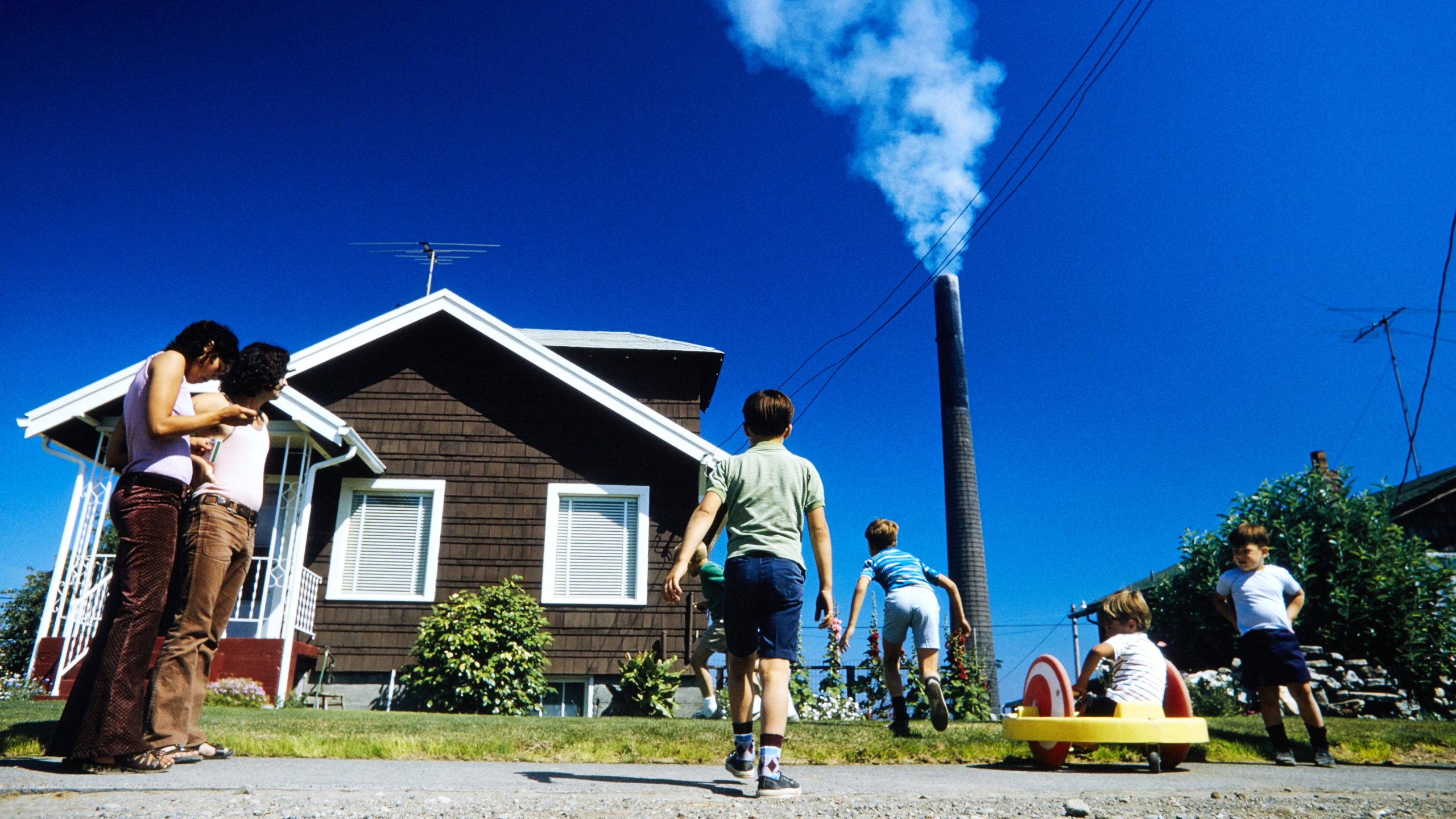
NARRATION: By the 1950s and ’60s, Americans were beginning to reckon with the amount of pollution caused by the country’s booming industrial economy.
DOUGLAS BRINKLEY (HISTORIAN): I think Americans of the 21st century certainly have forgotten what smog was in Los Angeles or New York. You couldn’t breathe.
WILLIAM REILLY (E.P.A. ADMINISTRATOR, 1989-1993): You could not see across the street. This is literally in some parts of Los Angeles, Chicago.
DOUGLAS BRINKLEY: In a town called Donora, pollution from factories made an entire community sick.
NARRATION: And it wasn’t just smog. Industrial plants dumped toxic waste into the water. In Cleveland, the Cuyahoga River caught on fire.
WILLIAM REILLY: That river had caught fire 13 times, and people thought, this is really shameful that a river, an important river in the United States, is so full of chemicals that it catches fire.
DOUGLAS BRINKLEY: Rivers and lakes and fish were dying. Lake Erie was dying. The Mississippi River was dying with the debris of hyper industrialization.
DENIS HAYES (PRESIDENT, THE BULLITT FOUNDATION): There were just a series of crises, one after another. Every year we were getting richer, and every year the quality of our lives was declining.
NARRATION: Denis Hayes was a graduate student and one of a growing number of people who wanted the government to do more to protect the environment.
ARCHIVAL (NBC NEWS, 8-1-69):
NEWS REPORT: Many citizens groups have formed lately to fight smog. Housewives, doctors, scientists.
NARRATION: But at the time, there wasn’t a national environmental movement.
DENIS HAYES: There were some traditional organizations dealing with wilderness and dealing with parks and recreation, but they wouldn’t have considered themselves to be a movement.
NARRATION: Then, in January 1969…
ARCHIVAL (NBC NEWS, 2-5-69):
NEWS REPORT: A smear of oil is spread over 800 square miles of the Pacific.
NARRATION: …a major oil spill off the coast of Santa Barbara, California, made the environment a national priority.
ARCHIVAL (ABC NEWS, 2-5-69):
NEWS REPORT: Wildlife is dying. Dead seals are becoming more numerous in the harbors, and hundreds of seabirds are suffocating and choking from the oil.
DENIS HAYES: It was good television. It was on the evening news, day after day after day, enough to leave a lasting impression.
ARCHIVAL (ABC NEWS, 2-5-69):
NEWS REPORT: For years, these beaches have been the place for the good life. But now these sands are a wildlife graveyard.
NARRATION: The spill happened just days after Richard Nixon, a Republican, was sworn in as president.
DOUGLAS BRINKLEY: President Nixon was not an environmentalist, but Nixon noticed the public outcry of the spill, and he got endless mail from Republicans in California. Nixon in the fall of 1969 decided, let’s take this issue away from Democrats and make the environment my issue. I’ll own it.
WILLIAM REILLY: He thought it was good for the country and he thought it was good for his election.
NARRATION: William Reilly worked on environmental policy in the Nixon administration.
WILLIAM REILLY: And he said, get out front. I want a forward-leaning position on the environment.
ARCHIVAL (RICHARD NIXON PRESIDENTIAL LIBRARY AND MUSEUM, 1-22-70):
PRESIDENT RICHARD NIXON: Clean air, clean water, open spaces: These should once again be the birthright of every American. If we act now, they can be.
NARRATION: The spill also had another impact. Senator Gaylord Nelson, a Democrat, decided to hold teach-ins at colleges around the country to educate students about the environment.
He hired Denis Hayes as the lead organizer, but Hayes found little interest on campus.
DENIS HAYES: I rather rapidly realized that I had made a huge blunder, because there was just no interest in this at all.
NARRATION: But Hayes says he started hearing from families in cities all over the country who were interested.
DENIS HAYES: So at that point, we shifted away from having college teach-ins to moving this out into communities and dealing with local environmental issues in everybody’s backyard, and changed the name from the National Environmental Teach-In to Earth Day. And then suddenly it started catching fire.
ARCHIVAL (CBS NEWS, 4-22-70):
DENIS HAYES: We are systematically destroying our land, our streams and our seas. We foul our air, deaden our senses and pollute our bodies.
NARRATION: On April 22, 1970, Hayes and his team helped organize thousands of Earth Day events. Hayes was in New York City that day.
DENIS HAYES: It was jammed shoulder-to-shoulder. It was like looking at the ocean out over the horizon. There were people farther than I could see.
WILLIAM REILLY: Everybody was in the streets. If you were not an environmentalist on Earth Day, you kept it to yourself. It was lawyers, professors, students, kids, adults, old people.
NARRATION: An estimated 20 million people participated in the first Earth Day, about one in every 10 Americans.
DOUGLAS BRINKLEY: CBS News and NBC carried Earth Day as if it were a political convention. It had become a bipartisan issue, saving the environment.
ARCHIVAL (ABC NEWS, 4-22-70):
NEWS REPORT: Republicans and Democrats, radicals and rightists, young and old, rich and poor, finally found a war all can support: a war on pollution.
NARRATION: Earth Day brought environmentalism into the mainstream.
ARCHIVAL (SESAME STREET, PBS, 1970):
That stuff is terrible. Maybe you can still make a fortune, see, but you don’t have to pollute the air. You already threw trash all over the street.
NARRATION: And it helped make reducing pollution an important issue for most Americans. By the 1980s, 76 percent of the country identified as environmentalists.
DENIS HAYES: The efforts of that first Earth Day really were to take all of these diverse strands of activist groups that didn’t think that they had much in common with one another and weave them together into the fabric of environmentalism with a shared set of values.
ARCHIVAL (CBS NEWS, 4-22-70):
NEWS REPORT: It will be frighteningly costly to each of us to clean up the mess each of us has made, but the cost of not doing so is more frightening. What is at stake and what is in question is survival.
DENIS HAYES: And suddenly this became something with real political leverage to it.
WILLIAM REILLY: Earth Day had a huge impact on the Nixon administration. This issue was taking off.
NARRATION: Later that year, Nixon created a new federal agency to oversee environmental policy and enforcement.
ARCHIVAL (CBS NEWS, 7-9-70):
NEWS REPORT: The new agency would direct environmental programs now scattered among several cabinet departments.
ARCHIVAL (ABC NEWS, 7-9-70):
NEWS REPORT: It’ll be called the Environmental Protection Agency.
WILLIAM REILLY: I remember the first E.P.A. administrator said to me, you know, I cannot do enough. I am asked constantly when I’m testifying in Congress, wouldn’t you like some more power? Wouldn’t you like more money? Is there anything that you haven’t addressed that you want to address? What can we pass? That was the spirit of the times, and it was a very exciting time.
NARRATION: Over the next few years, Congress passed a series of landmark environmental laws to protect endangered species, ensure safe drinking water and reduce pollution.
One of those laws, the Clean Air Act, would prompt a sea change in how the government regulates pollution and later would provide the authority for regulating greenhouse gases that contribute to climate change.
WILLIAM REILLY: The Clean Air Act included very specific pollution reduction requirements. It challenged the automotive industry to produce engines that were vastly cleaner than they had been. That was new, that was serious.
NARRATION: William Reilly went on to lead the E.P.A. in the late 1980s and early ’90s, and advocated for an amendment to make the Clean Air Act even stronger.
The E.P.A. has estimated that reduced levels of air pollution have prevented hundreds of thousands of premature deaths from heart and respiratory disease.
WILLIAM REILLY: The Clean Air Act has been vital to keeping our cities as clean as they have been, and compared to where they were 25, 35, 40 years ago, it’s light years. It’s huge improvements.
NARRATION: But there was also a backlash to those laws, with some arguing that environmental regulations were too burdensome on businesses, hurt the economy, and restricted oil and gas production.
DOUGLAS BRINKLEY: A lot of the money people out of the extraction industry writ large are brutally angry at Nixon. There became a counterswing to the environmentalists. By 1980, Ronald Reagan gets elected, and he is demonizing the environmental movement, connecting it to hippies and zealots.
NARRATION: Today, around 60 percent of Americans say the government is not doing enough to protect the environment, but only 40 percent consider themselves environmentalists. And there are large partisan divides about whether environmental regulations are worth the cost.
The Trump administration is now trying to eliminate many of those regulations.
ARCHIVAL (PBS, 3-13-25):
The Environmental Protection Agency announced what it called the biggest deregulatory action in U.S. history.
NARRATION: The administration has cut around 25 percent of E.P.A. staff and granted major polluters temporary exemptions from some clean-air rules, among other changes.
ARCHIVAL (CBS NEWS, 6-11-25):
NEWS REPORT: The agency has proposed cutting regulations that curb air pollution from fossil fuel power plants in an effort, it says, to boost economic growth.
NARRATION: William Reilly and others involved in the early days of the environmental movement worry that the country is heading back to the days before the Nixon administration.
WILLIAM REILLY: It will take some time, probably, but I would be surprised if we are not confronted once again with burning rivers and tragedies of one sort or another, major spills of toxic substances without a capacity to address them. Will we miss E.P.A.? I think we will.
DOUGLAS BRINKLEY: The final story’s not over because that ’60s generation had planted something new. Every university has environmental science, environmental studies, environmental history. It’s massive. It still is something that can be bipartisan.
DENIS HAYES: It was not the core issue until the public rose up and 20 million people turned out for that first Earth Day and showed that you fundamentally could bring about radical, positive change. I think that’s a very important thing for people to remember.
(END)
Choking Smog. A River on Fire. How Pollution Set the Stage for the First Earth Day
Earth Day, born in 1970 from public outrage over pollution, marked a turning point in U.S. environmental policy.
In the mid 20th century, smog choked cities, factories spewed industrial waste and a river in Ohio caught fire. By the late 1960s, a series of environmental crises, including a devastating oil spill off the coast of Santa Barbara, Calif., pushed environmental damage into the national spotlight.
This Retro Report traces how those events led to the creation of the first Earth Day on April 22, 1970, when an estimated 20 million Americans took part in demonstrations, teach-ins and community cleanup efforts. Public pressure eventually led to landmark legislation, including the Clean Air Act, and the creation of the Environmental Protection Agency.
The film draws on archival footage and interviews with historians, policymakers and organizers to show how Earth Day transformed scattered local concerns into a national movement. It also examines how some environmental protections have been rolled back in recent years, including a wave of deregulation during the Trump administration.
- Producer: Scott Michels
- Editor: Heru Muharrar
 Grades
6-12
Grades
6-12


 1 Lesson Plan

